

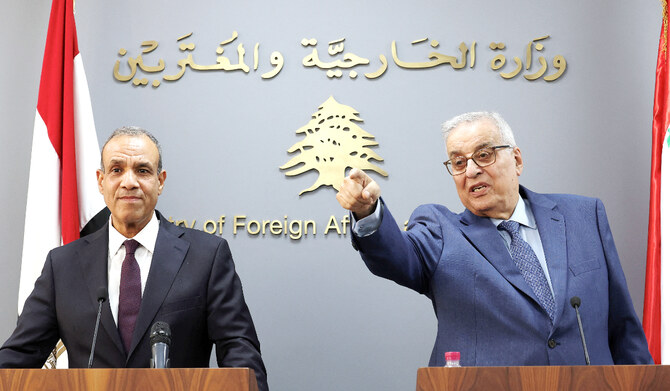


BEIRUT: Egyptian Foreign Minister Badr Abdelatty said in Beirut on Friday that Cairo will “make every possible effort to spare Lebanon and its brotherly people the woes of any uncalculated escalation.”
Abdelatty condemned “all provocative policies, including the violation of Lebanon’s sovereignty.”
He repeated Egypt’s rejection of “the Israeli aggression on Beirut’s southern suburb and the policy of assassinations.”
Abdelatty added that the security and stability of Lebanon “is an Egyptian interest and an Arab interest that we are working on maintaining.”
His talks in Beirut came two days after visits by US mediator Amos Hochstein and French Foreign Minister Stephane Sejourne.
FASTFACT
Prime Minister Najib Mikati repeated Lebanon’s commitment to ‘fully implementing’ UN Resolution 1701.
Hochstein and Sejourne had urged the need for deescalation, in parallel with the Doha talks targeting a ceasefire in Gaza and the exchange of hostages.
Abdelatty — under the assignment and direction of Egyptian President Abdel Fattah El-Sisi — met several Lebanese officials.
The talks were part of Arab and international efforts to reach a ceasefire in Gaza between the Israeli army and Hamas, and deescalate the situation on the Lebanese border between Israel and Hezbollah.
Following his meeting with Parliament Speaker Nabih Berri, Abdelatty said that he delivered a “message of support and solidarity from the Egyptian people to the Lebanese people.”
Abdelatty highlighted the importance of “stopping the escalation and not dragging the region into a comprehensive regional war.
“We are working to stop this escalation, and we must act to the fullest extent and as quickly as possible to reach an immediate ceasefire in the Gaza Strip and stop the Israeli aggression,” he said.
“The core of the conflict in this region is the persistence of the Palestinian cause without a solution, and the continued failure of the Palestinian people to obtain their legitimate rights, most importantly their right to establish an independent state on the entire national territory on the borders of June 4, 1967, with East Jerusalem as its capital.”
According to his media office, Berri said: “The success of the efforts exerted in Doha to reach a ceasefire is the main gateway to restoring stability and solutions in the region.”
He praised the “great effort made by Egypt and President Abdel Fattah El-Sisi to stop the Israeli war on the Gaza Strip.”
Abdelatty also met Caretaker Prime Minister Najib Mikati and his ministerial counterpart, Abdallah Bou Habib.
Mikati repeated his country’s commitment to “fully implementing” UN Resolution 1701.
“Pressure must be exerted on Israel to implement the resolution and stop its aggression against Lebanon,” he added.
As diplomacy intensified to prevent a wider regional conflict, Hezbollah again warned of a possible response to the assassination of its senior military commander, Fouad Shukr, who was killed in Beirut’s southern suburb in July.
In a threatening message to Israel, the militant group released a video on Friday containing footage of an underground facility carved from rock.
The site featured huge, illuminated tunnels containing steel doors, motorbikes, missile launchers and trucks.
Hezbollah’s military media said in a statement on the video: “Western media talks a lot about the tunnels.”
The clip was titled “Our mountains are our strongholds” and aimed to reveal Hezbollah’s extensive military capabilities.
It included a clip of a previous speech by Hassan Nasrallah, Hezbollah’s secretary-general.
He said: “The resistance now possesses precision and non-precision missiles, along with its weapons capabilities, so that if Israel imposes a war on Lebanon, Israel will face a destiny and reality it didn’t expect any day.”
Hezbollah sources told Lebanese media that the location, and entrances and exits, of the tunnel facility, were secret.
“It is unknown where this underground facility begins, where our fighters are operating, where it ends and what it is connected to,” they said.
“What we are revealing today is a small part of the real capabilities of the resistance, especially in terms of precision missiles.”
The video was accompanied by a message from the Iranian Embassy, which commented on the video.
The embassy said: “We call underground missile installations within rocks and mountains ‘missile cities.’ They are spread throughout the geography of Iran, instilling fear in the hearts of Iran’s enemies. If necessary, we can strike the enemy from any point within Iran.”
On Friday, Hezbollah launched a series of missile attacks on Israeli military sites in the Upper Galilee.
The party mourned one of its fighters who was killed by an Israeli air-to-surface missile on the border town of Aitaroun. He was identified as Ibrahim Shawqi Salameh from the town of Blida.
Israel again targeted the town of Kfar Kila and the outskirts of Rmeich, Ramia, Beit Lif, Al-Qouzah, Naqoura and Mays Al-Jabal.
Also on Friday, the leader of the Lebanese Forces party, Samir Geagea, said that Hezbollah’s actions on the southern border “are not in support of Gaza, but rather in support of Iran’s strategic interests in the region.”
Addressing a press conference, Geagea said: “Implementing Resolution 1701 would significantly improve our situation.”
He urged the government to “take a stance based on Lebanon’s national interest, rather than echoing Hezbollah’s actions.”
Former Lebanese president Michel Aoun had “put us in one hell,” and now the Axis of Resistance is “putting us in another hell and digging our hole even bigger,” Geagea added.


