Proposed EU mission to blocked pipeline awaiting Ukraine approval

The EU said Thursday it had proposed a mission to inspect a blocked oil pipeline at the center of a row between Ukraine and Hungary — and was waiting for Kyiv to respond. (X/@theUBN)
Short Url
Updated 12 March 2026
Follow

Proposed EU mission to blocked pipeline awaiting Ukraine approval

  • European Union member Hungary has in turn blocked a vital $106-billion EU loan to Ukraine
  • “We have proposed a mission to inspect the pipeline to Ukraine,” said Itkonen

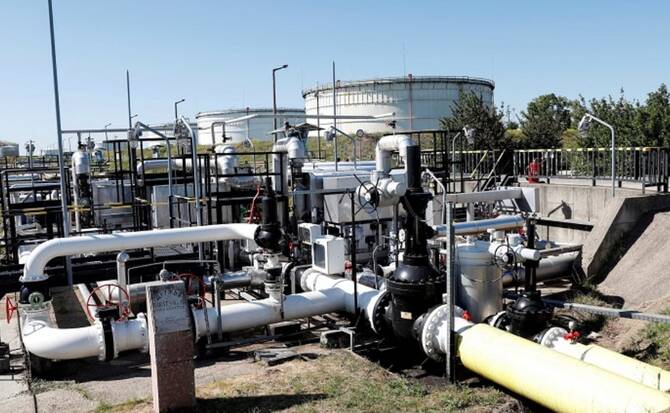
BRUSSELS: The EU said Thursday it had proposed a mission to inspect a blocked oil pipeline at the center of a row between Ukraine and Hungary — and was waiting for Kyiv to respond.
Hungary and Slovakia accuse Kyiv of deliberately delaying reopening the Druzhba pipeline, which pumps Russian oil to the two landlocked states and Ukraine says was damaged by Russian strikes in January.
European Union member Hungary has in turn blocked a vital 90-billion-euro ($106-billion) EU loan to Ukraine as well as a fresh round of sanctions on Russia.
“We have proposed a mission to inspect the pipeline to Ukraine,” Anna-Kaisa Itkonen, a spokeswoman for the European Commission told journalists in Brussels. “We are awaiting their response.”
The suggestion of an EU fact-finding mission came on the back of two weeks of “intense discussions and contact with Ukraine on this issue,” she added.
On Wednesday, Budapest said it had sent its own mission to assess the pipeline and hold talks with Ukrainian authorities — only for Kyiv to deny there were any discussions planned.
Ukrainian President Volodymyr Zelensky said last week it could take four to six weeks to make the pipeline operational again.
The dispute comes as Hungary’s nationalist Prime Minister Viktor Orban, has ramped up political attacks on Ukraine ahead of a closely fought parliamentary election in Hungary on April 12.
Orban, Russian President Vladimir Putin’s closest ally in the EU, has also urged the 27-nation bloc to suspend sanctions on Russian oil and gas to counter rising prices since the Middle East war erupted.


US NATO envoy says allies must ‘pull weight’ after Czech defense cut

Updated 13 March 2026
Follow

US NATO envoy says allies must ‘pull weight’ after Czech defense cut

PRAGUE, March 12 : The United States’ ambassador to ‌NATO said on Thursday that all allies must “pull their weight,” after Czech lawmakers approved a 2026 budget that cuts defense outlays.
Czech Prime Minister ​Andrej Babis’ government, in power since December, pushed a revamped budget through the lower house on Wednesday evening which cut the defense ministry’s allocation versus a previous proposal to 154.8 billion crowns ($7.31 billion), or 1.73 percent of gross domestic product.
That is below a NATO target of 2 percent of GDP already expected before alliance members pledged last year in the Hague ‌to raise defense spending ‌to 3.5 percent of GDP plus ​1.5 percent ‌on ⁠other defense-relevant investments ​over ⁠the next decade.
The Czech Finance Ministry says total defense spending in the budget will reach 2.07 percent of GDP, but the country’s budget watchdog has warned that includes money earmarked elsewhere, like for the transport ministry for road projects, that may not be recognized by NATO.
“All Allies must pull their weight and ⁠honor The Hague Defense Commitment,” US Ambassador to ‌NATO Matthew Whitaker said on X ‌on Thursday with a picture of ​a news headline on the Czech ‌budget approval.
“These numbers are not arbitrary. They are about ‌meeting the moment — and the moment requires 5 percent as the standard. No excuses, no opt-outs.”
European NATO countries are under pressure to raise defense spending amid the Ukraine-Russia war ‌and at US President Donald Trump’s urging.
Babis, whose populist ANO party won elections last year, said ⁠in February ⁠the country was “certainly not” on the path to raising core defense spending to the 3.5 percent target, saying there was a different focus, like on health care.
The budget watchdog on Thursday reiterated “strong doubts” that some spending deemed defense in this year’s budget would meet NATO’s definition.
President Petr Pavel, a former NATO official, has also said defense cuts risked a loss of trust from allies — but has signalled he would not veto the budget.
US Ambassador to Prague Nicholas Merrick said last ​week the Czech Republic may ​slip to the bottom of NATO’s defense-spending ranks.