Hezbollah says launched ‘squadrons of drones’ at Israel after Sidon attack

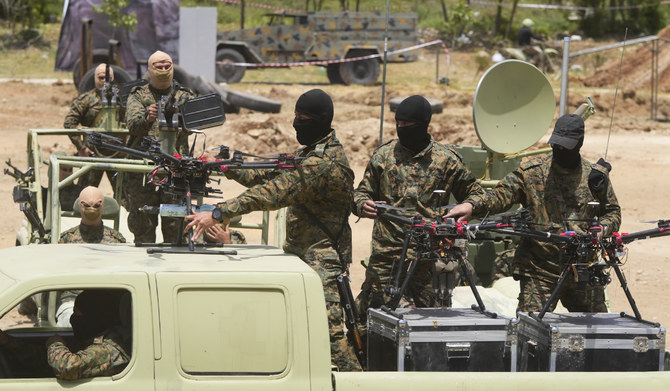
Hezbollah militants take part in a military exercise with armed drones in Aaramta village in the Jezzine District, southern Lebanon, on May 21, 2023. (AP)
Short Url
Updated 11 August 2024
Follow

Hezbollah says launched ‘squadrons of drones’ at Israel after Sidon attack

  • Ten months of cross-border violence has killed some 562 people in Lebanon, most of them fighters but also including at least 116 civilians, according to the AFP tally

BEIRUT, Lebanon: Lebanon’s Iran-back Hezbollah group said it launched on Saturday explosive-laden drones at a north Israel army base following the killing of a Hamas commander in south Lebanon a day earlier.
Hezbollah fighters launched “squadrons of explosive-laden drones” at the Michve Alon base near the Galilee town of Safed “in response to the attack and assassination carried out by the Israeli enemy in the city of Sidon” on Friday, the group said in a statement.
Hezbollah’s media office said it was “the first time” the group had targeted that base.
On Friday, an Israeli strike on a vehicle in the south Lebanon city of Sidon killed a Hamas commander, the Palestinian militant group and the Israeli military said.
Hamas said in a statement that Samer Al-Hajj was killed “in a Zionist strike in the city of Sidon.”
The Israeli military said that its aircraft struck the Sidon area and “eliminated” Hajj, whom it identified as “a senior commander” for Hamas in Lebanon.
It was the first strike of its kind in Sidon since Hamas launched its October 7 attack on Israel, triggering war in Gaza and prompting its Lebanese ally Hezbollah to begin trading near-daily cross-border fire with the Israeli army in a bid to tie down its troops.
Ten months of cross-border violence has killed some 562 people in Lebanon, most of them fighters but also including at least 116 civilians, according to the AFP tally.
On the Israeli side, including in the annexed Golan Heights, 22 soldiers and 26 civilians have been killed, according to army figures.


Lebanon signs gas exploration deal with French-Qatari-Italian consortium

Updated 6 sec ago
Follow

Lebanon signs gas exploration deal with French-Qatari-Italian consortium

  • France’s TotalEnergies, Qatar Energy and Italy’s Eni signed for Block 8, planning a 1,200 sq. km 3D seismic survey to assess potential
  • Previous searches in Block 4 and 9 did not yield any discoveries

BEIRUT: Lebanon on Friday signed a gas exploration deal for Block 8 with a consortium comprising France’s TotalEnergies, Qatar Energy and Italy’s Eni, in a ceremony held at the Prime Minister’s Office and attended by Prime Minister Nawaf Salam.

According to Gaby Daaboul, board member at the Lebanese Petroleum Administration, the agreement stipulates that the consortium will carry out a 3D seismic survey in Block 8, which spans 1,200 sq. km, in preparation for exploratory drilling based on analysis of the survey data.

In 2023, Lebanon marked the resumption of oil and gas exploration in its territorial waters, as a consortium that included Qatar Energy drilled an exploratory well in Block 9.

However, all activities were halted, ostensibly due to the lack of oil or gas. The companies’ cessation of operations coincided with the outbreak of hostilities between Israel and Hezbollah.

Earlier hopes were dashed when gas was not found in Block 4, leaving many Lebanese disappointed.

Lebanese Minister of Energy and Water Joe Saddi, who signed the agreement on behalf of the state, described the move as “a confirmation of the consortium’s commitment to continue exploration activities in Lebanon despite all challenges, and a reflection of continued confidence in the petroleum potential of Lebanese territorial waters.

“We look forward to the consortium coordinating and promptly implementing the 3D seismic survey campaign. This will enhance geological and technical understanding of Block 8 and allow for a more accurate assessment of the opportunities available,” the minister said.

He announced the preparation of a file for launching the fourth licensing round, aiming at attracting international companies to invest in open offshore blocks and boost exploration and production activity in Lebanon.

Asked whether there are guarantees that the consortium operating in Block 8 will provide Lebanon with an official technical report, Saddi explained that “for Block 9, an official report was submitted to the Ministry and the Petroleum Sector Administration.” 

He noted that oil companies do not spend tens of millions of dollars without expecting results.

“No oil was found in the Block 9 drilling area, but a full report is available. This highlights the importance of the seismic survey in Block 8 to understand the block’s detailed geology, which will guide future exploration,” he said.

Saddi stressed that regional and domestic stability will be key to accelerating the exploration process.

The agreement was signed by Romain de La Martiniere, managing director of Total Lebanon, on behalf of Total Energies; Ali Abdulla Al-Mana, head of exploration at Qatar Energy; and Andrea Cozzi, managing director for Eni’s Lebanon division.

“Lebanon looks forward to continuing its exploration efforts by promoting non-obligatory blocks, with the aim of intensifying exploration activities and achieving a commercial discovery that will boost the national economy and support sustainable development,” Daaboul said.

Lebanon’s offshore oil and gas exploration centers on 10 blocks in its exclusive economic zone, with Blocks 4, 8, 9, and 10 most relevant near the maritime border with Israel.

A 2022 US-brokered maritime border agreement resolved a long dispute, granting Israel full control of the Karish field while assigning Qana Prospect (Block 9) to Lebanon. However, Israel is poised to receive royalties from any future production there.

Lebanon is racing against time to resume exploration after Total’s 2023 drilling in Block 4 yielded negative results, prompting the company to return the block to the Lebanese state. Meanwhile, Israel began commercial production in the area roughly four months later.

Although the company was expected to resume drilling in Block 4 from a different location, it chose to return the block to the Lebanese state, where it will later be included among the blocks offered for exploration.

In 2018, Lebanon signed its first exploration contracts with three companies — Total, Eni, and Russia’s Novatek — to search for oil and gas in two blocks within its territorial waters, Blocks 4 and 9. Of the 10 blocks Lebanon has designated for oil and gas exploration, three are located in its exclusive economic zone.

Lebanese citizens are pinning their hopes on the exploration, anticipating the discovery of oil wells to help revive the struggling economy.