

Kremlin aide says NATO and the West helped Ukraine attack Russia

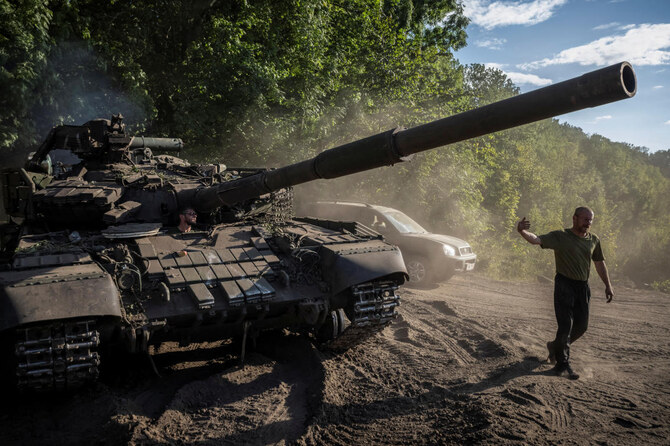
A Ukrainian serviceman operates a tank near the Russian border in Sumy region on Aug. 15, 2024. (Reuters)
Short Url
Updated 16 August 2024
Follow

Kremlin aide says NATO and the West helped Ukraine attack Russia

  • Weaponry provided by Britain and the US was reported to have been used on Russian soil
  • Russia’s defense ministry has published footage that it said showed a Russian drone destroying a US-made Stryker armored combat vehicle in the Kursk region

MOSCOW: An influential aide to Russian President Vladimir Putin said on Friday that the West and the US-led NATO alliance had been directly involved in planning Ukraine’s surprise attack on Russia’s Kursk region.

The lightning incursion into Russia unfurled on Aug. 6 when thousands of Ukrainian troops crossed Russia’s western border in a major embarrassment for Putin’s military.

The United States and Western powers, eager to avoid direct confrontation with Russia, said Ukraine had not given advance notice and that Washington was not involved, though weaponry provided by Britain and the US was reported to have been used on Russian soil.

Hawkish Kremlin aide Nikolai Patrushev dismissed the Western assertions in an interview with the Izvestia newspaper.

“The operation in the Kursk region was also planned with the participation of NATO and Western special services,” he was quoted as saying, without offering evidence.

“Without their participation and direct support, Kyiv would not have ventured into Russian territory.”

The remarks by one of the Kremlin’s influential “Cold War warriors” implied that Ukraine’s first acknowledged incursion into sovereign Russian territory since Moscow sent its forces into Ukraine in 2022 carried a high risk of escalation.

“Washington’s efforts have created all the prerequisites for Ukraine to lose its sovereignty and lose part of its territories,” Patrushev said.

Ukraine’s top commander said on Thursday that Kyiv had set up a military commandant’s office in the part of Russia’s Kursk region where he said his forces were still advancing, even as Moscow’s troops stepped up its offensives in Ukraine’s east.

TRYING TO AVOID NATO-RUSSIA CONFLICT

While the Ukrainian attack has revealed weaknesses in Russia’s defenses and changed the public narrative of the conflict, Russian officials said what they cast as a Ukrainian “terrorist invasion” would not change the course of the war.

Russia has been advancing for most of the year in the key eastern sector of the 1,000-km (620-mile) front line and has vast numerical superiority. It controls 18 percent of Ukraine.

The US so far deems the surprise incursion a protective move in which it is appropriate for Kyiv to use US equipment, officials in Washington said.

But they also expressed worries about complications as Ukrainian troops push further into enemy territory.

One US official, speaking on condition of anonymity, said that if Ukraine started taking Russian villages and other non-military targets using US weapons and vehicles, it could be seen as stretching the limits Washington has imposed, precisely to avoid any perception of a direct NATO-Russia conflict.

Britain said on Thursday that weaponry it had given to Ukraine could be used inside Russia to help Kyiv defend itself, and a British source said British Challenger 2 tanks were thought to have been used on Russian territory.

Russia’s defense ministry has published footage that it said showed a Russian drone destroying a US-made Stryker armored combat vehicle in the Kursk region.

In Moscow, one lawmaker said the Ukrainian incursion and the presence of Western military equipment on Russian soil had brought World War Three a step closer.


94 million need cataract surgery, but access lacking: WHO

A Somali patient undergoes free cataract surgery at Al Nuur eye Hospital in Mogadishu, on February 16, 2015. (AFP)
Updated 11 February 2026
Follow

94 million need cataract surgery, but access lacking: WHO

  • Of the 94 million affected, fewer than 20 percent are blind, while the rest suffer from impaired vision

GENEVA: More than 94 million people suffer from cataracts, but half of them do not have access to the surgery needed to fix it, the World Health Organization said Wednesday.
Cataracts — the clouding of the eye’s lens that causes blurred vision and can lead to blindness — are on the rise as populations get older, with age being the main risk factor.
“Cataract surgery — a simple, 15-minute procedure — is one of the most cost-effective medical procedures, providing immediate and lasting restoration of sight,” the WHO said.
It is one of the most frequently performed surgeries undertaken in high-income countries.
However, “half of the world’s population in need of cataract surgery don’t have access to it,” said Stuart Keel, the UN health agency’s technical lead for eye care.
The situation is worst in the WHO’s Africa region, where three in four people needing cataract surgery remain untreated.
In Kenya, at the current rate, 77 percent of people needing cataract surgery are likely to die with their cataract blindness or vision impairment, said Keel.
Across all regions, women consistently experience lower access to care than men.
Of the 94 million affected, fewer than 20 percent are blind, while the rest suffer from impaired vision.

- 2030 vision -

The WHO said that over the past two decades, global cataract surgery coverage had increased by 15 percent.

In 2021, WHO member states set a target of a 30-percent increase by 2030.
However, current modelling predicts that cataract surgery coverage will rise by only about 8.4 percent this decade.
To close the gap, the WHO urged countries to integrate eye examinations into primary health care and invest in the required surgical equipment.
States should also expand the eye-care workforce, training surgeons in a standardised manner and then distributing them throughout the country, notably outside major cities.
The WHO was on Wednesday launching new guidance for countries on how to provide quality cataract surgery services.
It will also issue guidance to help support workforce development.
Keel said the main issue was capacity and financing.
“We do need money invested to get rid of this backlog, which is nearly 100 million people,” he told a press conference.
While age is the primary risk factor for cataracts, others include prolonged UV-B light exposure, tobacco use, prolonged corticosteroid use and diabetes.
Keel urged people to keep up regular eye checks as they get older, with most problems able to be either prevented or diagnosed and treated.
The cost of the new lens that goes inside the eye can be under $100.
However, out-of-pocket costs can be higher when not covered by health insurance.
“Cataract surgery is one of the most powerful tools we have to restore vision and transform lives,” said Devora Kestel, head of the WHO’s noncommunicable diseases and mental health department.
“When people regain their sight, they regain independence, dignity, and opportunity.”