

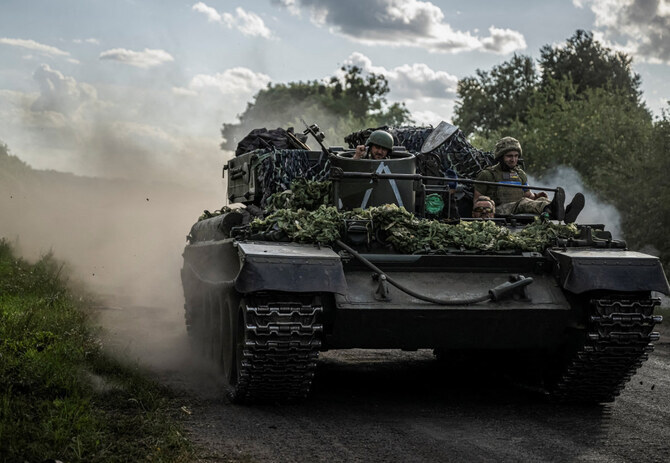
Ukraine opens military office in occupied Kursk region, says it is still advancing

Short Url
Updated 16 August 2024
Follow

Ukraine opens military office in occupied Kursk region, says it is still advancing

  • “We are moving forward in Kursk region. A military commandant’s office has been created which must ensure order and also all the needs of the local population,” Syrskyi said
  • Syrskyi told President Volodymyr Zelensky in a video published by the Ukrainian leader that the incursion had so far advanced 35 km into the Kursk region, capturing 82 settlements

KYIV: Ukraine’s top commander said on Thursday Kyiv had set up a military commandant’s office in the occupied part of Russia’s Kursk region where he said his forces were still advancing, even as Moscow’s troops stepped up its offensives in Ukraine’s east.
The remarks by Col. General Oleksandr Syrskyi were the strongest sign yet that Kyiv’s forces plan to dig in after launching a lightning cross-border assault on Russia last week that has opened a new front in the 2-1/2 year-old all-out war.
“We are moving forward in Kursk region. A military commandant’s office has been created which must ensure order and also all the needs of the local population,” Syrskyi said in a written statement on his Telegram channel. The office would be headed by Major General Eduard Moskalyov, he said.
Kyiv’s surge into Russian territory caught Moscow by surprise, seizing the initiative from the Kremlin’s forces who have been grinding out small but steady gains all year in eastern Ukraine. Some 18 percent of Ukraine is occupied by Russia.
Syrskyi told President Volodymyr Zelensky in a video published by the Ukrainian leader that the incursion had so far advanced 35 km (22 miles) into the Kursk region, capturing 82 settlements and an area of 1,150 square kilometers (444 square miles).
Though far higher than an estimate of 480 square km of territory given by the Russian acting regional governor of Kursk on Monday, the advances are the largest attack on Russia since World War Two and have overturned a perception of a fading Ukraine on the backfoot.
Zelensky, who spoke cryptically of the need to move on to the “next steps” in public remarks on Wednesday, again hinted at other possible offensive actions on Russian territory.
“We must clearly guarantee at the legislative level that our warriors, who participate, for example, in the Kursk operation and will participate in all our other actions on the territory of the aggressor state, will receive absolutely all payments and benefits designated for the front line,” he said in an address posted on Telegram.

Russia to toughen defenses
Russia said Ukrainian forces were still on the attack and that it would beef up its border defenses, improve command and control and send in additional forces.
“The enemy is pushing, it is trying to get through from everywhere, push through,” said Major General Apti Alaudinov, commander of Chechnya’s Akhmat special forces who are fighting in Kursk. “But every day the enemy’s forces are melting.”
Russian Defense Minister Andrei Belousov said the general staff had prepared a series of measures to defend Russia’s border regions of Kursk, Bryansk and Belgorod — which cover an area the size of Portugal.
Russian officials have warned that if Western weapons were used on Russian territory, then Moscow would consider that a grave escalation. Russian President Vladimir Putin has vowed to hit back with a “worthy response” to the incursion.
Syrskyi’s remarks suggested Kyiv’s rate of advance had slowed in the Kursk region. Ukraine, he said, had taken between 500 meters (547 yards) and 1.5 km in the last 24 hours, compared with between 1 and 2 km the day before.

No letup in the east
Ukraine said there was no sign that Russian military pressure was receding along the eastern front inside its borders and reported the heaviest fighting in weeks near the city of Pokrovsk, an important logistics hub.
The head of the Pokrovsk military administration appealed to locals to evacuate, saying Russian forces were getting closer.
“The enemy has come almost right up to the city of Pokrovsk. Just over 10 kilometers from the outskirts of the city,” he said on Telegram.
Syrskyi told Zelensky in his report by video link that the situation in the east and south where Russia has already captured swathes of the country was “difficult but under control.”
“The main efforts are focused on preventing the enemy from advancing in the directions of Toretsk and Pokrovsk, inflicting maximum losses, and creating favorable conditions for further actions,” he said.


Bangladesh sets February date for first vote since 2024 mass uprising

Updated 5 sec ago
Follow

Bangladesh sets February date for first vote since 2024 mass uprising

  • At least 1,400 protesters were killed in violent crackdown under ex-PM Hasina’s rule
  • Interim government promises ‘all necessary support’ for upcoming elections

DHAKA: Bangladesh will hold national elections on Feb. 12, its chief election commissioner has announced, setting the timeline for the nation’s first vote since a student-led uprising that ousted long-serving Prime Minister Sheikh Hasina.

Hasina, whose Awami League party-led government was marred by allegations of human rights violations, rigged elections and corruption, was removed from office in August last year after 15 uninterrupted years in power.

Bangladesh has since been led by interim leader Muhammad Yunus, a Nobel Prize-winning economist, who took over governance after Hasina fled to India, where she is now in self-exile.

In a televised address on Thursday, chief election commissioner A.M.M. Nasir Uddin confirmed the voting date to elect 300 lawmakers and said a national referendum on political reforms would also be held on the same day.

“It’s a relief for the voters; it’s a relief for the country. It’s a relief for the investors, it’s a relief for the development partners and for the political parties and the people who did a massive job in July 2024 by sacrificing their lives and limbs to oust a tyranny,” said Prof. A.S.M. Amanullah, political analyst and vice chancellor of the National University in Dhaka.

Mass protests that broke out in 2024 began in early July as peaceful demonstrations, triggered by the reinstatement of a quota system for the allocation of civil service positions.

Two weeks later, they were met with a communications blackout and a violent crackdown by security forces.

A special tribunal in Dhaka found Hasina guilty of allowing lethal force to be used against the protesters, at least 1,400 people of whom died, according to estimates from the UN’s human rights office.

After a months-long trial, she was sentenced to death in November for crimes against humanity.

The February elections will take place in the aftermath of Hasina’s reign, with the Yunus-led administration banning all activities of Awami League, meaning the former ruling party would not be able to join the race next year.

Minor political tensions now revolve around the more than 40 million voters of the Awami League, as the public speculate “how they would move, in which party they would support or whether they would remain silent,” Amanullah said.

“(But) if you consider other than Awami League, if we consider the other political parties, I think the other political parties are sufficient, you know, to make the next poll participatory, and free and fair.”

Bangladesh last held elections in January 2024, which saw Hasina return to office for a fourth consecutive term. That vote was boycotted by the country’s main opposition parties, which accused her administration of rigging the polls.

“There is a growing demand within the society and in the community that they would cast their first vote after almost 15, 16 years. And that would be an (occasion) of big national celebration,” Amanullah said.

In February, more than 127.6 million Bangladeshis will be eligible to cast their vote. It will be Bangladesh’s 13th election since the country gained independence in 1971.

The long-awaited election process now begins with the filing of nominations from Dec. 12 to 29, which will then be reviewed over the following six days. The last date for withdrawing nominations is Jan. 20.

After the voting date was announced, Yunus pledged to “provide all necessary support” to encourage festivity, participation and fairness in the upcoming polls.

“After the historic mass uprising (last year), the country is now moving toward a new path,” he said in a statement. “This election and referendum will consolidate that trajectory, prioritize the will of the people and further strengthen the foundation of a new Bangladesh.”

For Malaika Nur, a 24-year-old Dhaka University student who took part in the 2024 protests, the elections are an opportunity for young people to formally take part in politics.

“Young people have been showing much interest in politics since July 2024. They showed us how the youth can reshape a country’s political condition. If they have a few seats in the parliament, it can be a game-changer for the future of politics in Bangladesh,” she said.

“I hope this election will be different from the last three elections held in the previous regime. There will be a festive mood, people will cast their valuable votes and will get to choose their representative … I hope the elected government will ensure safety and basic rights of every citizen, and will hold fair elections in the future and will not become another fascist.”
