

Pakistan PM vows to present 5-year economic program as nation marks 78th Independence Day

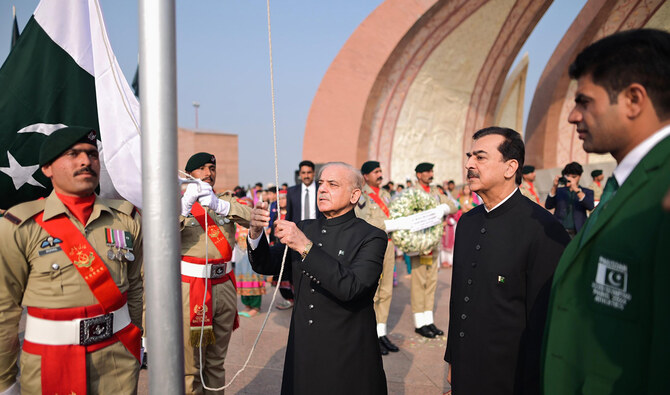
Prime Minister Shehbaz Sharif hoists Pakistan's national flag at the Pakistan Monument in Islamabad on August 14, 2024. (Photo courtesy: @CMShehbaz/X)
Short Url
Updated 14 August 2024
Follow

Pakistan PM vows to present 5-year economic program as nation marks 78th Independence Day

  • Sharif says will address the nation, present five-year economic plan “in a few days“
  • Pakistan President Asif Ali Zardari urges nation to forge unity, bring about stability

ISLAMABAD: Prime Minister Shehbaz Sharif vowed to put Pakistan on the path to progress as the nation celebrated its 78th Independence Day on Wednesday, announcing that he would unveil a five-year economic plan in the next couple of days, and present his vision to transform the country into a prosperous one. 

Pakistan has faced a prolonged economic crisis that has seen its external debt mount, its currency weaken against the US dollar and its foreign exchange reserves drop to dangerous levels in the past two years. 

The South Asian country, desperate to stave off a balance of payments crisis, has turned to regional allies and global financial institutions such as the International Monetary Fund (IMF) for debt rollovers and loan programs to sustain its fragile economy. 

Speaking at a ceremony in Islamabad to celebrate Pakistan’s 78th Independence Day, Sharif acknowledged that people were suffering from high inflation and unemployment in the country. 

“I have focused my speech today on Independence Day but In a few days, I will address the nation and present a five-year economic plan in front of you,” Sharif told participants of the event. 

The Pakistani prime minister vowed to work hard whilst he was prime minister to put the South Asian country on the path to progress and prosperity. 

“Till the last drop of blood in my body, I will work day and night with my colleagues in the government to bring down inflation, electricity prices and uplift Pakistan’s economy and ensure it progresses,” Sharif vowed. 

Sharif noted that Pakistan’s industries and particularly its agriculture sector cannot progress until electricity prices are slashed. He said it is also not possible to increase revenue from exports without slashing power prices and granting relief to the business community. 

“I want to tell you today that the entire government is working together on this,” he said. “God willing in the next few days, you will get a good news about the decrease in electricity prices across Pakistan.”

PRESIDENT STRESSES UNITY, STABILITY 

Pakistan’s President Asif Ali Zardari, meanwhile, urged the country to forge unity and bring about stability as it marked its 78th Independence Day. 

“Zardari stressed the need to set aside differences and work with dedication for the unity, integrity, and economic stability of the country to cope with current challenges,” the state-run Associated Press of Pakistan (APP) reported. 

He called for a collective commitment to uplift the nation and work toward making Pakistan a prosperous country. 

“We should wholly and solely concentrate on the well-being of the people, especially of the masses and the poor,” Zardari said. 

“It is time to invest in our youth and women, improve service delivery, and create a business-friendly environment to make Pakistan a great nation.”


Pakistan highlights economic reforms at Davos, eyes cooperation in AI, IT and minerals

Updated 30 min 5 sec ago
Follow

Pakistan highlights economic reforms at Davos, eyes cooperation in AI, IT and minerals

  • Prime Minister Shehbaz Sharif speaks at breakfast event in Davos at sidelines of World Economic Forum summit
  • Pakistan, rich in gold, copper reserves, has sought cooperation with China, US, Gulf countries in its mineral sector

ISLAMABAD: Prime Minister Shehbaz Sharif highlighted Pakistan’s recent economic reforms during the sidelines of the ongoing World Economic Forum (WEF) summit in Davos on Wednesday, saying that his country was eyeing greater cooperation in mines and minerals, information technology, cryptocurrency and artificial intelligence with other states. 

The Pakistani prime minister was speaking at the Pakistan Pavilion in Davos on the sidelines of the WEF summit at a breakfast event. Sharif arrived in Switzerland on Tuesday to attend the 56th annual meeting of the WEF, which brings together global business leaders, policymakers and politicians to speak on social, economic and political challenges. 

Pakistan has recently undertaken several economic reforms, which include removing subsidies on energy and food, privatization of loss-making state-owned enterprises and expanding its tax base. Islamabad took the measures as part of reforms it agreed with the International Monetary Fund (IMF) in exchange for a financial bailout package. 

“We are now into mines and minerals business in a big way,” Sharif said at the event. “We have signed agreements with American companies and Chinese companies.”

Islamabad has sought to attract foreign investment in its critical minerals sector in recent months. In April 2025, Pakistan hosted an international minerals summit where top companies and government officials from the US, Saudi Arabia, China, Türkiye, the UK, Azerbaijan, and other nations attended.

Pakistan is rich in gold, copper and lithium reserves as well as other minerals, yet its mineral sector contributes only 3.2 percent to the countrys GDP and 0.1 percent to global exports, according to official figures.

Sharif said Pakistan has been blessed with infinite natural resources which are buried in its mountains in the northern Gilgit-Baltistan, Khyber Pakhtunkhwa, Azad Kashmir and southwestern Balochistan regions. 

“But we have now decided to go forward at lightning speed,” he said. “And we are also moving speedily in the field of crypto, AI, IT.”

He said the government’s fiscal and economic measures have reduced inflation from nearly 30 percent a few years ago to single-digit figures, adding that its tax-to-GDP ratio had also increased from 9 to 10.5 percent. 

The prime minister admitted Pakistan’s exports face different kinds of challenges collectively, saying the country’s social indicators needed to improve. 

“But the way forward is very clear: that Pakistan has to have an export-led growth,” he said. 

SHARIF MEETS IMF MANAGING DIRECTOR

Separately, Sharif met IMF Managing Director Kristalina Georgieva on improvements in Pakistan’s macroeconomic indicators, efforts toward stability and progress on institutional reforms, a statement from Sharif’s office said.

He emphasized Pakistan’s commitment to fiscal discipline, revenue mobilization and sustainable development, it added. 

The IMF managing director acknowledged and appreciated Pakistan’s reform efforts, the Prime Minister’s Office (PMO) said.

“Both sides exchanged views on the global economic outlook, challenges facing emerging economies, and the importance of multilateral cooperation in safeguarding economic stability,” the PMO said.