

Army chief thanks Saudi Arabia, UAE and China for supporting Pakistan during ‘difficult times’

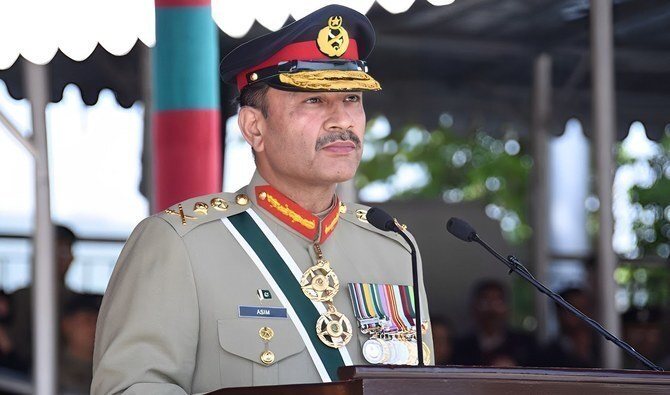
Pakistan army chief General Asim Munir addresses the passing out parade of cadets of the 147th PMA Long Course at the Pakistan Military Academy in Kakul, Pakistan, on April 29, 2023. (ISPR/File)
Short Url
Updated 14 August 2024
Follow

Army chief thanks Saudi Arabia, UAE and China for supporting Pakistan during ‘difficult times’

  • China, Saudi Arabia and UAE have frequently bailed out Pakistan during its macroeconomic crisis over past couple of years
  • Army chief says Pakistan wants peaceful relations with Afghanistan, urges Kabul not to “prioritize” militants over it 

ISLAMABAD: Pakistan’s Army Chief General Syed Asim Munir thanked Saudi Arabia, China, the United Arab Emirates, Turkiye and Qatar for standing by Pakistan during its “difficult times,” the military’s media wing said on Wednesday on the occasion of the country’s 78th Independence Day. 

Pakistan has increasingly relied on regional allies China, Saudi Arabia and the United Arab Emirates as it suffers from a prolonged economic crisis over the past two years. 

International publication Bloomberg reported earlier this month that Islamabad has secured debt rollover commitments from the three countries for a year, paving the way for its $7 billion loan program from the International Monetary Fund (IMF). 

All three countries are important trade and investment allies of Pakistan and have frequently bailed Islamabad out of its macroeconomic crisis that has seen its reserves plummet, and its currency weaken over the past two years. 

“We are grateful to China, Saudi Arabia, the United Arab Emirates, Qatar and Turkiye for supporting Pakistan in its difficult time,” Munir said during his speech at a parade on Independence Day eve at the Pakistan Military Acad­emy in Kakul. 

In a wide-ranging speech, the army chief said Islamabad wanted to establish peaceful relations with neighboring Afghanistan. 

“Our message to them is: Do not give priority to the Fitnah-ul-Khawarij over your long-standing, benevolent and brotherly neighbor,” Munir said, referring to the Pakistani Taliban as the “Fitnah-ul-Khawarij.”

Pakistan’s ties with Afghanistan have remained strained ever since the Taliban seized Kabul in 2021. Islamabad accuses the outlawed Pakistani Taliban of launching attacks on it from sancutaries in Afghanistan, allegations that Kabul denies. 

It has frequently warned Kabul to desist from providing safe havens to the Pakistani Taliban fighters and urged it to take decisive action against the militant group.

Munir also spoke about freedom of speech in the country, saying that whilst the constitution guarantees it, it also defines its limits. 

The army chief’s comments come amid a ban on X in Pakistan since February when a government official held a press conference and made confessions of rigging in the general election. 

The government also has reportedly begun installing a nationwide firewall to regulate Internet usage, control access to social media sites, including Facebook, YouTube, and X, and empower the government to identify IP addresses associated with what it calls “anti-state propaganda.”

The ban has been criticized by digital rights activists and journalists, who see it as an attempt to muzzle freedom of speech and restrict Internet freedoms in the country. 


Pakistan rejects Amnesty claims of Israeli spyware use, calls reports ‘disinformation’

Updated 10 sec ago
Follow

Pakistan rejects Amnesty claims of Israeli spyware use, calls reports ‘disinformation’

  • FO denies any link with Israel, says Pakistan has “absolutely no cooperation” on surveillance tools
  • Islamabad accuses India of delaying clearance for relief aircraft bound for flood-hit Sri Lanka

ISLAMABAD: Pakistan on Friday rejected an Amnesty International report alleging the use of Israeli-made invasive spyware in the country, calling the findings speculative and misleading.

Amnesty’s investigation, published Thursday under the title Intellexa Leaks, cited the case of a Pakistan-based human rights lawyer who reported receiving a suspicious WhatsApp link in 2025. According to Amnesty International’s Security Lab, the link bore signatures consistent with Predator, a spyware product developed by Israeli manufacturer c

Foreign Office spokesperson Tahir Andrabi dismissed the suggestion that Islamabad had deployed the tool or maintained any technological cooperation with Israel.

“These are all media speculations. These are all rumor-mongering and disinformation. There is absolutely no cooperation between Pakistan and Israel on anything, let alone a spyware or these kinds of tools. So, I would reject it quite emphatically,” he said at a weekly briefing.

Andrabi also accused India of obstructing humanitarian operations, saying New Delhi delayed flight clearance for a Pakistani relief aircraft carrying aid to flood-affected Sri Lanka.

“The special aircraft carrying Pakistan’s relief goods had to wait for 48 hours, in fact more than 48 hours, around 60 hours, while the flight clearance from India was delayed,” he said.

He added that the eventual conditional flight window was too narrow to be workable.

“The partial flight clearance which eventually was given after 48 hours was operationally impractical, time-bound just for a few hours and hence not operable, severely hindering the urgent need for the relief mission for the brotherly people of Sri Lanka,” Andrabi stated.

“Humanitarian assistance is like justice, if it is delayed, it is denied.”

Responding to India’s claim that clearance was granted within four hours, he said Pakistan has documentary proof contradicting New Delhi’s version.

On a separate question about reported delays in the arrival of a Turkish delegation aimed at mediating between Islamabad and Kabul, Andrabi said Pakistan welcomed Ankara’s initiative but was unaware of the cause of postponement.

“We stand ready to receive the Turkish delegation. That delegation has not arrived as yet. And I’m not aware of any schedule. Pakistan is ready to hold negotiations, discussions,” he said, adding that the delay may be linked to coordination with the Afghan side.