KYIV: Ukraine said Tuesday it would not hold on to Russian territory captured in its surprise cross-border incursion and offered to stop raids if Moscow agreed a “just peace.”
Ukrainian forces entered Russia’s Kursk region last Tuesday, taking over two dozen settlements in the biggest attack by a foreign army on Russian soil since World War II. Russia said Tuesday it had fended off new attacks in Kursk.
More than 120,000 people have fled the area and Ukraine’s military chief Oleksandr Syrsky said Monday that his troops controlled about 1,000 square kilometers of Russian territory.
At least 800 square kilometers was under Ukrainian control as of Monday, according to an AFP analysis of data from the US-based Institute for the Study of War.
Foreign ministry spokesman Georgiy Tykhy on Tuesday said Kyiv was not interested in “taking over” Russian territory and defended Ukraine’s actions as “absolutely legitimate.”
“The sooner Russia agrees to restore a just peace... the sooner the raids by the Ukrainian defenses forces into Russia will stop,” he told reporters.
Ukraine meanwhile said it was imposing movement restrictions in a 20-kilometer zone in Sumy region along the border with Kursk region due to an “increase in the intensity of hostilities” and “sabotage” activities.
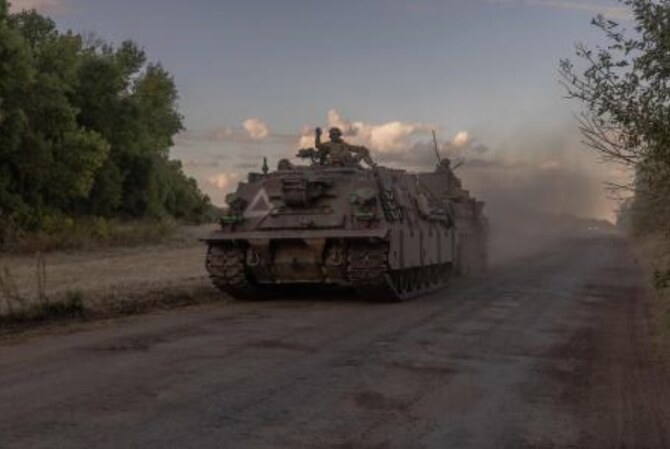
Russia’s defense ministry said it had “foiled” new Ukrainian attacks in Kursk by “enemy mobile groups in armored vehicles to break through deep into Russian territory.”
Alexander Bortnikov, head of Russia’s FSB security service, also said in a statement that Ukraine had carried out the attack “with the support of the collective West.”
Since launching its invasion in February 2022, Russia has captured territory in southern and eastern Ukraine and subjected Ukrainian cities to missile and drone barrages.
Ukraine’s offensive was the biggest cross-border action since the invasion and it caught Russia off guard.
“They didn’t protect the border,” a Ukrainian serviceman who took part in the offensive and identified himself as Ruzhyk told AFP in Sumy region.
“They only had anti-personnel mines scattered around trees at the side of the road and a few mines that they managed to quickly throw along the highways,” he said.
A 27-year-old squad leader, who identified himself as Faraon, was sparing but direct in his description of battles in Kursk.
“I saw a lot of death in the first few days. It was terrifying at first but then we got used to it,” he told AFP.
“There have been many deaths,” he repeated stood next to a forest road leading to the frontier, without elaborating.
Ukrainian military analyst Mykola Bielieskov told AFP: “Russian complacency prevailed.”
“Russia assumed that since it had initiative elsewhere, Ukraine wouldn’t dare to do things we’ve seen,” he said, referring to months of Russian advances along the front.
ISW figures also showed that Russian troops had captured 1,360 square kilometers of Ukrainian territory since the start of 2024.
Russian President Vladimir Putin has vowed to “dislodge” Ukrainian troops.
Putin told a televised meeting with officials on Monday that “one of the obvious goals of the enemy is to sow discord” and “destroy the unity and cohesion of Russian society.”
Putin also said Ukraine wanted to “improve its negotiating position” for any future talks with Moscow.
Regional governor Alexei Smirnov told the same meeting that Ukrainian forces had entered at least 12 kilometers into the region and the new front was now 40 kilometers wide.
Russia had conceded earlier that Ukrainian forces had penetrated up to 30 kilometers (20 miles) into Russian territory in places.
A Ukrainian security official told AFP, on condition of anonymity, at the weekend, that Ukraine sought to “stretch the positions of the enemy, to inflict maximum losses and to destabilize the situation in Russia as they are unable to protect their own border.”
The Ukrainian official said thousands of Ukrainian troops were involved in the operation.


![]()

Ukraine urges Russia to accept ‘just peace’ amid incursion
Short Url
https://arab.news/9a49m
Ukraine urges Russia to accept ‘just peace’ amid incursion
- At least 800 square kilometers was under Ukrainian control as of Monday
- Foreign ministry spokesman Georgiy Tykhy on Tuesday said Kyiv was not interested in “taking over” Russian territory and defended Ukraine’s actions as “absolutely legitimate“


Latest updates


© 2026 SAUDI RESEARCH & PUBLISHING COMPANY, All Rights Reserved And subject to Terms of Use Agreement.