



Hunderman: The ancient trade route over the Himalayan passes of Hunderman once brought communities together, but the rugged peaks are now used as fortifications by nuclear-armed rivals India and Pakistan.
Indian apricot farmer Ghulam Ahmad, 66, separated from his parents as a teenager in the chaos of war that saw control of his village swap from Pakistan to India, dreams of seeing his mother’s grave.
If the crossing was open, it would be a day’s trek of 50 kilometers (30 miles) to Pakistani territory.
But to visit the site now requires a roundtrip of some 2,500 kilometers (1,550 miles), visa permission that is hard to obtain, and expenses he cannot afford.
“What can we do?” said Ahmad. “Many here have died without meeting, only in hope of meeting.”
India and Pakistan have only one tightly restricted border point where people can cross, in Punjab state far to the south, but few do so.
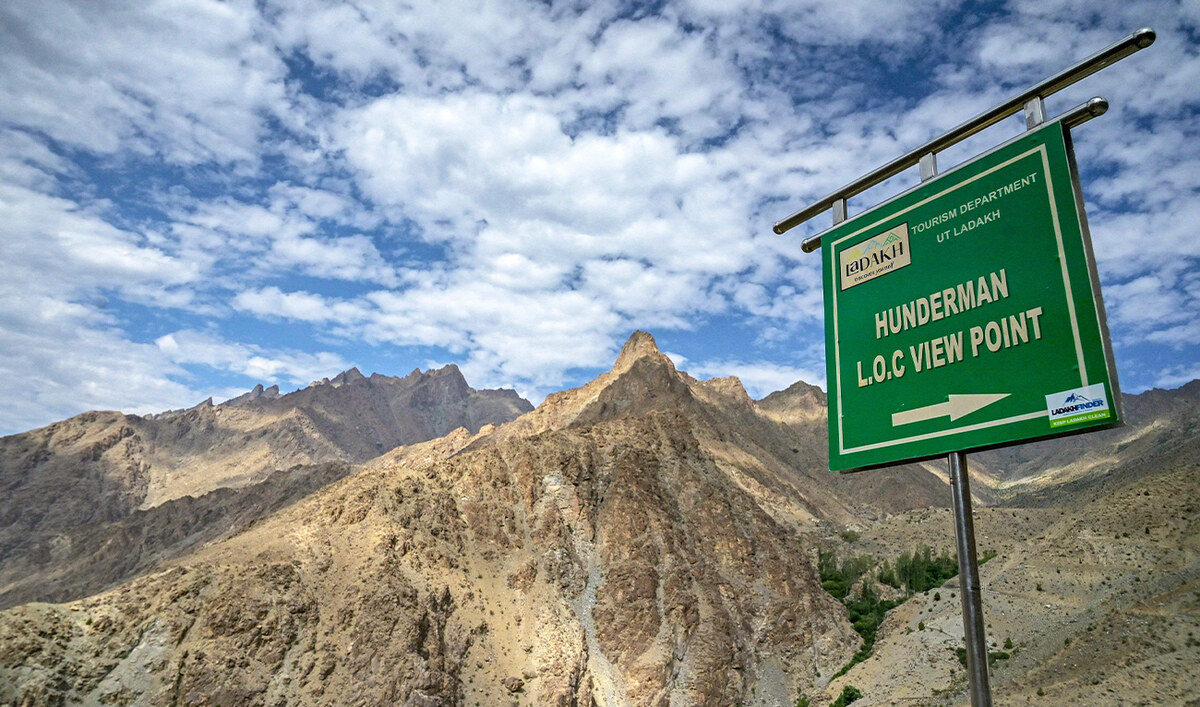
This photograph taken on July 27, 2024 shows a sign board near Line of Control (LOC) - the border between India and Pakistan, at the Hunderman village in Kargil district. (AFP)
The rivals, who both celebrate their 77th independence day this week, have fought three major wars and countless border conflicts since they were partitioned out of the Indian subcontinent in 1947.
They remain bitterly at odds over control of the restive territory of Kashmir, divided between the two countries and claimed in full by both.
“If someone reopens this border many would go there,” he said. “And many from there would come here to meet relatives.”
Ahmad’s village in the Kargil area lies beside a raging glacial meltwater tributary of the Indus river, at the fortified line of control dividing Kashmir between the countries.
Imposing snow-capped peaks shadow the village dotted with rival army posts.
Kargil was also the site of the last major clash between New Delhi and Islamabad in 1999.
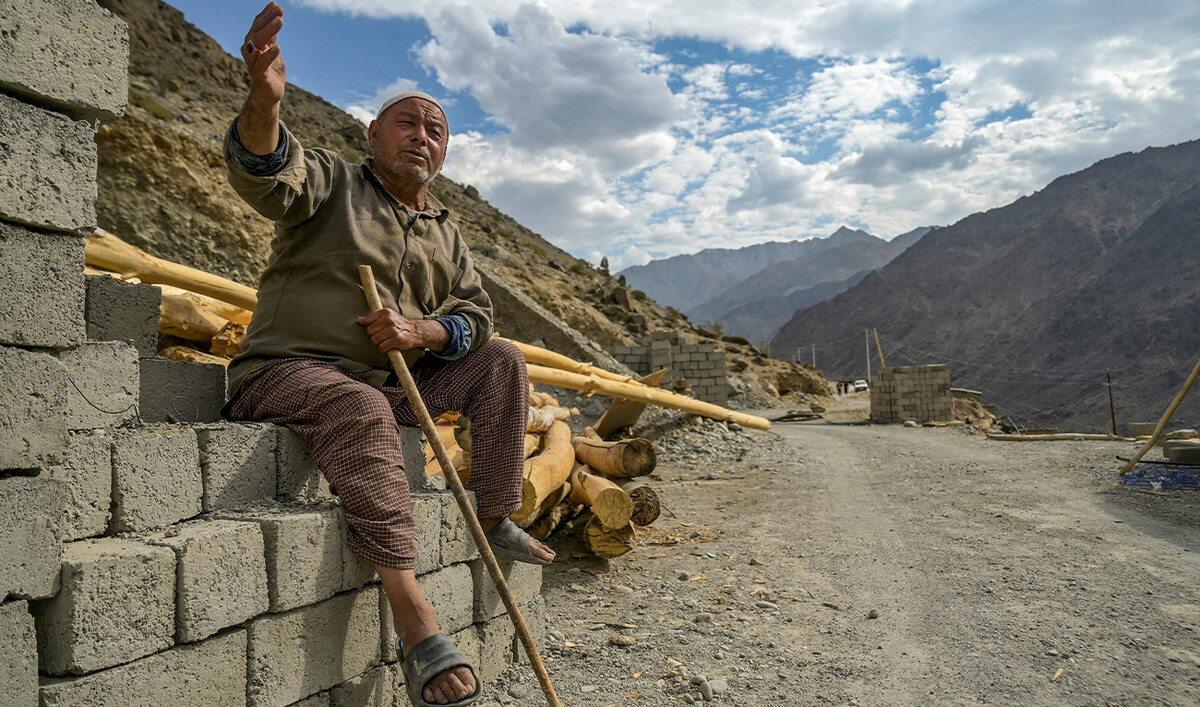
In this photograph taken on July 27, 2024 Ghulam Ahmad, an Indian apricot farmer speaks during an interview with AFP near Line of Control (LOC) - the border between India and Pakistan, at the Hunderman village in Kargil district. (AFP)
Ali, 49, who uses only one name, is a tour guide in the summer months when curious tourists come to visit, and otherwise leads donkeys carrying supplies to Indian military mountain outposts.
He has never met his uncle’s family across the border.
“My mother’s brother and their entire family are on the other side,” Ali said, saying his mother “keeps crying about her separation from them.”
He recalled the terrifying 10-week conflict in 1999, in which at least 1,000 people were killed.
“It was a really tough period,” Ali said, describing how villagers would shelter in mountain caves.
“The men only came out at night to water the fields and take care of the animals.”
After a quarter of a century of relative peace, the narrow valley is far less isolated.
India’s military has made a giant push to bolster strategic infrastructure, such as roads and telecommunication lines.
Families can now connect online, swapping messages after decades of silence — or even, for the first time.
“There was nothing here in 1999,” said Kargil veteran Major General Lakhwinder Singh. “Now small townships are coming up, new hotels.”
But Mohammad Baqir, 51, said while he had now reconnected with relatives in Pakistan, his desire to meet in person and pray at a mosque together was just a dream.
“I’ve seen our soldiers fortify defenses and have no hope of a thaw,” Baqir said. “There’s always fear that something may happen.”
Ahmad, the apricot farmer, said he showed his late father’s photograph to his teenage grandson, but he was not interested.
The young generations were “entirely disconnected,” he said.
Villager Ali Mohammad, 55, said his memories of the other sides were now “blurred,” the fading remnants of a once vibrant community split in two.
“A generation has been lost, and the young haven’t connected on either side.”


