Sudan peace talks moving forward, says US envoy

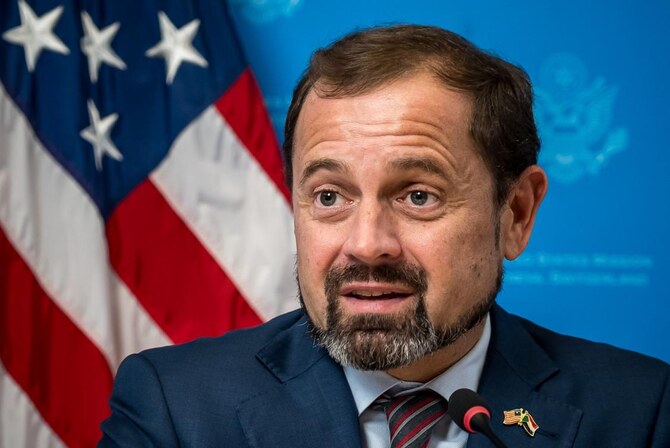
US envoy to Sudan Tom Perriello speaks during a press briefing ahead of Sudan ceasefire talks, on August 12, 2024 in Geneva. (AFP)
Short Url
Updated 12 August 2024
Follow

Sudan peace talks moving forward, says US envoy

  • Country is experiencing a state of collapse due to the current war, RSF leader says

DUBAI: Talks to end Sudan’s 16-month war between the army and the paramilitary Rapid Support Forces (RSF) will move forward this week, the US’s special envoy said, despite little sign from either party that they seek a peaceful resolution.
The Sudanese army has all but rejected the invitation, while the RSF has continued its costly offensives in parts of the country, despite welcoming the US and Saudi initiative.
Failure of efforts to bring the war to an end would exacerbate a conflict that has created the world’s largest humanitarian crisis, pushing 10 million people out of their homes and creating famine-like conditions across the country.
“We will move forward with this event this week. That has been made clear to the parties,” Tom Perriello, the US special envoy to Sudan, said in Geneva, where talks are set to begin on Wednesday.
In a taped speech on Monday, RSF leader General Mohamed Hamdan Dagalo reiterated his force’s participation in the talks, while also announcing a new force to protect civilians.
“The country is experiencing a state of collapse due to the current war, causing significant security instability and chaos,” he said, saying his forces were exhausted fighting “rogue criminals.”
Eyewitnesses told Reuters the RSF has struggled to control unruly fighters it has recruited for its advance through the center of the country, putting its ability to comply with a ceasefire in question.
The RSF has also in recent days continued its assault in Omdurman, near the capital, killing children in a designated “safe space,” according to UNICEF, and attacking a maternity hospital, according to the government.
It also killed or injured at least 40 people during morning prayers in Al-Fashir, the capital of North Darfur where fighting has intensified over the past week, according to local activists, as it seeks to solidify its hold over the west of the country.
“How serious (the RSF) are about negotiating a deal and compliance is a question we and the Sudanese people want to have an answer to,” Perriello said on Monday.

EXISTENTIAL FIGHT
The talks are the latest in several international efforts to bring an end to the war, and aim to agree on a cessation of violence, broader humanitarian access, and a mechanism to monitor and ensure implementation.
Army chief Abdelfattah Al-Burhan has said the RSF’s actions, particularly its occupation of civilian areas despite agreements made last year, are why the army has reservations on meeting in Switzerland.
After a meeting with Perriello in Saudi Arabia over the weekend, the Sudanese delegation recommended not participating, citing also the invitation of the army as opposed to the Sudanese government, and the participation of the UAE, which the army and others say is supporting the RSF with weapons and diplomatically. The UAE denies this.
But several military and political sources close to the army say its position also aims to maintain its unity internally and with former rebel groups who are leading the defense of Al-Fashir.
Some factions see the war as an existential fight and seek an outright victory, while others want to at least see the army take the upper hand before negotiations, the sources said. Loyalists of former President Omar Al-Bashir within and outside the army have successfully pushed against any talks that exclude them from the negotiating table.
Perriello said on Monday that even if mediated talks between the army and the RSF are not possible, talks will move ahead with technical experts and observers, including the African Union, the UAE, and Egypt, on formulating a plan of action to present to the parties.
“The trajectory of delay would not have benefited the Sudanese people and frankly would not benefit (the army) either, but I’ll leave that to their judgment,” he said.


Abbas reiterates opposition to displacement of Palestinians

Russian President Vladimir Putin with Palestinian President Mahmoud Abbas at the Senate Palace of the Kremlin in Moscow. (AP)
Updated 23 January 2026
Follow

Abbas reiterates opposition to displacement of Palestinians

  • During Moscow talks, president calls for immediate halt to Israeli acts of terror
  • Historically, Russia has supported and stood by the Palestinian people at political and diplomatic levels

MOSCOW: The Palestinian National Authority’s President Mahmoud Abbas has reiterated his opposition to all attempts to displace Palestinian people from their land.

Speaking with Russian President Vladimir Putin at the presidential palace in Moscow, Abbas was reported by the Kremlin’s official website as saying that “the Palestinian people are holding on to their land, and we categorically oppose attempts by the Americans and Israelis to expatriate Palestinians beyond Palestinian territory.” 
He said the Palestinian people “will not abandon their land, whatever the cost.” Abbas stressed the need to fully implement US President Donald Trump’s peace plan, leading to the withdrawal of occupation forces and the launch of the reconstruction process.
He emphasized that the Palestinian Authority would assume a central role in administering the Gaza Strip, and that the enclave and the West Bank constituted two parts of a single territorial unit, with a unified and undifferentiated system of civilian institutions.
He stressed the need for an immediate halt to “Israeli settler colonialism and Israeli acts of terror in the West Bank, including Jerusalem, along with the release of withheld Palestinian funds and the cessation of all measures that undermined the Palestinian Authority and the two-state solution.”
He reaffirmed his commitment to continue the struggle for the realization of the Palestinian people’s right to self-determination and of their right to a fully sovereign, independent state based on the borders of June 4, 1967, with East Jerusalem as its capital, while living in security and peace with neighbors.
He told Putin: “What we need is peace, and we hope that with your help and support, we can achieve it — a peace built on the basis of international legal resolutions, decisions of the United Nations, and the principles established following the wars of 1967 and 1973.
“East Jerusalem remains the capital of Palestine, and we know that Russia has always supported — indeed, was the first to support — Palestine, maintaining a firm stance in support of our people.”
Abbas thanked his Russian counterpart for Moscow’s support and commended the bilateral “bonds of friendship” between both countries. He added: “We are friends of Russia and the Russian people. For over 50 years our nations have been bound by a strong friendship that has developed over the decades and continues on the correct path. Russia is a great friend and a nation upon which we rely in many spheres.
“Historically, Russia has supported and stood by the Palestinian people at political and diplomatic levels. Your economic and financial support is both significant in scale and crucial in importance.”
Abbas emphasized moving forward with the implementation of a comprehensive national reform program aimed at consolidating the rule of law, strengthening the principles of good governance, transparency, and accountability, and ensuring the separation of powers.
Putin affirmed Moscow’s “principled and consistent approach” to the Palestinian question.
He said: “We believe that only the establishment and full functioning of the Palestinian state can lead to a lasting settlement of the Middle East conflict.”