

Abbas reiterates opposition to displacement of Palestinians

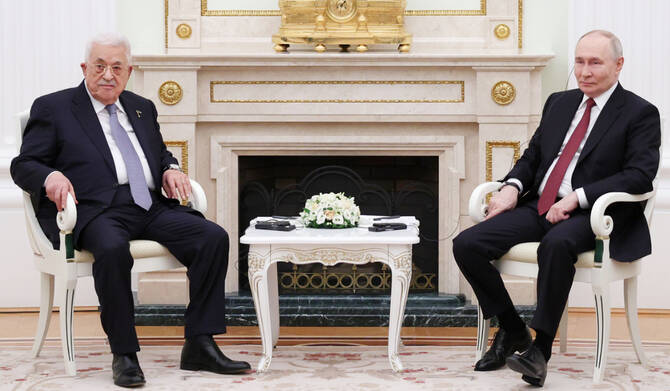
Russian President Vladimir Putin with Palestinian President Mahmoud Abbas at the Senate Palace of the Kremlin in Moscow. (AP)
Short Url
Updated 23 January 2026
Follow

Abbas reiterates opposition to displacement of Palestinians

  • During Moscow talks, president calls for immediate halt to Israeli acts of terror
  • Historically, Russia has supported and stood by the Palestinian people at political and diplomatic levels

MOSCOW: The Palestinian National Authority’s President Mahmoud Abbas has reiterated his opposition to all attempts to displace Palestinian people from their land.

Speaking with Russian President Vladimir Putin at the presidential palace in Moscow, Abbas was reported by the Kremlin’s official website as saying that “the Palestinian people are holding on to their land, and we categorically oppose attempts by the Americans and Israelis to expatriate Palestinians beyond Palestinian territory.” 
He said the Palestinian people “will not abandon their land, whatever the cost.” Abbas stressed the need to fully implement US President Donald Trump’s peace plan, leading to the withdrawal of occupation forces and the launch of the reconstruction process.
He emphasized that the Palestinian Authority would assume a central role in administering the Gaza Strip, and that the enclave and the West Bank constituted two parts of a single territorial unit, with a unified and undifferentiated system of civilian institutions.
He stressed the need for an immediate halt to “Israeli settler colonialism and Israeli acts of terror in the West Bank, including Jerusalem, along with the release of withheld Palestinian funds and the cessation of all measures that undermined the Palestinian Authority and the two-state solution.”
He reaffirmed his commitment to continue the struggle for the realization of the Palestinian people’s right to self-determination and of their right to a fully sovereign, independent state based on the borders of June 4, 1967, with East Jerusalem as its capital, while living in security and peace with neighbors.
He told Putin: “What we need is peace, and we hope that with your help and support, we can achieve it — a peace built on the basis of international legal resolutions, decisions of the United Nations, and the principles established following the wars of 1967 and 1973.
“East Jerusalem remains the capital of Palestine, and we know that Russia has always supported — indeed, was the first to support — Palestine, maintaining a firm stance in support of our people.”
Abbas thanked his Russian counterpart for Moscow’s support and commended the bilateral “bonds of friendship” between both countries. He added: “We are friends of Russia and the Russian people. For over 50 years our nations have been bound by a strong friendship that has developed over the decades and continues on the correct path. Russia is a great friend and a nation upon which we rely in many spheres.
“Historically, Russia has supported and stood by the Palestinian people at political and diplomatic levels. Your economic and financial support is both significant in scale and crucial in importance.”
Abbas emphasized moving forward with the implementation of a comprehensive national reform program aimed at consolidating the rule of law, strengthening the principles of good governance, transparency, and accountability, and ensuring the separation of powers.
Putin affirmed Moscow’s “principled and consistent approach” to the Palestinian question.
He said: “We believe that only the establishment and full functioning of the Palestinian state can lead to a lasting settlement of the Middle East conflict.”


Iraqi lawmakers to elect president Tuesday, PM appointment next

Updated 25 January 2026
Follow

Iraqi lawmakers to elect president Tuesday, PM appointment next

  • Parliamentary speaker Haibat Al-Halbussi announced on Sunday that the new parliament will convene on Tuesday to elect a president

BAGHDAD: Iraq’s parliament will meet on Tuesday to elect the country’s new president, who will then appoint a prime minister expected to be Nouri Al-Maliki after he was endorsed by the largest Shiite bloc.
By convention, a Shiite Muslim holds the post of prime minister, the parliament speaker is Sunni and the largely ceremonial presidency goes to a Kurd.
Parliamentary speaker Haibat Al-Halbussi announced on Sunday that the new parliament will convene on Tuesday to elect a president, according to the official INA press agency.
The president will then have 15 days to appoint a prime minister, who is usually nominated by the largest Shiite bloc formed through post-election alliances.
On Saturday, the Coordination Framework alliance — whose Shiiite factions have varying links to Iran — endorsed former prime minister and powerbroker Al-Maliki as the country’s next premier.
The alliance, to which Al-Maliki belongs, spoke of his “political and administrative experience and his record in running the state.”
Kurdish parties have yet to agree on a presidential candidate, who must be endorsed by other blocs and win a two-thirds majority in parliament.
The presidency is usually held by the Patriotic Union of Kurdistan (PUK). This year, the rival Kurdistan Democratic Party (KDP) named its own candidate: Foreign Minister Fuad Hussein.
Although Maliki’s endorsement effectively guarantees him the post, forming a new government remains a daunting challenge that could drag on for months and still fail.
The designated premier has one month to form a government and present it to parliament for a vote of confidence.
The 75-year-old Maliki, a shrewd politician, is set to return to power at a time of seismic changes in the Middle East, as Tehran’s regional influence wanes and tensions with Washington rise.
Government formation in Iraq must balance internal political dynamics and power-sharing among major parties, all under the continued influence of Iraq’s two main allies: Iran and the United States.
A close Iran ally, Al-Maliki will be expected to address Washington’s longstanding demand that Baghdad dismantle Tehran-backed factions, many of which are designated terrorist groups by the US.
Last month, Iraqi officials and diplomats told AFP that Washington demanded the eventual government exclude Iran-backed armed groups, even though most of them hold seats in parliament, and have seen their political and financial clout increase.
But Iraq is struggling with weak economic growth and cannot risk punitive measures by the US, which has already sanctioned several Iraqi entities, accusing them of helping Tehran evade sanctions.