Pakistan’s capital bans horns, whistles ahead of Independence Day to prevent noise pollution 

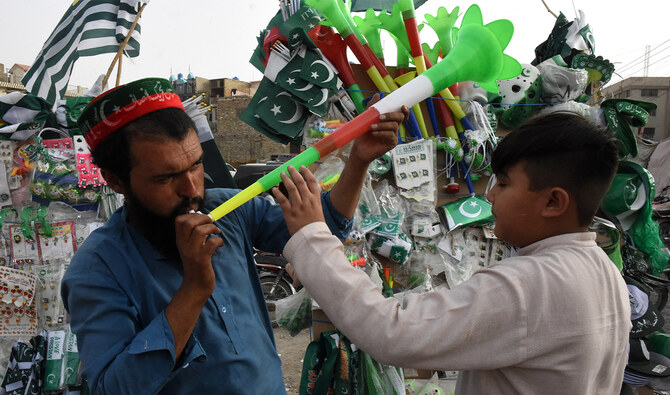
boy purchases a blow horn in a market on the eve of Pakistan's Independence Day celebrations in Quetta on August 13, 2023. (AFP/File)
Short Url
Updated 13 August 2024
Follow

Pakistan’s capital bans horns, whistles ahead of Independence Day to prevent noise pollution 

  • Order came into effect on Aug. 8 for ten days, notification by Islamabad’s district magistrate says
  • Magistrate says decision taken to uphold public peace and tranquility and discourage “public nuisance”

ISLAMABAD: The administration in Pakistan’s capital has banned the sale and purchase of horns and whistles for ten days ahead of Pakistan’s Independence Day celebrations on Aug. 14, an official notification said, to deter people from disturbing “public peace and tranquility.”

Thousands of shops and makeshift stalls in various parts of the country sell vuvuzela horns, whistles and other Independence Day paraphernalia ahead of Aug. 14 every year. A notification released last Thursday by Islamabad’s district magistrate but reported by local media on Monday said it had been noted that people were selling horns and whistles on the capital’s roads which was disturbing the flow of traffic. 

A vuvuzela is a plastic horn, brightly colored and seen in abundance at sporting events around the world and at Independence Day celebrations in Pakistan. The horns can be really loud and generate a lot of noise. 

“I do hereby prohibit the stock, sale, purchase and use of horns/whistles in Islamabad, which is likely to disturb public peace and tranquility and also cause public nuisance within the revenue limits of Islamabad District,” the notification read, signed by Islamabad’s Additional District Magistrate Usman Ashraf. 

The order, issued on Aug. 8, said it was to come into force immediately and would stay in effect till ten days. 

According to the state-run Associated Press of Pakistan (APP), Islamabad’s deputy commissioner has directed all assistant commissioners to launch a crackdown on hawkers selling horns across various parts of the city.

“In the past few days, several operations were carried out in different areas, including I-8, Lehtrar Road, Ghori Town, and Kural,” APP reported. “These operations led to the confiscation of horns from various stalls, sending a clear message that the sale and purchase of horns would not be tolerated.”

Islamabad’s Deputy Commissioner Irfan Nawaz also called on citizens to avoid using horns and asked stall owners to stop selling them.

“Using or selling a toy horn can land you in legal trouble,” he warned on social media platform X. 

In 2022, a citizen fed up of the noise generated by the vuvuzelas, moved the Lahore High Court (LHC) seeking a ban on plastic toy horns. The court, however, rejected his plea since it was filed after Aug. 14, when Independence Day celebrations had ended. 

In August 2023, a judicial magistrate in Karachi ordered authorities to take stern action against people selling plastic toy horns, citing noise pollution as the main reason. 


Pakistan, global crypto exchange discuss modernizing digital payments, creating job prospects 

Updated 05 December 2025
Follow

Pakistan, global crypto exchange discuss modernizing digital payments, creating job prospects 

  • Pakistani officials, Binance team discuss coordination between Islamabad, local banks and global exchanges
  • Pakistan has attempted to tap into growing crypto market to curb illicit transactions, improve oversight

ISLAMABAD: Pakistan’s finance officials and the team of a global cryptocurrency exchange on Friday held discussions aimed at modernizing the country’s digital payments system and building local talent pipelines to meet rising demand for blockchain and Web3 skills, the finance ministry said.

The development took place during a high-level meeting between Finance Minister Muhammad Aurangzeb, Pakistan Virtual Assets Regulatory Authority (PVARA) Chairman Bilal bin Saqib, domestic bank presidents and a Binance team led by Global CEO Richard Teng. The meeting was held to advance work on Pakistan’s National Digital Asset Framework, a regulatory setup to govern Pakistan’s digital assets.

Pakistan has been moving to regulate its fast-growing crypto and digital assets market by bringing virtual asset service providers (VASPs) under a formal licensing regime. Officials say the push is aimed at curbing illicit transactions, improving oversight, and encouraging innovation in blockchain-based financial services.

“Participants reviewed opportunities to modernize Pakistan’s digital payments landscape, noting that blockchain-based systems could significantly reduce costs from the country’s $38 billion annual remittance flows,” the finance ministry said in a statement. 

“Discussions also emphasized building local talent pipelines to meet rising global demand for blockchain and Web3 skills, creating high-value employment prospects for Pakistani youth.”

Blockchain is a type of digital database that is shared, transparent and tamper-resistant. Instead of being stored on one computer, the data is kept on a distributed network of computers, making it very hard to alter or hack.

Web3 refers to the next generation of the Internet built using blockchain, focusing on giving users more control over their data, identity and digital assets rather than big tech companies controlling it.

Participants of the meeting also discussed sovereign debt tokenization, which is the process of converting a country’s debt such as government bonds, into digital tokens on a blockchain, the ministry said. 

Aurangzeb called for close coordination between the government, domestic banks and global exchanges to modernize Pakistan’s payment landscape.

Participants of the meeting also discussed considering a “time-bound amnesty” to encourage users to move assets onto regulated platforms, stressing the need for stronger verifications and a risk-mitigation system.

Pakistan has attempted in recent months to tap into the country’s growing crypto market, crack down on money laundering and terror financing, and promote responsible innovation — a move analysts say could bring an estimated $25 billion in virtual assets into the tax net.

In September, Islamabad invited international crypto exchanges and other VASPs to apply for licenses to operate in the country, a step aimed at formalizing and regulating its fast-growing digital market.