


KYIV/MOSCOW: Russian President Vladimir Putin said on Monday that Ukraine was trying to undermine Russian stability with its incursion into the south of the country, but it would not succeed.
“The losses of the Ukrainian armed forces are increasing dramatically for them, including among the most combat-ready units, units that the enemy is transferring to our border,” Putin told a televised meeting with top security officials and regional governors.
“The enemy will certainly receive a worthy response, and all the goals facing us will, without a doubt, be achieved.”
Two Russian regions bordering Ukraine ordered more evacuations on Monday as Moscow battled to contain an unprecedented push onto its territory.
Ukraine sent troops into Russia last week in its biggest cross-border operation since Moscow launched its invasion in February 2022 and the most significant by a foreign army since World War II.
Authorities in the Kursk region announced they were widening their evacuation area to include Belovsky district, home to some 14,000 people. The neighboring Belgorod region said it was evacuating its border district of Krasnoyaruzhsky.
“For the health and security of our population, we’re beginning to move people who live in Krasnoyaruzhsky to safer places,” Belgorod region governor Vyacheslav Gladkov said on Telegram.
The assault on Kursk had already led to 76,000 people being ordered out.
A top Ukrainian official said over the weekend that the operation was aimed at stretching Russian troops and destabilizing the country after months of slow Russian advances across the frontline.
The assault appeared to catch the Kremlin off guard. Russia’s army rushed in reserve troops, tanks, aviation, artillery and drones in a bid to quash it.
But the army on Sunday conceded that Ukraine had penetrated up to 30 kilometers (20 miles) into Russian territory in places.
In a briefing, the defense ministry said it had “foiled attempts” by Ukraine’s forces to “break through deep into Russian territory” using armored vehicles.
But it said some forces were near the villages of Tolpino and Obshchy Kolodez, some 25 kilometers and 30 kilometers from the Russia-Ukraine border.
A Ukrainian security official said, on condition of anonymity, that “the aim is to stretch the positions of the enemy, to inflict maximum losses and to destabilize the situation in Russia as they are unable to protect their own border.”
The Ukrainian official said thousands of Ukrainian troops were involved in the operation.
Russia’s defense ministry said on Monday that its air defense systems had destroyed 18 Ukrainian drones — including 11 over the Kursk region.
On Sunday, each country blamed the other for a fire at the Russian-occupied Zaporizhzhia nuclear plant in southern Ukraine. Both sides — and the UN’s nuclear watchdog — said there was no sign of a nuclear leak.
“No impact has been reported for nuclear safety,” said the International Atomic Energy Agency, which has experts at the site. Kyiv and Moscow said there had been no rise in radiation levels.
In a later statement, the IAEA said it had requested “immediate access to the cooling tower to assess the damage.”
A Moscow-installed official, Vladimir Rogov, said the blaze has been “completely extinguished” in a Telegram post Monday.
The plant’s Russian-installed operator said on Monday that it was working normally following the incident and that all six reactors remained in “cold shutdown.”
Russia’s emergency situations ministry said on Sunday that over 44,000 residents in the Kursk region have applied for financial assistance, TASS news agency reported.
At an aid center in Moscow, 28-year-old midwife Daria Chistopolskaya was critical of the response.
“I think that the state does not care enough about such people, and people themselves should help each other in these kinds of situations,” she said.
Russia’s rail operator organized emergency trains from Kursk to Moscow, around 450 kilometers away, for those fleeing.
“It’s scary to have helicopters flying over your head all the time,” said Marina, refusing to give her surname, who arrived by train in Moscow on Sunday. “When it was possible to leave, I left.”
Kursk regional governor Alexei Smirnov conceded on Sunday that the situation was “difficult.”
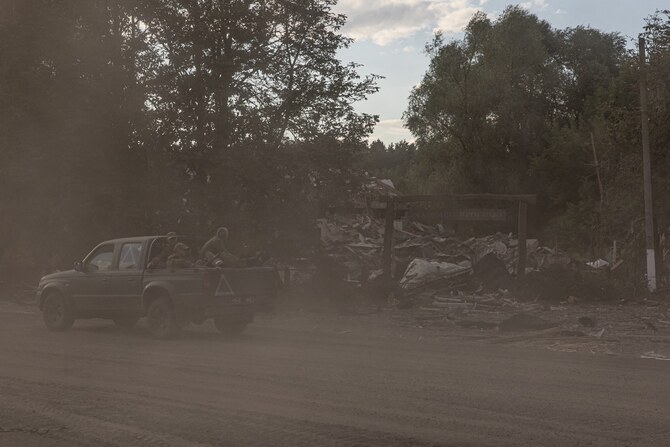
Across the border in Ukraine’s Sumy region, AFP journalists on Sunday saw dozens of armored vehicles daubed with a white triangle — the insignia apparently being used to identify Ukrainian military hardware deployed in the attack.
At an evacuation center in the regional capital of Sumy, 70-year-old retired metal worker Mykola, who fled his village of Khotyn some 10 kilometers from the Russian border, welcomed Ukraine’s push into Russia.
“Let’s let them find out what it’s like,” he said. “They don’t understand what war is. Let them have a taste of it.”
Analysts think Kyiv may have launched the assault to try to relieve pressure on its troops in other parts of the front line.
But the Ukrainian official said: “Their pressure in the east continues, they are not pulling back troops from the area,” even if “the intensity of Russian attacks has gone down a little bit.”
The Ukrainian official said he expected Russia would “in the end” stop the incursion.
Ukraine was bracing for a large-scale retalliatory missile attack, including “on decision-making centers” in Ukraine, the official said.


