Thousands of Ukrainian troops on incursion to ‘destabilize’ Russia: official

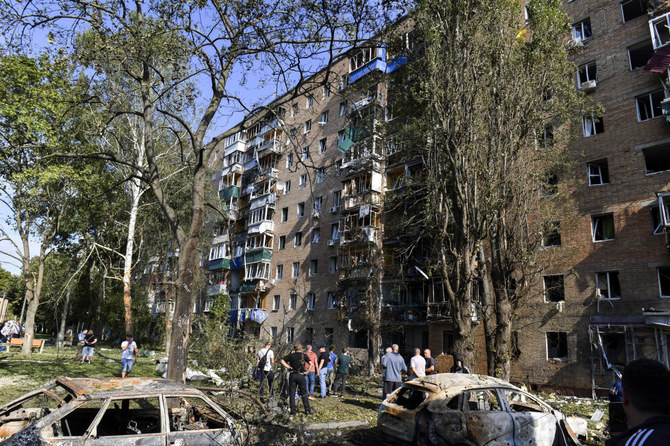
People gather at an apartment building damaged after shelling by the Ukrainian side in Kursk, Russia. (AP)
Short Url
Updated 11 August 2024
Follow

Thousands of Ukrainian troops on incursion to ‘destabilize’ Russia: official

  • President Volodymyr Zelensky acknowledged the offensive for the first time in his nightly address on Saturday
  • Ukrainian units stormed across the border Tuesday in what so far has been the largest and most successful such offensive

KYIV: Thousands of Ukrainian troops are taking part in an incursion aiming to destabilize Russia by showing up its weaknesses, a top Ukrainian official has told AFP as the assault entered its sixth day.
“We are on the offensive. The aim is to stretch the positions of the enemy, to inflict maximum losses and to destabilize the situation in Russia as they are unable to protect their own border,” the security official said on condition of anonymity.
The Russian army had said about 1,000 Ukrainian troops were deployed in the cross-border incursion which began on Tuesday and appeared to catch the Kremlin off guard, allowing Ukrainian forces to penetrate Russian defensive lines.
Asked whether the 1,000 figure was right, the official said: “It is a lot more... Thousands.”
After days of official silence, President Volodymyr Zelensky acknowledged the offensive for the first time in his nightly address on Saturday, saying that Kyiv was “pushing the war into the aggressor’s territory.”
Russia invaded Ukraine in February 2022 and has waged an unrelenting offensive, occupying swathes of eastern and southern Ukraine and subjecting Ukrainian cities to daily missile and drone attacks.
After re-capturing large areas in 2022, Ukrainian forces have largely been on the backfoot and are increasingly struggling with manpower and arms supplies.
But Ukrainian units stormed across the border Tuesday in what so far has been the largest and most successful such offensive by Kyiv in the conflict.
Its troops have advanced several kilometers forcing Russia’s army to rush in reserves and extra equipment — though neither side has given precise details on the forces committed.
Russia has evacuated tens of thousands of civilians from the area and Ukraine has also evacuated thousands of people from the Sumy region across the border.
Ukraine on offensive
The operation has “greatly raised our morale, the morale of the Ukrainian army, state and society,” the Ukrainian official said, speaking late Saturday after weeks of Russian advances in eastern Ukraine.
“This operation has shown that we can go on the offensive, move forward,” the official said.
“It seems that the Russians have problems with coordination, preparedness for action,” he said.
But he said there had been little effect so far on fighting in the east.
“The situation is basically unchanged. Their pressure in the east continues, they are not pulling back troops from the area,” he said, adding only that “the intensity of Russian attacks has gone down a little bit.”
The official said Ukrainian troops would respect international humanitarian law while on Russian territory and had no plans to annexe areas they currently hold.
“There is no idea of annexation... We are operating in strict accordance with international law,” he said, contrasting this with alleged violations by Russian troops in occupied territory.
Asked whether capturing the Kursk nuclear power plant near the border was an aim, he said: “We will see how the Kursk operation will develop.”
“We absolutely will not cause problems for nuclear security. This we can guarantee,” he said.
The International Atomic Energy Agency has urged both sides “to exercise maximum restraint in order to avoid a nuclear accident with the potential for serious radiological consequences.”
US weapons
The White House said Wednesday it was contacting Ukraine to learn more about the “objectives” of the incursion.
President Joe Biden in May allowed Kyiv to use American-supplied weapons against targets just across the Russian border to repel Moscow’s push on the Kharkiv region.
But White House National Security Council spokesman John Kirby has said that “nothing had changed” about US policy discouraging broader strikes or attacks inside Russia.
Asked whether Western partners had been kept in the dark about Ukraine’s offensive, the official said this was “incorrect.”
“Judging by how actively Western arms are being used, our Western partners played a part indirectly in the planning,” he said.
The official said he expected Russia would “in the end” manage to stop Ukrainian forces in Kursk and retaliate with a large-scale missile attack including “on decision-making centers” in Ukraine.
There has already been more intense bombardment of Ukraine’s Sumy region just across the border from Kursk.
And an overnight missile attack near the Ukrainian capital Kyiv killed a man and his four-year-old son, emergency services said.
Explosions rang out Saturday night in the center and east of Kyiv after Ukraine’s air force said two Russian missiles were headed toward the city.


UK veterans are ‘ticking time bomb’ after Iraq war chemical exposure

Updated 18 January 2026
Follow

UK veterans are ‘ticking time bomb’ after Iraq war chemical exposure

  • Fifteen former RAF personnel were deployed to the Qarmat Ali water plant in 2003, which was contaminated with sodium dichromate
  • Veterans say they were not screened or protected, and are now living with serious health conditions

LONDON: Fifteen British servicemen who worked on a carcinogen-contaminated water treatment site during the Iraq war say they were not offered biological screening despite official guidance saying they should have been.

The former Royal Air Force members, who have suffered from ailments including cancer, tumors and nosebleeds, told Sky News they were offered no medical assistance or subsequent treatment after having been exposed to toxic sodium dichromate at the Qarmat Ali water treatment plant in 2003.

The channel said it had seen a letter from the RAF’s medical authority stating that senior officers knew of the dangers posed by the substance.

Peter Lewis, 53, was one of 88 personnel deployed to guard the site, which was deemed vital for getting Iraq’s oil industry up and running. He told Sky: “I’ve had eight or nine operations to remove cancer.

“I’ve had so many lumps taken out of my neck, one on my face. This is something I’m literally fighting every year now. It’s constant.”

Qarmat Ali, the former troops say, was covered in ripped bags of bright orange sodium dichromate.

“We were never warned what the bags of chemicals were,” Jon Caunt, another former serviceman, said. “We were breathing this stuff in.”

His former comrade Tony Watters added: “I never thought about what it was. We were told the site is safe.”

Several months after deployment to the site, however, the servicemen were joined by two workers wearing protective gear who placed signs around it reading: “Warning. Chemical hazard. Full protective equipment and chemical respirator required. Sodium dichromate exposure.”

Watters said: “When you left the site, your uniform was contaminated, your webbing was contaminated.

“You went in your sleeping bag, and that was contaminated. And you were contaminating other people with it back at camp.”

Andy Tosh, who has led the group of veterans as they sought answers from the Ministry of Defence, said: “Even with the warning signs going up … they kept us there. They knowingly kept us exposed.”

The RAF gave some of the men a leaflet on their return to the UK, warning of the dangers of the substance, but not all were told.

The letter seen by Sky acknowledging the dangers posed to the veterans made a “strong” link to “increased risk of lung and nose cancer” as well as numerous other issues. It suggested personnel sent to Qarmat Ali should have their medical records altered to mention their exposure to sodium dichromate.

“Offer biological screening. This cannot be detailed until the numbers exposed are confirmed,” the letter also said.

An inquiry into US personnel deployed to Qarmat Ali found that 830 people were “unintentionally exposed” to sodium dichromate, giving them access to support from the US Department of Veterans Affairs. This came after the death of Lt. Col. James Gentry from cancer in 2009, which the US Army determined came “in line of duty for exposure to sodium dichromate.”

There has been no such inquiry by UK authorities despite British personnel being deployed at the site for longer than their American counterparts.

Thirteen of them have suffered from cancer and similar symptoms, including one who developed a brain tumor.

Jim Garth told Sky: “My skin cancer will never go away … It’s treatable, but when the treatment is finished, it comes back, so I’ve got that for life really.”

Lewis added: “I’m actually getting to the point now where I don’t care anymore … sooner or later, it’s going to do me.”

Caunt described his former colleagues’ conditions as a “ticking time bomb.”

He added: “We do not know what’s going to happen in the future."

The MoD insists medical screening was offered to personnel at the time, despite the men stating that it was not. In 2024, several met with Labour MPs about the issue. One, John Healey, who is now the UK defence secretary, said at the time the veterans should have “answers to their important questions.”

In a statement, the MoD said: “We take very seriously the concerns raised by veterans who were deployed to guard the Qarmat Ali Water Treatment Plant in 2003.

“As soon as we were alerted to the possible exposure of Sodium Dichromate, an environmental survey was conducted to evaluate typical exposure at Qarmat Ali. Results showed that the levels at the time were significantly below UK government guidance levels.”

A 2004 letter seen by Sky News suggested, however, that the MoD knew the levels of sodium dichromate were higher.

“Anyone who requires medical treatment can receive it through the Defence Medical Services and other appropriate services,” the MoD said.

“Veterans who believe they have suffered ill health due to service can apply for no-fault compensation under the War Pensions Scheme.”

Watters called on the government to hold an investigation into what happened at Qarmat Ali.

“We are the working class, we are ex-soldiers who have put our lives on the line and you’re turning a blind eye to us,” he said.

Garth added: “We felt let down at Qarmat Ali all those years ago, and we still feel let down now.”