

‘Hajj Hero’: Meet Pakistani who saved lives of over dozen pilgrims, mostly Indians

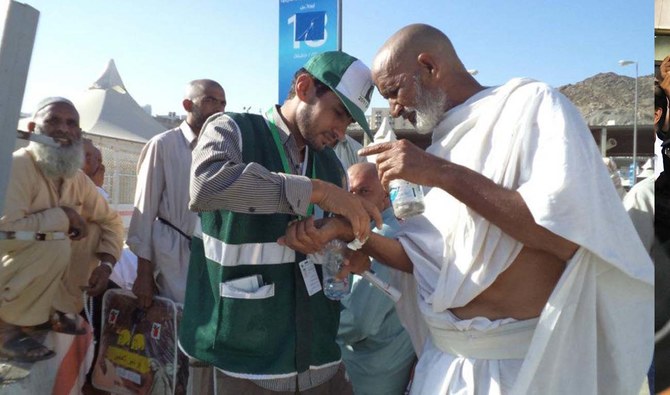
The photo posted on November 11, 2014, shows a Pakistani hajj volunteer helps an elderly man during Hajj.
Short Url
Updated 11 August 2024
Follow

‘Hajj Hero’: Meet Pakistani who saved lives of over dozen pilgrims, mostly Indians

  • Hajj assistant Asif Bashir rescued 17 pilgrims who fainted from heat, even carried a few on his shoulders to hospital 
  • Among the survivors were 15 Indians, prompting Indian minorities minister to write Bashir a letter of gratitude for “selfless service”

PESHAWAR: Thirty-two-year old Pakistani Asif Bashir was working as a Hajj assistant in Makkah on a June afternoon earlier this year when he saw a number of pilgrims faint and collapse to the ground. 

Without thinking twice, Bashir along with his five-member team rushed to provide first aid to the pilgrims, most of whom were Indians, and transported 26 to hospital.

Saudi Health Minister Fahd bin Abdurrahman Al-Jalajel has said 83 percent of the 1,301 people who died during Hajj this year were unauthorized pilgrims who walked long distances in soaring temperatures to perform the Hajj rituals. Saudi authorities cracked down on unauthorized pilgrims, expelling tens of thousands of people but many, mostly Egyptians, managed to reach holy sites in and around Makkah, some on foot, and unlike authorized pilgrims did not have hotels to return to to escape the scorching heat. After the deaths, Egypt revoked the licenses of 16 travel agencies that helped unauthorized pilgrims travel to Saudi Arabia.

Hajj assistants like Bashir were instrumental in saving lives amid extreme high temperatures at Islamic holy sites in the Kingdom this year. 

“It was an emotional moment when you save the life of anyone, it is the best feeling, it is also in the [Holy] Qur’an that ‘saving the life of one person is like saving the whole of humanity’,” Bashir told Arab News in an interview in his hometown of Peshawar. “I don’t have enough words to explain the feeling.”

Bashir, among 550 Pakistanis sent by the government to assist Hajj pilgrims, said it was “strange” to see people collapsing and falling to the ground, but he felt “blessed” to have gotten the opportunity to save them. 

“On that specific day, if I remember correctly, with my team, I transported more than 26 people to hospital. Unfortunately, nine of them died and 17 survived,” Bashir said.

Among the survivors were 15 Indians, one British and one Canadian national.

“We [don’t see] the race [or] nationality, but I was deployed near the Indian camps, Indian Maktabs. The pilgrims were from multiple nationalities, but mostly they were Indians, and they were unconscious. When I saw that they were unconscious, I decided with my team that I will help them.”

Bashir and others gave the ill pilgrims water and ORS [Oral Rehydration Solution] and transported those who needed medical attention to a nearby hospital that was almost 5-6 kilometers from my check-post. 

In recognition of Bashir’s efforts, Indian Minister for Parliamentary and Minority Affairs Kiren Rijju wrote him a letter of gratitude.

“Your dedication, compassion and unwavering commitment to serving the pilgrims have been truly commendable,” Rijju wrote. “I am particularly impressed by your remarkable act of kindness and bravery in providing first aid and transporting patients to the hospitals on your shoulder, when ambulances and medical staff were occupied.”

Bashir said he wishes for Pakistan and India to have cordial relations and work together for each other’s development.

The bitter enemies have fought multiple wars, mainly over the disputed Himalayan territory of Kashmir, since their independence from British rule in 1947. They often trade barbs and diplomatic ties have been frozen since August 2019 when New Delhi revoked the autonomy of part of Kashmir it controls.

“My sole purpose is to serve humanity,” Bashir said, “and I want to see this region, between Pakistan and India, prosperous.”


Pakistan expands pilgrim travel system for Iran, Iraq with licenses to 67 new operators

Updated 9 sec ago
Follow

Pakistan expands pilgrim travel system for Iran, Iraq with licenses to 67 new operators

  • New system requires all Iraq-Iran pilgrimages to be organized by licensed groups under state oversight
  • Long-running “Salar” model relied on informal caravan leaders, leading to overstays and missing pilgrims

ISLAMABAD: Pakistan has issued registration certificates to 67 additional licensed pilgrimage companies, expanding a tightly regulated travel system designed to curb overstays, undocumented migration and security risks linked to religious travel to Iran and Iraq, the ministry of religious affairs said on Tuesday.

The move is part of a broader overhaul of Pakistan’s pilgrim management framework after authorities confirmed that tens of thousands of Pakistani pilgrims had overstayed or gone missing abroad over the past decade, raising concerns with host governments and triggering diplomatic pressure on Islamabad to tighten oversight.

“The dream of safe travel for pilgrims to Iran and Iraq through better facilities and a transparent mechanism is set to be realized,” the religious affairs ministry said in a statement, quoting Federal Minister for Religious Affairs Sardar Muhammad Yousaf, who announced that 67 new Ziyarat Group Organizers had been registered.

Pakistan’s government has dismantled the decades-old “Salar” system, under which informal caravan leaders arranged pilgrimages with limited state oversight. The model was blamed for weak documentation, poor accountability and widespread overstays, particularly during peak pilgrimage seasons. 

Under the new framework, only licensed companies are allowed to organize pilgrimages, and they are held directly responsible for ensuring pilgrims return within approved timelines.

Authorities say pilgrimages to Iran and Iraq will be conducted exclusively under the new system from January 2026, marking a full transition to regulated travel. The religion ministry said it has now completed registration of 24 operators in the first phase and 67 more in the second, with remaining applicants urged to complete documentation to obtain licenses.

The religious affairs ministry said a digital management system is being developed with the National Information Technology Board to monitor pilgrim movements and operator compliance, while a licensed ferry operator has also secured approval to explore future sea travel options.

The overhaul has been accompanied by tighter coordination with host countries. Earlier this month, Pakistan and Iraq agreed to share verified pilgrim data and restrict entry to travelers cleared under the new system, following talks between interior ministers in Islamabad and Baghdad. Pakistan has also barred overland pilgrim travel for major religious events, citing security risks in its southwestern Balochistan province, meaning travel to Iran and Iraq is now limited to approved air routes.

Officials say the reforms are aimed at balancing facilitation with accountability, as tens of thousands of Pakistani pilgrims travel annually to key Shia shrines, including Karbala and Najaf in Iraq and Mashhad and Qom in Iran. Travel peaks during religious occasions such as Arbaeen, when millions of worshippers converge on Iraq, placing heavy logistical and security demands on regional authorities.

The government says the new system is intended to restore confidence among host countries while ensuring safer, more transparent travel for Pakistani pilgrims.