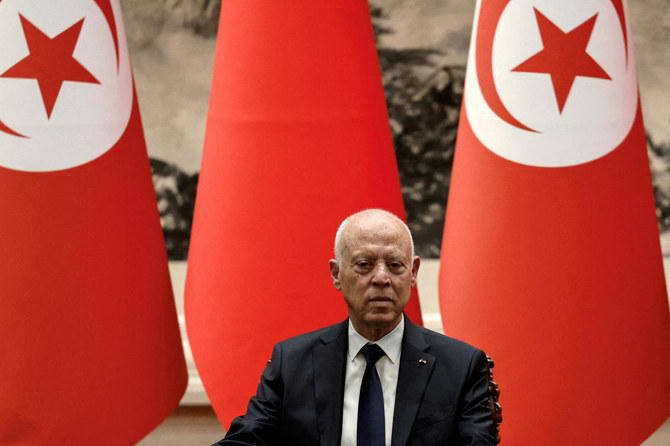
TUNIS: The Tunisian election board announced Saturday that three candidates including incumbent President Kais Saied had been cleared to run in upcoming elections.
Saied, 66, was democratically elected in 2019 but orchestrated a sweeping power grab in 2021 and is now seeking another term in office in elections to be held on October 6.
Farouk Bouasker, president of the High Independent Authority for Elections (ISIE), told a news conference that 14 other presidential hopefuls were barred from the race after "not collecting enough endorsements".
Apart from Saied, the two other candidates on the ballot are former lawmakers Zouhair Maghzaoui and Ayachi Zammel, who heads a little-known party.
Maghzaoui has come out in support of Saied's power grab.
Experts have said presidential hopefuls faced significant constraints in their bid to challenge Saied, who has faced accusations of an "authoritarian drift" and a "rollback" on freedoms from rights groups and critics.
To be listed on the ballot, candidates are required to present a list of signatures from 10,000 registered voters, with at least 500 voter signatures per constituency -- "an enormous number" according to political analyst Amine Kharrat -- or secure endorsements from lawmakers or local officials.
ISIE also required a clean criminal record.
Several would-be contenders complained of obstacles in obtaining their criminal records as well as the necessary endorsement forms.
Numerous potential candidates are behind bars, many of them over accusations of "conspiracy against the state".
As part of Saied's consolidation of power, Tunisia's constitution was rewritten in 2022 to create a presidential regime whose parliament has extremely limited powers.
More than 20 of Saied's opponents have been detained in a flurry of arrests that began in February 2023.
ayj-fka/ami/dcp


![]()

Tunisia president among three cleared to run in election
Short Url
https://arab.news/j7u7e
Tunisia president among three cleared to run in election
- Experts have said presidential hopefuls faced significant constraints in their bid to challenge Saied


Latest updates


© 2026 SAUDI RESEARCH & PUBLISHING COMPANY, All Rights Reserved And subject to Terms of Use Agreement.