NICOSIA: The United Nations refugee agency on Friday accused government authorities in ethnically divided Cyprus of rounding up dozens of migrants and forcing them back inside a UN-controlled buffer zone that they crossed to seek asylum.
UNHCR spokeswoman Emilia Strovolidou said that as many as 99 asylum seekers were “pushed back” into the buffer zone between mid-May and Aug. 8.
The asylum seekers entered the European Union member country from the breakaway Turkish Cypriot north and crossed the buffer zone into the south where they could file their applications with the internationally recognized government.
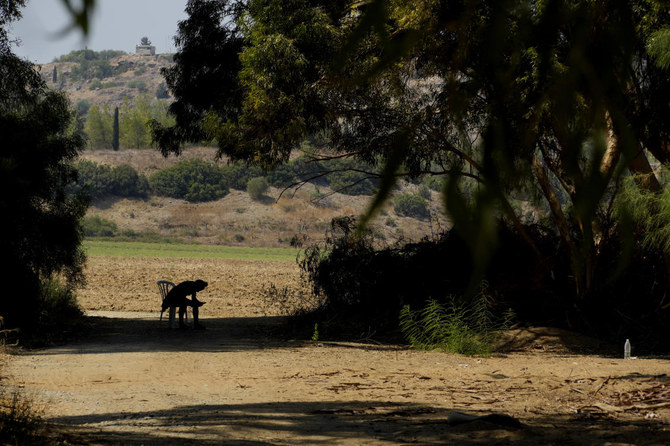
Of those 99 migrants, 76 people from countries including Syria, Iran, Afghanistan, Nigeria, Somalia, Bangladesh, Sudan, Iraq and Gaza remain stranded in two locations inside the buffer zone, to the west and east of the capital Nicosia. They include 18 minors, six of whom are unaccompanied.
Strovolidou said although the UN has supplied the asylum seekers with military food rations, tents, blankets, toilets and washing facilities, they remain exposed to extreme heat, dust and humidity.
“Their humanitarian needs are increasing, and their physical and psychological condition is deteriorating as they continue to remain in these conditions, some for nearly three months,” Strovolidou told The Associated Press.
She said some are survivors of gender-based violence and trafficking and people suffering from serious illnesses such as cancer, asthma and serious mental health issues.
Cyprus was split in 1974 when Turkiye invaded after supporters of a union with Greece mounted a coup with the backing of the junta then ruling Greece. Cyprus joined the EU in 2004, but only the south enjoys full membership benefits.
Aleem Siddique, spokesman for the UN peacekeeping force in Cyprus, urged an immediate end to the “pushbacks” and for Cypriot authorities to live up to their obligations under international and EU law.
“In nearly all instances, the asylum seekers found their way into government-controlled areas from where they were intercepted by the Cyprus Police and forcibly dumped into the buffer zone after having their passports and mobile phones confiscated,” Siddique told AP.
He said the UN has shared video evidence of the “pushback operations” with Cypriot authorities.
“The buffer zone in not a refugee camp,” Siddique said.
The Cyprus government has taken a tough line with migrant crossings along the 180-kilometer (120 mile) length of the buffer zone, insisting that it would not permit it to become a gateway for illegal migration.
Deputy Minister for Migration Nicholas Ioannides said earlier this week that the government doesn’t want to be at odds with the UN and is in talks with the UNHCR to resolve the issue.
What complicates the issue are the peculiarities of the buffer zone itself, which isn’t a formal border and as such. Cypriot authorities say the UN is mistaken when it speaks about pushbacks that specifically pertain to “expulsions at recognized sea or land borders.”
In a written statement to AP, the ministry said migrants who cross the buffer zone arrive on the island’s north from Turkiye — a safe country — and then cross southward along remote stretches of the porous buffer zone where there are no physical barriers preventing crossings.
According to an established legal framework, Cypriot police and other authorities are lawfully empowered to conduct “effective surveillance” of the buffer zone in order to combat illegal migration by “discouraging people from circumventing checks” at all eight lawful crossing points.
The ministry said given the “tremendous migratory pressures” Cyprus is under, the government has adopted a “principled stance” to avoid turning the buffer zone into a “route for irregular migration” while offering humanitarian assistance to stranded migrants.
Human rights lawyer Nicoletta Charalambidou is contesting the Cypriot government’s claim that it’s acting in line with international and EU law.
She has launched legal action on behalf of 46 stranded migrants to get Cypriot authorities to allow them to submit asylum applications.
“The government has an obligation to allow these people to file asylum claims,” she told AP. She added that asylum applications should be assessed individually to determine if conditions of safety exist in Turkiye for each applicant.


![]()

UN refugee agency accuses Cyprus government of pushing asylum seekers into a UN buffer zone
Short Url
https://arab.news/nj8dq
UN refugee agency accuses Cyprus government of pushing asylum seekers into a UN buffer zone
- UNHCR spokeswoman Emilia Strovolidou said that as many as 99 asylum seekers were “pushed back” into the buffer zone between mid-May and Aug. 8
- Of those 99 migrants, 76 people from countries including Syria, Iran, Afghanistan, Nigeria, Somalia, Bangladesh, Sudan, Iraq and Gaza remain stranded in two locations


Latest updates





© 2026 SAUDI RESEARCH & PUBLISHING COMPANY, All Rights Reserved And subject to Terms of Use Agreement.