

Cruise ship rescues 77 migrants in boat found southwest of Greece

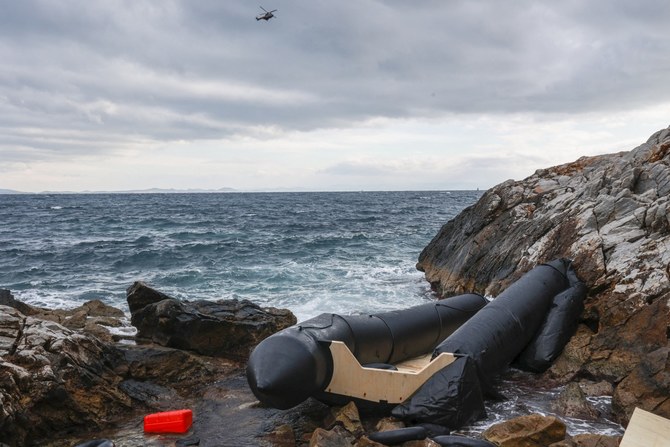
A rescue helicopter flies over the sea close to where a rubber boat, believed to be used by migrants, lies destroyed on the rocky shoreline, in Thermi on the Greek island of Lesbos on February 7, 2023. (AFP)
Short Url
Updated 07 August 2024
Follow

Cruise ship rescues 77 migrants in boat found southwest of Greece

ATHENS: A cruise ship rescued 77 migrants found overnight in a sailboat in distress far off the southwestern coast of Greece and was transporting them to the nearest major port, Greek authorities said Tuesday.

A passing Maltese-flagged cargo ship found the boat 112 nautical miles (129 miles, 207 kilometers) southwest of the town of Pylos in the early hours of Tuesday, the coast guard said. In an operation coordinated by Greece’s search and rescue authority, all those on board were picked up by a cruise ship sailing in the area and were being transported to the southern Greek port town of Kalamata, authorities said.

There were no reports of any people missing. No information was immediately available on the nationalities of those on the sailboat or where they had set out from.

Greece lies on one of the most popular migration routes for people fleeing conflict and poverty in the Middle East, Africa and Asia, and seeking to enter the European Union.

Many attempt to make the short crossing from the Turkish coast to nearby eastern Greek islands in small dinghies. But with a crackdown on attempts to enter the country illegally, some prefer to skirt around Greece altogether and head directly to Italy in larger boats such as sailing or fishing boats, starting out either from southern Turkiye or from north Africa.

Last year, a massively overcrowded fishing trawler carrying an estimated 500-750 people sank off the coast of Pylos as it headed from Libya to Italy, in one of the Mediterranean’s deadliest migrant shipwrecks. Only 104 people survived the sinking of the Adriana, and just over 80 bodies were recovered. 


Blacklisted naphtha tanker from Russia enters Venezuelan waters while another diverts, ship data shows

Updated 56 min 28 sec ago
Follow

Blacklisted naphtha tanker from Russia enters Venezuelan waters while another diverts, ship data shows

  • Under U.S. sanctions related to Russia, the ship has a different sanctions profile than Skipper, the tanker that was seized by the U.S. on December 10

HOUSTON: A tanker subject to U.S. sanctions carrying some 300,000 barrels of naphtha from Russia entered Venezuelan waters late ​on Thursday, while another began redirecting course in the Atlantic Ocean, ship tracking data showed, a reflection of diverging last-minute decisions by ship owners after President Donald Trump ordered a "blockade" of oil tankers under sanctions bound for the OPEC country earlier this week.
The move ramped up pressure on Venezuelan president Nicolas Maduro by targeting the country's main source of income and followed the seizure by the U.S. of an oil tanker off the coast of Venezuela earlier in December.
Vessels that were not subject to sanctions began setting sail on Wednesday from Venezuelan waters after a week's pause, helping drain the country's mounting crude stocks.

HIGHLIGHTS

• Trump's 'blockade' aims to halt sanctioned oil tankers to Venezuela

• Hyperion's sanctions profile differs from seized Skipper tanker

• Venezuela condemns US actions as violating international law

Gambia-flagged medium tanker Hyperion docked on Friday at Amuay ‌Bay on Venezuela's ‌western coast, according to LSEG ship tracking data. It loaded near ‌Murmansk ⁠in ​Russia in ‌late November.
Under U.S. sanctions related to Russia, the ship has a different sanctions profile than Skipper, the tanker that was seized by the U.S. on December 10.
The U.S. can only seize vessels outside of its jurisdiction, or vessels that aren't heading to or from the country, if Washington has placed them under sanctions for links to groups it designates as terrorist, said David Tannenbaum, a director at consulting firm Blackstone Compliance Services that specializes in sanctions and anti-money laundering compliance.
Skipper, formerly called the Adisa, was under sanctions for what the U.S. says was involvement in Iranian oil trading that generated ⁠revenue for Iranian groups it has designated as foreign terrorist organizations.
With the Hyperion, though, sanctions were imposed to reduce Russian revenues from energy because of ‌its war with Ukraine.
"The Hyperion doesn't have known ties to ‍terrorism, and therefore unless they can prove it's subject ‍to the jurisdiction of the U.S., Washington can't grab it extraterritorially," said Tannenbaum, who previously worked with the ‍U.S. Treasury's Office of Foreign Assets Control that administers and enforces economic and trade sanctions.

REDIRECTS AND U-TURNS
The Angola-flagged Agate, another medium tanker under sanctions that loaded in Russia and had been sailing toward the Caribbean, was seen redirecting on Friday, according to LSEG ship tracking. The vessel was pointing towards Africa, but had not yet signaled a new destination.
Oman-flagged Garnet, also under sanctions ​and loaded in Russia, continued on its track, signaling the Caribbean as its destination on Friday.
Benin-flagged tanker Boltaris, under sanctions and carrying some 300,000 barrels of Russian naphtha bound for Venezuela, made ⁠a U-turn earlier this month and was heading for Europe without having discharged, according to LSEG vessel monitoring data.
Two very large crude carriers not subject to sanctions set sail for China on Thursday from Venezuela, according to sources familiar with Venezuela's oil export operations, marking only the second and third tankers unrelated to Chevron to depart the country since the U.S. seized Skipper.
The American oil major, which has continued to ship Venezuelan crude under a U.S. authorization, exported a crude cargo on Thursday bound for the U.S., LSEG data showed.
Secretary of State Marco Rubio on Friday said the U.S. was not concerned about the four vessels that sailed from Venezuela on Thursday, as those were not ships under sanctions.
"Sanctioned boats, we have the capabilities necessary to enforce our laws. We'll have a judicial order, we'll execute on those orders and there's nothing that will impede us from being able to do that," Rubio said.
Venezuela's government ‌called Trump's blockade a "grotesque threat" in a statement on Tuesday, saying it violates international law, free commerce and the right of free navigation.