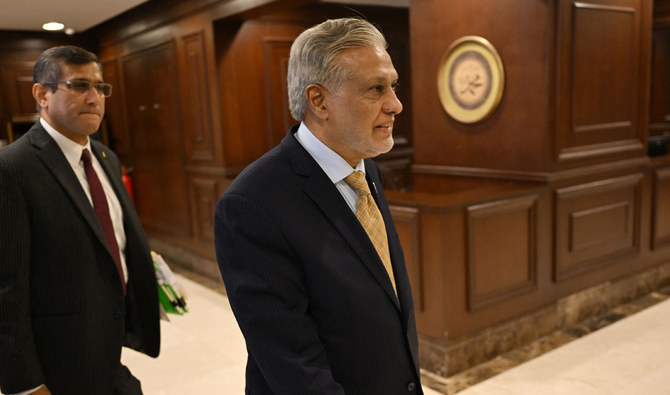
ISLAMABAD: Pakistan’s deputy prime minister and foreign minister, Ishaq Dar, on Friday called for the country’s diplomats to divert from conventional foreign policy to economic diplomacy, amid a push for growth and financial stability in the South Asian country.
Pakistan avoided a sovereign default last year, thanks to a last-gasp $3 billion International Monetary Fund (IMF) program that was completed in April this year, and has since recovered slightly from an acute balance-of-payments crisis. The South Asian country last month reached a staff-level agreement with the global lender for a new 37-month, $7 billion loan program.
The loan deal aims to strengthen fiscal and monetary policy as well as reforms to broaden the tax base, improve the management of state-owned enterprises, strengthen competition, secure a level playing field for investment, enhance human capital, and scale up social protection through increased generosity and coverage in a major welfare program, the IMF said.
Addressing foreign policy graduates at a ceremony in Islamabad, Dar said they needed to reorient their diplomatic initiatives to ensure that Pakistan’s development agenda also advanced along with its foreign policy.
“Conventional diplomacy times are over. The basic purpose of foreign policy is not only to safeguard national interests but also to help stimulating economic growth by transforming geo-strategic position into economic position,” he said. “I think we have failed to streamline and benefit from our location.”
Pakistan wants to position itself as a regional trade hub and to leverage its strategic geopolitical position and enhance its role as a pivotal trade and transit hub connecting China and Central Asia with the rest of the world.
In recent months, there has been a flurry of visits, investment talks, and economic activity between Pakistan, China and Central Asian states, including Uzbekistan, Azerbaijan, Tajikistan and Turkmenistan.
“The world we are living in is undergoing a profound transformation. The world order is moving toward multi polarity,” Dar said. “In addition to the old and security threats, new and non-traditional security challenges have made global security more vulnerable.”
He said conventional warfare had been replaced with “battle of narratives and disinformation” with the popularity of social media.
“These challenges are directly impacting Pakistan’s global relations and foreign policy,” he said. “Our foreign policy must respond to these challenges to ensure that Pakistan’s sovereignty, territorial integrity and independence are fully secured.”


![]()

Pakistani deputy PM calls for pivot to ‘economic diplomacy’ amid push for growth, stability
Short Url
https://arab.news/jkjb9
Pakistani deputy PM calls for pivot to ‘economic diplomacy’ amid push for growth, stability
- Pakistan narrowly avoided a sovereign default last year, thanks to a last-gasp, $3 billion IMF program that was completed in April this year
- The country has since recovered slightly and has reached a new $7 billion loan deal with the lender to help achieve further economic stability
Latest updates



© 2026 SAUDI RESEARCH & PUBLISHING COMPANY, All Rights Reserved And subject to Terms of Use Agreement.