Pakistan’s counterterrorism force arrests militant leader for attacks on Rangers, Chinese workers

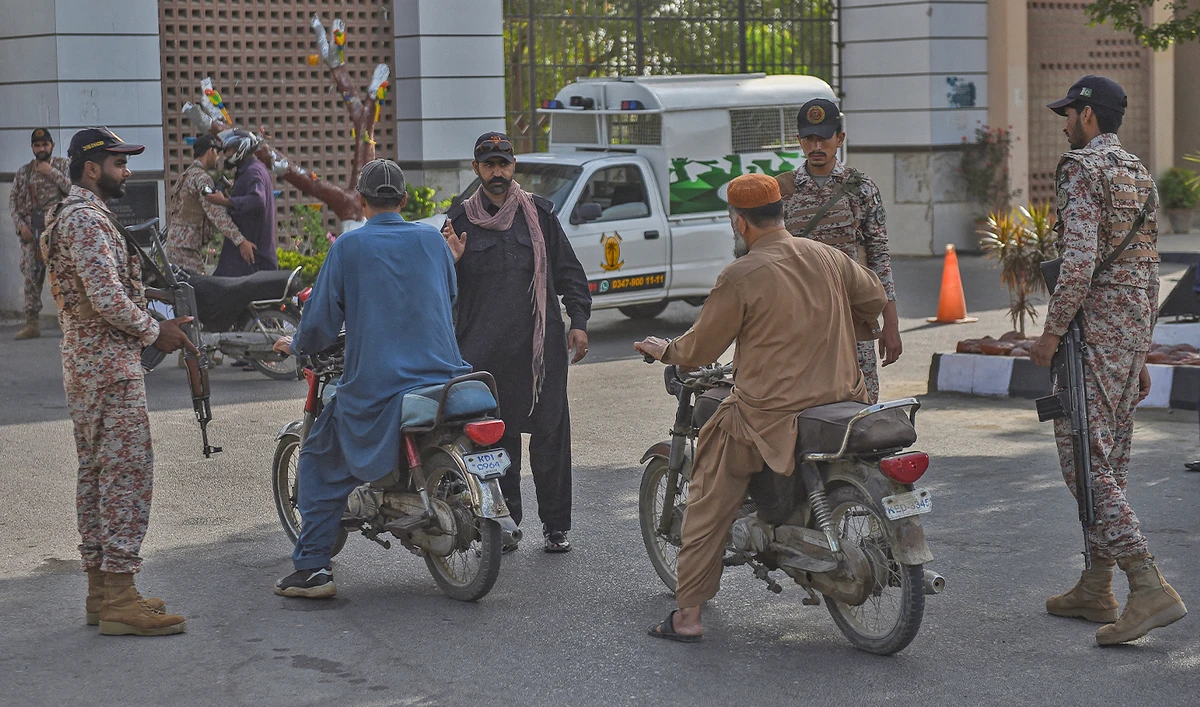
Rangers check motorcyclists at a security checkpoint set up near a university gate a day after a suicide attack on a van near the Confucius institute which is the cultural programme that China operates at universities around the world at the Karachi University in Karachi on April 27, 2022. (AFP/File)
Short Url
Updated 08 August 2024
Follow

Pakistan’s counterterrorism force arrests militant leader for attacks on Rangers, Chinese workers

  • Muhammad Hanif of banned Sindh Revolutionary Army was caught with significant quantity of explosives
  • CTD says he took militant training in Kandahar where he traveled twice and learned to use different weapons

KARACHI: The Counter-Terrorism Department (CTD) in Pakistan’s southeastern province of Sindh announced the arrest of a local militant leader on Thursday, saying he was involved in violent activities targeting paramilitary personnel, Chinese workers and a prominent religio-political party in the country.

Muhammad Hanif, a member of the banned separatist outfit Sindh Revolutionary Army (SRA), was arrested in Shaheed Benazirabad district, previously known as Nawabshah, along with a significant quantity of explosives and detonators, according to an official statement.

The SRA is known for its violent activities aimed at promoting Sindhi independence, including attacks on law enforcement and government targets.

The group has also launched attacks against Chinese nationals working on China-Pakistan Economic Corridor (CPEC) projects, reflecting its opposition to foreign investment in the region.

“The suspect was found in possession of 460 grams of explosive material, one hand grenade, and seven detonators along with a battery and adapter,” the CTD said in its statement.

“The suspect was on the railway track, planning to carry out an explosion on a train traveling from Sindh to Punjab to spread terror,” it continued. “He was apprehended during an intelligence-based operation, thanks to timely and effective information received from sensitive agencies, before he could carry out any potential terrorist act.”

The CTD also shared a list of militant activities allegedly confessed by Hanif during the investigation following his arrest, including two separate attacks in 2019 on Rangers in Sindh, in which six paramilitary personnel were killed.

The statement said he admitted to attempting to detonate a vehicle used by Chinese workers using a magnetic explosive device in 2020, though his plan could not succeed.

The same year, he opened fire on Chinese nationals in Karachi, injuring one of them.

The CTD said the SRA suspect targeted a 2020 Jamaat-e-Islami rally, resulting in six deaths and 20 injuries.

The official statement informed Hanif admitted to receiving militant training in Kandahar, Afghanistan, where he traveled twice and learned to use various weapons and make improvised explosive devices.

It added that charges had been framed against him under the Anti-Terrorism Act of 1997.

EU, Pakistan sign €60 million loan agreement for clean drinking water in Karachi

Updated 17 December 2025
Follow

EU, Pakistan sign €60 million loan agreement for clean drinking water in Karachi

  • Project will finance rehabilitation, construction of water treatment facilities in Karachi city, says European Investment Bank
  • As per a report in 2023, 90 percent of water samples collected from various places in city was deemed unfit for drinking

ISLAMABAD: The European Investment Bank (EIB) and Pakistan’s government on Wednesday signed a €60 million loan agreement, the first between the two sides in a decade, to support the delivery of clean drinking water in Karachi, the EU said in a statement. 

The Karachi Water Infrastructure Framework, approved in August this year by the EIB, will finance the rehabilitation and construction of water treatment facilities in Pakistan’s most populous city of Karachi to increase safe water supply and improve water security. 

The agreement was signed between the two sides at the sidelines of the 15th Pak-EU Joint Commission in Brussels, state broadcaster Radio Pakistan reported. 

“Today, the @EIB signed its first loan agreement with Pakistan in a decade: a €60 million loan supporting the delivery of clean drinking water for #Karachi,” the EU said on social media platform X. 

Radio Pakistan said the agreement reflects Pakistan’s commitment to modernize essential urban services and promote climate-resilient infrastructure.

“The declaration demonstrates the continued momentum in Pakistan-EU cooperation and highlights shared priorities in sustainable development, public service delivery, and climate and environmental resilience,” it said. 

Karachi has a chronic clean drinking water problem. As per a Karachi Water and Sewerage Corporation (KWSC) study conducted in 2023, 90 percent of water from samples collected from various places in the city was deemed unsafe for drinking purposes, contaminated with E. coli, coliform bacteria, and other harmful pathogens. 

The problem has forced most residents of the city to get their water through drilled motor-operated wells (known as ‘bores’), even as groundwater in the coastal city tends to be salty and unfit for human consumption.

Other options for residents include either buying unfiltered water from private water tanker operators, who fill up at a network of legal and illegal water hydrants across the city, or buying it from reverse osmosis plants that they visit to fill up bottles or have delivered to their homes.

The EU provides Pakistan about €100 million annually in grants for development and cooperation. This includes efforts to achieve green inclusive growth, increase education and employment skills, promote good governance, human rights, rule of law and ensure sustainable management of natural resources.