Egypt posts 6.1% primary budget surplus for 2023/24

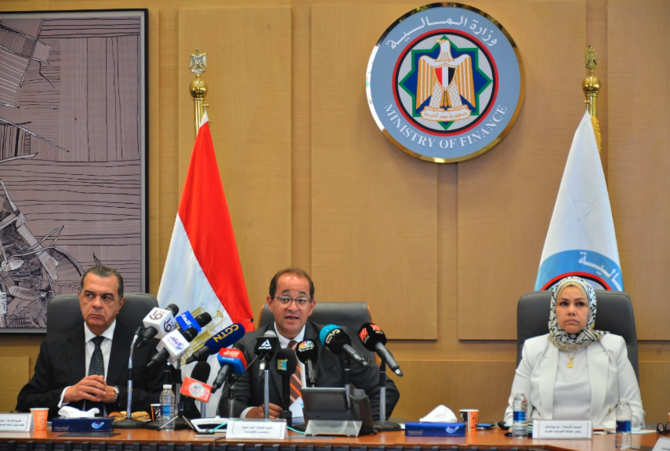
Egypt’s Finance Minister Ahmed Kouchouk speaking at a press conference. Facebook/Egypt Cabinet
Short Url
Updated 07 August 2024
Follow

Egypt posts 6.1% primary budget surplus for 2023/24

  • Egypt’s total expenditure amounted to $61.3 billion, with a budget deficit of 3.6%

RIYADH: Egypt achieved a primary budget surplus of 6.1 percent in the fiscal year 2023/24, bolstered by a landmark sale of coastal land to the UAE, said the country’s finance minister. 

At a press conference, Ahmed Kouchouk disclosed that Egypt’s total expenditure amounted to 3.016 trillion Egyptian pounds ($61.3 billion), with a budget deficit of 3.6 percent. 

In February, the UAE, through a consortium led by Abu Dhabi’s sovereign wealth fund ADQ, signed an agreement to invest $35 billion in Ras El-Hekma, a Mediterranean region 350 km northwest of Cairo. This deal represents the largest foreign direct investment in Egypt’s history. 

The minister highlighted that no new taxes were imposed last year, and tax revenues increased by 30 percent year on year for the financial year 2023/24. 

This aligns with the International Monetary Fund’s objective for Egypt to boost tax revenue in its 2025/26 budget. 

“The priority is to improve services for citizens as much as we can and we work with all our efforts so that what is coming will be better,” Kouchouk said. 

“The Egyptian people are the real owners of the budget, and we will also work hard to maximize resources to create sufficient financial space for spending on human development areas and everything that matters to citizens,” he added. 

He further explained that despite improvements in budget numbers, they would be ineffective unless they translate into better economic performance, enhanced business competitiveness, and an improved standard of living. 

“The challenges are difficult for the people, the economy, and the government, and the state is trying to bear the greatest burden,” the minister said. 

Kouchouk also noted a 25 percent increase in spending on education, 24 percent on health, and 20 percent on social protection. Allocations for support and social protection have more than doubled since 2020/21 to reach 550 billion pounds, he said. 

“We will rearrange our priorities again so that public spending is more socially conscious in order to contain the impact of economic reforms,” the minister added. 

Kouchouk acknowledged a decline in public investments but said: “We are working hard to increase the volume of private investments with a focus on investments directed to industry and export and we still need more work to increase the private sector’s contributions to economic activity.” 

In April, then-Finance Minister Mohamed Maait noted that Egypt’s economic reforms, aimed at empowering the private sector and attracting investment, had begun to yield positive results despite global and regional economic challenges. 

Financial indicators had surpassed budget estimates and targets over the previous nine months of the fiscal year 2023/2024.

The Yazidi nightmare
Ten years after the genocide, their torment continues

Enter


keywords

Kuwait to boost Islamic finance with sukuk regulation

Updated 05 February 2026
Follow

Kuwait to boost Islamic finance with sukuk regulation

  • The move supports sustainable financing and is part of Kuwait’s efforts to diversify its oil-dependent economy

RIYADH: Kuwait is planning to introduce legislation to regulate the issuance of sukuk, or Islamic bonds, both domestically and internationally, as part of efforts to support more sustainable financing for the oil-rich Gulf nation, Prime Minister Sheikh Ahmad Abdullah Al-Ahmad Al-Sabah said on Wednesday.

Speaking at the World Governments Summit in Dubai, Al-Sabah highlighted that Kuwait is exploring a variety of debt instruments to diversify its economy. The country has been implementing fiscal reforms aimed at stimulating growth and controlling its budget deficit amid persistently low oil prices. Hydrocarbons continue to dominate Kuwait’s revenue stream, accounting for nearly 90 percent of government income in 2024.

The Gulf Cooperation Council’s debt capital market is projected to exceed $1.25 trillion by 2026, driven by project funding and government initiatives, representing a 13.6 percent expansion, according to Fitch Ratings.

The region is expected to remain one of the largest sources of US dollar-denominated debt and sukuk issuance among emerging markets. Fitch also noted that cross-sector economic diversification, refinancing needs, and deficit funding are key factors behind this growth.

“We are about to approve the first legislation regulating issuance of government sukuk locally and internationally, in accordance with Islamic laws,” Al-Sabah said.

“This enables us to deal with financial challenges flexibly and responsibly, and to plan for medium and long-term finances.”

Kuwait returned to global debt markets last year with strong results, raising $11.25 billion through a three-part bond sale — the country’s first US dollar issuance since 2017 — drawing substantial investor demand. In March, a new public debt law raised the borrowing ceiling to 30 billion dinars ($98 billion) from 10 billion dinars, enabling longer-term borrowing.

The Gulf’s debt capital markets, which totaled $1.1 trillion at the end of the third quarter of 2025, have evolved from primarily sovereign funding tools into increasingly sophisticated instruments serving governments, banks, and corporates alike. As diversification efforts accelerate and refinancing cycles intensify, regional issuers have become regular participants in global debt markets, reinforcing the GCC’s role in emerging-market capital flows.

In 2025, GCC countries accounted for 35 percent of all emerging-market US dollar debt issuance, excluding China, with growth in US dollar sukuk issuance notably outpacing conventional bonds. The region’s total outstanding debt capital markets grew more than 14 percent year on year, reaching $1.1 trillion.