

Bangladesh awaits interim government, may include Nobel laureate Yunus

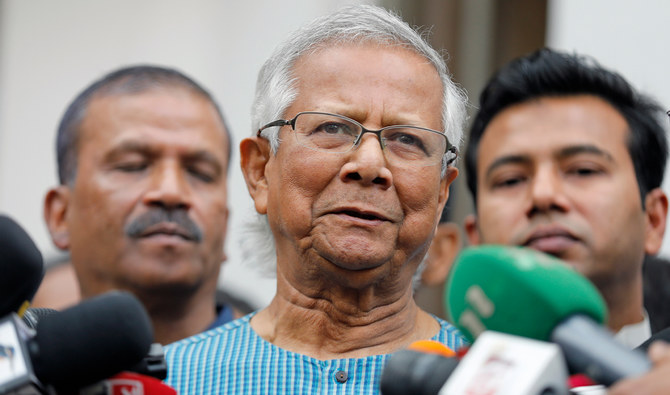
Nobel laureate Muhammad Yunus speaks to the media after he was granted bail by a court in an embezzlement case, in Dhaka, Bangladesh, on March 3, 2024. (AP)
Short Url
Updated 06 August 2024
Follow

Bangladesh awaits interim government, may include Nobel laureate Yunus

  • Bangladesh Prime Minister Sheikh Hasina resigned and fled country on Monday following violent uprising against her
  • Yunus, 84, and his Grameen Bank won 2006 Nobel Peace prize for work to lift millions out of poverty in rural Bangladesh 

DHAKA: Bangladesh’s army chief will meet student protest leaders on Tuesday as the country awaits the formation of a new government a day after Prime Minister Sheikh Hasina resigned and fled following a violent uprising against her.

Traffic was lighter than usual in Dhaka and schools reopened with thin attendance after closing down in mid-July as the anti-quota protests spiralled. About 300 people were killed and thousands injured in violence that ripped through the country.

Garment factories, which supply apparel to some of world’s top brands and are a mainstay of the economy, will remain closed on Tuesday and plans to reopen will be announced later, the main garment manufacturers association said.

Student leaders, who spearheaded a movement against job quotas that turned into a call for Hasina to resign, said early on Tuesday that they want a new interim government with Nobel Peace laureate Muhammad Yunus as its chief adviser.

“Any government other than the one we recommended would not be accepted,” Nahid Islam, one of the key organizers of the student movement, said in a video on Facebook with three other organizers. “We wouldn’t accept any army-supported or army-led government.”

“We have also had discussions with Muhammad Yunus and he has agreed to take on this responsibility at our invitation,” Islam added.

Yunus, 84, and his Grameen Bank won the 2006 Nobel Peace prize for work to lift millions out of poverty by granting tiny loans of under $100 to the rural poor of Bangladesh but he was indicted by a court in June on charges of embezzlement that he denied.

Reports said Yunus is currently in Paris and he did not immediately respond to a request for comment from Reuters. He told Indian broadcaster Times Now in a recorded interview that Monday marked the “second liberation day” for Bangladesh after its 1971 war of independence from Pakistan.

But he said Bangladeshis were angry with neighbor India for allowing Hasina to land there after fleeing Dhaka.

“India is our best friend...people are angry at India because you are supporting the person who destroyed our lives,” Yunus said.

Hasina landed at a military airfield at Hindon near Delhi on Monday after leaving Dhaka, two Indian government officials told Reuters, adding that India’s National Security Adviser Ajit Doval met her there. They did not elaborate on her stay or plans.

India’s foreign minister was due to address an all-party meeting on Tuesday morning about the crisis in Bangladesh, Indian news agency ANI reported.

FRESH ELECTIONS PLANNED

Army chief General Waker-Uz-Zaman plans to meet the protest organizers at 12 noon local time (0600 GMT) on Tuesday, the army said in a statement, a day after Zaman announced Hasina’s resignation in a televised address and said an interim government would be formed.

Jubilant crowds stormed unopposed into the opulent grounds of Hasina’s residence after she fled, carrying out looted furniture and TVs. One man balanced a red velvet, gilt-edged chair on his head. Another held an armful of vases.

Zaman said he had held talks with leaders of major political parties — excluding Hasina’s long-ruling Awami League — to discuss the way ahead and was due to hold talks with the president, Mohammed Shahabuddin.

An interim government will hold elections as soon as possible after consulting all parties and stakeholders, President Shahabuddin said in a televised address late on Monday.

He also said that it was “unanimously decided” to immediately release the opposition Bangladesh Nationalist Party (BNP) chairperson and Hasina’s nemesis, Begum Khaleda Zia, who was convicted in a graft case in 2018 but moved to a hospital a year later as her health deteriorated. She has denied the charges against her.

A BNP spokesperson said on Monday that Zia, 78, was in hospital and “will clear all charges legally and come out soon.”

Hasina, 76, had ruled since winning a decades-long power struggle with Zia in 2009.

The Indian Express newspaper reported that Hasina was taken to a “safe house” after her arrival at Hindon and she was likely to travel to the United Kingdom. Reuters could not immediately verify the report.


Australian state parliament reconvenes to push through stricter gun laws after Bondi mass shooting

Updated 7 sec ago
Follow

Australian state parliament reconvenes to push through stricter gun laws after Bondi mass shooting

  • The state parliament was recalled for two days from Monday to debate the firearm legislation, which would cap the number of firearms a person can own at four

SYDNEY: Australia’s New South Wales state parliament was recalled on Monday to vote on proposed new laws that would ​impose major curbs on firearm ownership, ban the display of terror symbols and restrict protests, following a mass shooting at Bondi Beach.
The state parliament was recalled for two days from Monday to debate the firearm legislation, which would cap the number of firearms a person can own at four, or up to 10 for certain groups, such as farmers.
There is currently no limit to firearm ownership if the reason can be justified to police, and there are more than 50 people in the state who own more than 100 guns, the Australian Broadcasting Corp. ‌said in a ‌report, citing police data.
One of the alleged Bondi gunmen, ‌Sajid ⁠Akram, ​50, was ‌shot dead by police and owned six firearms. His 24-year-old son Naveed Akram has been charged with 59 offenses, including murder and terrorism, according to police.
Fifteen people were killed and dozens injured in the mass shooting at a Jewish Hanukkah celebration at Sydney’s Bondi Beach on December 14. The attack has shocked the nation and sparked calls for tougher gun laws and heightened efforts to stop antisemitism.
The proposed legislation would also give police more powers to remove face coverings during protests or rallies. The state government has ⁠vowed to ban the chant “globalize the intifada” which it says encourages violence in the community.
Jewish leaders on Sunday called for ‌a royal commission, the most powerful type of Australian government ‍inquiry, to be set up to investigate the ‍attack at Bondi.
The opposition Liberal Party leader Sussan Ley backed those calls on Monday, and ‍told a news conference that she has called on Prime Minister Anthony Albanese to meet with her to review the terms of reference for a royal commission.

ALBANESE APPROVAL DIPS
Albanese has faced mounting criticism from opponents who argue his government has not done enough to curb a rise in antisemitism. He was booed by ​sections of the crowd during a memorial event in Bondi attended by tens of thousands of people on Sunday, one week after the shooting.
Albanese’s government has ⁠said it has consistently denounced antisemitism and highlighted legislation passed over the last two years to criminalize hate speech and doxxing. It also expelled Iran’s ambassador earlier this year after accusing Tehran of directing antisemitic attacks in Sydney and Melbourne.
“You’ve seen us crack down on hate speech. You’ve seen us criminalize doxxing. You’ve seen us be very clear about counterterrorism laws banning Nazi salutes and so forth,” Foreign Minister Penny Wong told ABC Radio on Monday.
A poll conducted for the Sydney Morning Herald newspaper among 1,010 voters released on Monday found Albanese’s approval rating slumped 15 points to -9 from +6 at the beginning of December, the lowest since his resounding election win in May.
Authorities on Monday started clearing flowers, candles, letters and other items placed by the public at Bondi Beach.
The tributes would be preserved ‌for display at the Sydney Jewish Museum and the Australian Jewish Historical Society, authorities said.
Thirteen people remain in hospital, including four in critical but stable condition, health officials said.