

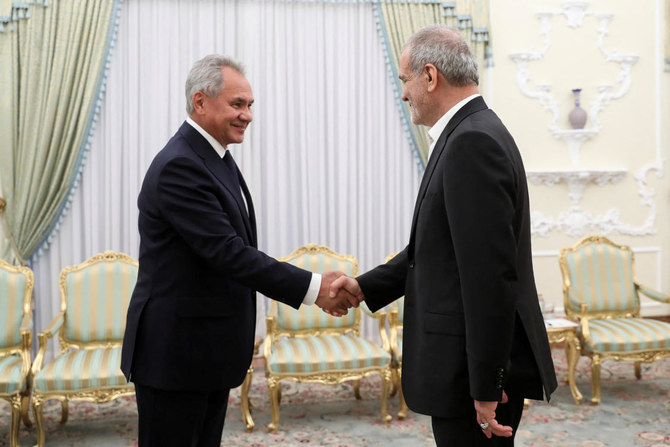

MOSCOW: Iran’s President Masoud Pezeshkian told a senior ally of Kremlin leader Vladimir Putin on Monday that Tehran was determined to expand relations with its “strategic partner Russia,” Iranian state media reported.
Sergei Shoigu, the secretary of Russia’s security council, met Iran’s president and top security officials as the Islamic Republic weighs its response to the killing of a Hamas leader.
“Russia is among the countries that have stood by the Iranian nation during difficult times,” Pezeshkian told Shoigu in a meeting, Iranian state media reported.
The president said that shared positions between Iran and Russia “in promoting a multipolar world will certainly lead to greater global security and peace.”
Russia has condemned the killing of Ismail Haniyeh, leader of the Palestinian Islamist group Hamas, in Iran last week and called on all parties to refrain from steps that could tip the Middle East into a wider regional war.
In further comments reported during the meeting with Shoigu, Pezeshkian said Israel’s “criminal actions” in Gaza and the assassination of Haniyeh “are clear examples of the violation of all international laws and regulations.”
Shoigu was Russia’s defense minister before being moved to the security council in May. He was shown earlier by Russia’s Zvezda television meeting Rear Admiral Ali Akbar Ahmadian, a senior Islamic Revolutionary Guard Corps commander who serves as secretary of the Supreme National Security Council.
Though Putin has yet to comment in public on the recent escalation of tensions in the Middle East, senior Russian officials have said that those behind the killing of Haniyeh were seeking to scuttle any hope of peace in the Middle East and to draw the United States into military action.
Iran has blamed Israel and said it will “punish” it; Israeli officials have not claimed responsibility. Iran backs Hamas, which is at war with Israel in Gaza, and also the Lebanese group Hezbollah, whose senior military commander Fuad Shukr was killed in an Israeli strike on Beirut last week.
MOSCOW’S CLOSER TIES WITH TEHRAN
Russia has cultivated closer ties with Iran since the start of its war with Ukraine and has said it is preparing to sign a wide-ranging cooperation agreement with the Islamic republic.
Reuters reported in February that Iran had provided Russia with a large number of powerful surface-to-surface ballistic missiles.
In Washington, State Department spokesperson Matthew Miller referred to Shoigu’s talks in Tehran, saying the US had no expectation that Russia would play a productive role in easing Middle East tensions.
Miller said Washington had been sending messages through its diplomatic engagements encouraging countries to tell Iran that escalation in the Middle East is not in Tehran’s interest.
The US said in June that Russia appeared to be deepening its defense cooperation with Iran and had received hundreds of one-way attack drones that it was using to strike Ukraine, something Moscow denies.


