BEIRUT: Urgent calls for foreign nationals to leave Lebanon grew on Sunday with France warning of “a highly volatile” situation as Iran and its allies ready their response to high-profile killings blamed on Israel.
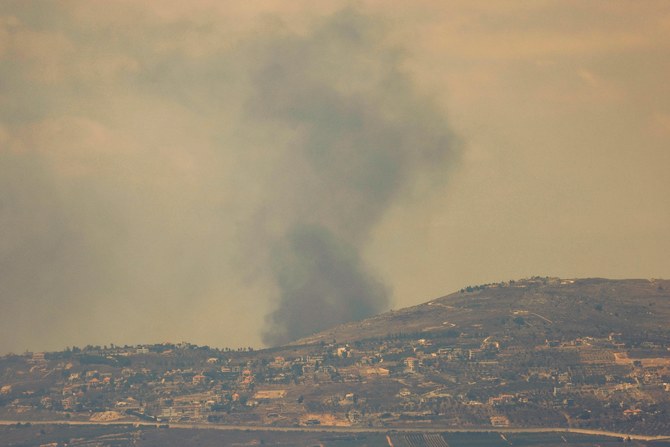
Lebanon’s Iran-backed Hezbollah movement, which has traded near-daily fire with Israeli forces since the Gaza war broke out in October, announced its fighters had fired a barrage of rockets at Israel’s north overnight.
The Israeli military said 30 projectiles were launched from Lebanon, with most of them intercepted.
With Israel on high alert anticipating major military action from Tehran-aligned armed groups including Hezbollah and Hamas, medics and police said two people were killed on Sunday in a stabbing attack in a Tel Aviv suburb.
The assailant, a Palestinian from the occupied West Bank, was “neutralized” by police and taken to hospital, where he was pronounced dead.
Israeli forces meanwhile kept bombarding the Gaza Strip, witnesses and officials in the besieged Hamas-ruled territory said, with no end in sight to the nearly 10-month Israeli agression on Gaza.
France, Canada and Jordan were among the latest governments to issue calls for their citizens to leave Lebanon.
“In a highly volatile security context,” French nationals were “urgently asked” to avoid traveling to Lebanon, and those already in the country “to make their arrangements now to leave... as soon as possible,” the foreign ministry in Paris said.
The United States and Britain have issued similar warnings.
Several Western airlines have suspended flights to the region.
On Sunday Qatar Airways said that “in light of recent developments in Lebanon,” the Doha-Beirut route “will operate exclusively during daylight hours” at least until Monday.
The killing Wednesday of Hamas leader Ismail Haniyeh in Tehran, hours after the Israeli assassination of Hezbollah’s military chief in Beirut, has triggered vows of vengeance from Iran and the so-called “axis of resistance” of Tehran-backed armed groups.
Israel, accused by Hamas, Iran and others of carrying out the attack that killed Haniyeh, has not directly commented on it.
Israel’s agression on the Gaza strip has killed at least 39,550 people, according to the territory’s health ministry.
Haniyeh, Hamas’s political chief, was the group’s lead negotiator in efforts to end the war.
His killing raised questions about the continued viability of efforts by Qatari, Egyptian and US mediators to broker a truce and exchange of hostages and prisoners.
On the ground in Gaza, fighting continued on Sunday.
The Palestinian Red Crescent said eight bodies had been recovered from a residential building in north Gaza’s Jabalia refugee camp after an Israeli air strike.
Medics at central Gaza’s Al-Aqsa Martyrs hospital said at least five people were killed and 16 wounded in an Israeli drone strike on tents housing displaced Palestinians at the medical complex, with a separate attack on a house nearby in the same area killing three.
On Saturday, an Israeli strike on a school turned displacement shelter killed at least 17 people, the civil defense agency said. Israel claims the facility was used by militants.
An AFP correspondent reported Israeli air strikes and artillery shelling early Sunday in and around Gaza City, while witnesses said there was more shelling, gunfire and at least two air strikes on the territory’s south.
The Israeli military said its air forces had struck “approximately 50 terror targets throughout the Gaza Strip” in the past 24 hours.
Israeli ally the United States said it would move warships and fighter jets to the region to protect US personnel and defend Israel.
Analysts have told AFP that a joint but measured action from Iran and its allies was likely, while Tehran said it expects Hezbollah to hit deeper inside Israel and no longer be confined to military targets.
US President Joe Biden, asked by reporters if he thought Iran would stand down, said: “I hope so. I don’t know.”
On Sunday, Jordanian Foreign Minister Ayman Safadi will visit Tehran to meet his Iranian counterpart, his ministry said.
Haniyeh’s killing “has brought the Middle East to its moment of greatest peril in years,” the International Crisis Group (ICG) think tank said in a report issued on Saturday.
“The risk of a spiralling conflagration is high,” with the potential for a miscalculation that would trigger a war “without constraints... likely greater now than it was in April,” it added.
On April 13, Iran launched its first ever direct attack on Israeli soil, firing a barrage of drones and missiles — most of which were intercepted — after a strike killed Revolutionary Guards at Tehran’s consulate in Damascus.
The ICG said that securing “a long overdue ceasefire” in Gaza was “the best way of meaningfully reducing tensions in the region.”
Hamas officials but also some analysts as well as protesters in Israel have accused Prime Minister Benjamin Netanyahu of prolonging the war to safeguard his ruling hard-right coalition.
On Sunday, Netanyahu told his cabinet he was “making every effort” to return the hostages and was prepared “to go a long way” to do so.


![]()

Foreign nationals told to leave Lebanon
Short Url
https://arab.news/bmxnw
Foreign nationals told to leave Lebanon
- France, Canada and Jordan were among the latest governments to issue calls for their citizens to leave Lebanon
- Several Western airlines have suspended flights to the region


Latest updates


© 2026 SAUDI RESEARCH & PUBLISHING COMPANY, All Rights Reserved And subject to Terms of Use Agreement.