

Pakistan backs Iran’s call for OIC meeting after Hamas leader’s assassination in Tehran

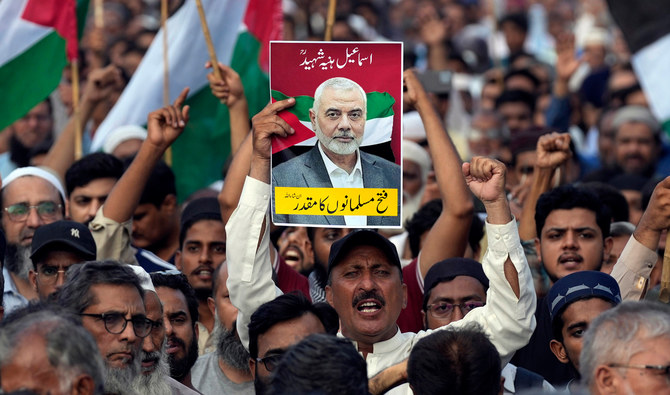
A supporter of the Pakistani religious group ‘Jamaat-e-Islami’ holds a poster with the portrait of Hamas leader Ismail Haniyeh in Karachi on July 31, 2024, during a protest to condemn his killing. (AP)
Short Url
Updated 03 August 2024
Follow

Pakistan backs Iran’s call for OIC meeting after Hamas leader’s assassination in Tehran

  • Iran’s foreign minister called Pakistan’s deputy PM after demanding the OIC session, requesting him to participate
  • Ismail Haniyeh’s assassination in Tehran has led to fears of a broader regional war, with Iran vowing revenge

ISLAMABAD: Pakistan’s Deputy Prime Minister Ishaq Dar said on Saturday his country supported Iran’s call for an extraordinary session of the Organization of Islamic Cooperation (OIC) following the assassination of Hamas political chief Ismail Haniyeh earlier this week.
The Hamas leader was targeted on July 31 in Tehran, where he had gone to attend the inauguration of newly elected President Masoud Pezeshkian. His funeral prayer was led by Iran’s Supreme Leader Ali Khamenei the next day before his body was taken to Qatar and buried in Doha.
The strike that took Haniyeh’s life was widely believed to have been ordered by Israel, though the Netanyahu administration neither confirmed nor denied the allegation.
Iran’s official Islamic Republic News Agency (IRNA) reported earlier in the day its Acting Foreign Minister Ali Bagheri Kani had demanded an extraordinary meeting of OIC foreign ministers before contacting Dar with a request to participate.
“The Deputy Prime Minister fully supported this call and confirmed that Pakistan would actively participate in the important meeting,” the foreign office said in a social media post.
It mentioned that Kani shared Iran’s “deep anguish” over the assassination of the Hamas leader during his phone call.
Dar conveyed similar sentiments while also condemning the developments in Gaza where Palestinians have been targeted by Israel’s war machine since last October.

 Iran has vowed to retaliate against Israel, which killed a senior Hezbollah commander in Lebanon hours before the Hamas leader was targeted.
The situation has created fears of a broader regional war, with the United States saying it will move additional warships and fighter jets toward the Middle East.
Top Pakistani parliamentarians, along with thousands of people, offered funeral prayers in absentia for Haniyeh during Friday congregations.
The National Assembly of Pakistan also passed a unanimous resolution expressing “unified grief and anger” over the ongoing conflict in the Gaza Strip.
Israel launched its air and ground offensive targeting Gaza following a surprise attack by Hamas on October 7, 2023, in which around 1,200 people were killed and more than 250 were taken hostages.
The Palestinian group said the attack was in response to the deteriorating condition of Palestinian people living under occupation.
Israel’s response was widely viewed as disproportionate by the international community in which over 39,000 people, mostly women and children, have died.
Israel was taken to the International Court of Justice (ICJ) by South Africa on the allegation of committing genocide where other nations joined the proceedings as well.


Pakistan, Libya discuss defense and counterterrorism cooperation during army chief’s visit

Updated 4 sec ago
Follow

Pakistan, Libya discuss defense and counterterrorism cooperation during army chief’s visit

  • Military says Field Marshal Asim Munir met Libyan Commander-in-Chief Khalifa Belqasim Haftar during the visit
  • Unlike several other states in the region, bilateral defense collaboration remains limited between the two countries

ISLAMABAD: Pakistan and Libya discussed enhancing defense cooperation, with a focus on training and counterterrorism partnership, during a visit by Pakistan’s Chief of Army Staff Field Marshal Asim Munir to the North African country, the military said in a statement on Thursday.

Pakistan and Libya established diplomatic relations in 1951, with ties particularly close during the era of former Libyan leader Muammar Qaddafi, when Tripoli positioned itself as a supporter of Muslim causes and developing countries, including

Pakistan. Relations have been more restrained since Libya’s political upheaval in 2011.

According to the military’s media wing, Inter-Services Public Relations (ISPR), Munir met Field Marshal Khalifa Belqasim Haftar, commander-in-chief of the Libyan Arab Armed Forces, and Lt. Gen. Saddam Khalifa Haftar, deputy commander-in-chief, during the visit.

“Both sides underscored the importance of collaboration in training, capacity building and counterterrorism domains,” ISPR said in a statement.

“Field Marshal Syed Asim Munir reaffirmed Pakistan’s commitment to strengthening defense ties with Libya, based on shared interests,” it added.

ISPR said Munir was accorded a guard of honor by a contingent of the Libyan Armed Forces on arrival and that the talks also covered matters of mutual interest, regional security dynamics and avenues for expanding military-to-military cooperation.

The Libyan military leadership appreciated the professionalism of the Pakistan armed forces and expressed a desire to expand defense cooperation between the two countries, the statement said.

Unlike Pakistan’s relations with some Gulf and Middle Eastern states, there is currently no significant defense or military cooperation between Islamabad and Tripoli, with engagement remaining limited amid Libya’s prolonged political instability.