US recognizes opposition candidate Gonzalez as the winner of Venezuela’s presidential election

1 / 2
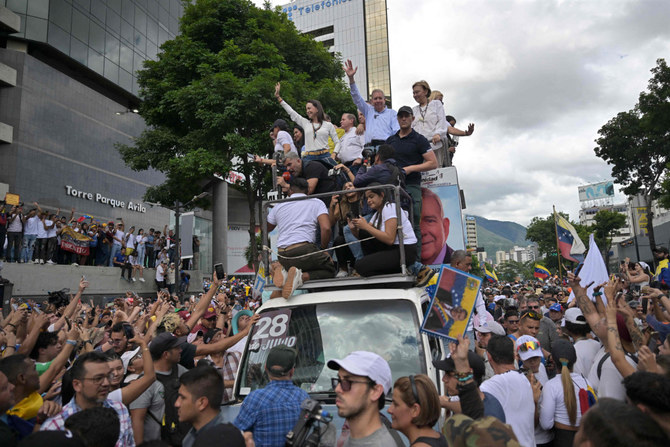
Venezuelan opposition leader Maria Corina Machado (C-left) and opposition presidential candidate Edmundo Gonzalez Urrutia (C-right) greet supporters during a rally in front of the United Nations headquarters in Caracas on July 30, 2024. (AFP)
2 / 2
Venezuelans carrying the national flag protest in Maracaibo state on July 30, 2024 protest the election results that awarded President Nicolas Maduro with a third term. (REUTERS)
Short Url
Updated 02 August 2024
Follow

US recognizes opposition candidate Gonzalez as the winner of Venezuela’s presidential election

  • Brazil, Colombia and Mexico have called on Venezuela’s electoral authority to show the vote tally sheets from Sunday’s election and allow impartial verification
  • President Nicolas Maduro’s officials had earlier threatened to arrest opposition leaders for calling for mass protests against the election commission’s partiality

CARACAS, Venezuela: The stakes grew higher for Venezuela’s electoral authority to show proof backing its decision to declare President Nicolas Maduro the winner of the country’s presidential election after the United States on Thursday recognized opposition candidate Edmundo Gonzalez as the victor, discrediting the official results of the highly anticipated vote.

The US Department of State announcement followed calls from multiple governments, including close allies of Maduro, for Venezuela’s National Electoral Council to release detailed vote counts, as it has done during previous elections.

The electoral body declared Maduro the winner Monday, but the main opposition coalition revealed hours later that it had evidence to the contrary in the form of more than two-thirds of the tally sheets that each electronic voting machine printed after polls closed.

“Given the overwhelming evidence, it is clear to the United States and, most importantly, to the Venezuelan people that Edmundo Gonzalez Urrutia won the most votes in Venezuela’s July 28 presidential election,” US Secretary of State Antony Blinken said in a statement.

The US government announcement came amid diplomatic efforts to persuade Maduro to release vote tallies from the election and increasing calls for an independent review of the results, according to officials from Brazil and México.

Government officials from Brazil, Colombia and Mexico have been in constant communication with Maduro’s administration to convince him that he must show the vote tally sheets from Sunday’s election and allow impartial verification, a Brazilian government official told The Associated Press Thursday.

The officials have told Venezuela’s government that showing the data is the only way to dispel any doubt about the results, said the Brazilian official, who was not authorized to speak publicly about the diplomatic efforts and requested anonymity.

A Mexican official, who also spoke on condition of anonymity for the same reason, confirmed the three governments have been discussing the issue with Venezuela but did not provide details.

Earlier, Mexican President Andrés Manuel Lopez Obrador said he planned to speak with President Luiz Inacio Lula da Silva of Brazil and President Gustavo Petro of Colombia, and that his government believes it is important that the electoral tallies be made public.

Later Thursday, the governments of Brazil, Colombia and Mexico issued a joint statement calling on Venezuela’s electoral authorities “to move forward expeditiously and publicly release” detailed voting data, but they did not confirm any backroom diplomatic efforts to persuade Maduro’s government to publish the vote tallies.

“The fundamental principle of popular sovereignty must be respected through impartial verification of the results,” they said in the statement.

On Monday, after the National Electoral Council declared Maduro the winner of the election, thousands of opposition supporters took to the streets. The government said it arrested hundreds of protesters and Venezuela-based human rights organization Foro Penal said 11 people were killed. Dozens more were arrested the following day, including a former opposition candidate, Freddy Superlano.

Opposition leader Maria Corina Machado — who was barred from running for president — and Gonzalez addressed a huge rally of their supporters in the capital, Caracas, on Tuesday, but they have not been seen in public since. Later that day, the president of the National Assembly, Jorge Rodriguez, called for their arrest, calling them criminals and fascists.

In an op-ed published Thursday in the Wall Street Journal, Machado said she is “hiding, fearing for my life, my freedom, and that of my fellow countrymen.” She reasserted that the opposition has physical evidence that Maduro lost the election and urged the international community to intervene.

“We have voted Mr. Maduro out,” she wrote. “Now it is up to the international community to decide whether to tolerate a demonstrably illegitimate government.”

Government repression over the years has pushed opposition leaders into exile. After the op-ed was published, Machado’s team told the AP that she was “sheltering.” Machado later posted a video on social media calling on supporters to gather Saturday across the country.

The Gonzalez campaign had no comment on the op-ed.

On Wednesday, Maduro asked Venezuela’s highest court to conduct an audit of the election, but that request drew almost immediate criticism from foreign observers who said the court is too close to the government to produce an independent review.

Venezuela’s Supreme Tribunal of Justice is closely aligned with Maduro’s government. The court’s justices are nominated by federal officials and ratified by the National Assembly, which is dominated by Maduro sympathizers.

On Thursday, the court accepted Maduro’s request for an audit and ordered him, Gonzalez and the eight other candidates who participated in the presidential election to appear before the justices Friday.

Gonzalez and Machado say they obtained more than two-thirds of the tally sheets printed from electronic voting machine after the polls closed. They said the release of the data on those tallies would prove Maduro lost.

Asked why electoral authorities have not released detailed vote counts, Maduro said the National Electoral Council has come under attack, including cyber-attacks, without elaborating.

The presidents of Colombia and Brazil — both close allies of the Venezuelan government — have urged Maduro to release detailed vote counts.

The Brazilian official said the diplomatic efforts are only intended to promote dialogue among Venezuelan stakeholders to negotiate a solution to the disputed election. The official said this would include the release of voting data and allowing independent verification.

López Obrador said Mexico hopes the will of Venezuela’s people will be respected and that there’s no violence. He added that Mexico expects “that the evidence, the electoral results records, be presented.”

Pressure has been building on the president since the election.

The National Electoral Council, which is loyal to Maduro’s United Socialist Party of Venezuela, has yet to release any results broken down by voting machine, as it did in past elections. It did, however, report that Maduro received 5.1 million votes, versus more than 4.4 million for Gonzalez. But Machado, the opposition leader, has said vote tallies show Gonzalez received roughly 6.2 million votes compared with 2.7 million for Maduro.

Venezuela has the world’s largest proven crude reserves and once boasted Latin America’s most advanced economy, but it entered into free fall after Maduro took the helm in 2013. Plummeting oil prices, widespread shortages and hyperinflation that soared past 130,000 percent led to social unrest and mass emigration.

More than 7.7 million Venezuelans have left the country since 2014, the largest exodus in Latin America’s recent history.


Thailand heads to polls with voters demanding ‘real change’

Updated 4 sec ago
Follow

Thailand heads to polls with voters demanding ‘real change’

  • Millennials, Generation Z make up around 46.5 percent of Thailand’s eligible voters
  • Voters will also decide on whether to rewrite current military-backed constitution

BANGKOK: Thai voters will head to the polls on Sunday after cycling through three prime ministers in less than three years, with the three-way contest of major parties set to decide the leader of the Southeast Asian nation over the next four years.

For the first time in the country’s history, nearly 53 million eligible voters in the kingdom of 71 million people will choose 500 lawmakers and also decide whether to rewrite the constitution.

The snap election was called in December by Anutin Charnvirakul, Thailand’s third premier since the 2023 election, who dissolved the House of Representatives to preempt a looming no-confidence vote.

More than 5,000 candidates from 57 parties are registered to take part in the polls, which will directly elect 400 lawmakers based on constituencies, while 100 others will be chosen from “party list” nominees, who gain seats according to each party’s proportional share of the vote.

Together, they will constitute the 500 members of the House of Representatives who will select the prime minister.

“This election is a gamble on the future of Thailand. Over the past decade, I have never seen the country move backward as much as it has,” Lawan Sarovat, a 60-year-old resident of Bangkok, told Arab News.

Thailand has been struggling with prolonged political uncertainty and a series of challenges, including an economy stuck at about 2 percent growth for the past five years and a border conflict with Cambodia last year that killed more than 100 people and cost at least $436 million.

“We want to see change. We had hoped that the previous election would bring about real change, but that did not happen. This time, people must try to make their voices heard in every possible way,” Sarovat said.

Main contenders

Sunday’s vote pits incumbent Prime Minister Charnvirakul’s Bhumjaithai party, which is backed by Thailand’s royalist conservative establishment, with the progressive youth-led People’s Party and Pheu Thai, a once-dominant party associated with now-jailed former premier Thaksin Shinawatra.

A nationwide survey by the National Institute of Development Administration put People’s Party leader Natthaphong Ruengpanyawut in first place for prime minister at over 29 percent, followed by Anutin at more than 22 percent.

The People’s Party was also a leading choice in terms of party preference, chosen by more than 33.5 percent of the January survey’s 2,500 respondents, while Bhumjaithai and Pheu Thai came second and third with about 22.7 percent and 16.9 percent, respectively.

The People’s Party is the successor to the group that won the last election — Move Forward — but was blocked from power, despite winning the greatest number of seats in the House of Representatives with the support of 14 million Thais.

It was eventually dissolved by the Constitutional Court over its proposals to revise the country’s strict royal insult laws.

“Elections in Thailand are not simply about citizens voting to choose a government. They are surrounded by multiple factors,” Thai senator Tewarit Maneechai told Arab News.

Even after securing popular support, Thai political parties must gain acceptance from a network of independent bodies established under the current constitution, including the Senate, the Constitutional Court, and the National Anti-Corruption Commission.

These institutions, Maneechai said, continue to function as mechanisms of the old power structure that has dominated Thailand’s political direction since the 2014 military coup.

Under this system, even an elected government can be removed from office at any time. Maneechai pointed to the case of Paetongtarn Shinawatra, ex-premier from the Pheu Thai Party, who was removed from office in August 2025 following a ruling by the Constitutional Court — a decision that raised public concerns over the expanding authority of independent agencies.

“There are surrounding factors that determine whether a government can actually be formed. Political parties that are able to govern are those that operate within the rules designed by the group that came to power through the coup,” Maneechai said.

Constitutional referendum

On Sunday, voters will also decide if a new constitution should replace a military-backed 2017 charter.

The ballot will simply ask voters if they “approve that there should be a new constitution,” with options of “Yes,” “No,” or “No opinion.”

The referendum needs more than 17 million votes in favor to become “a mandate that the entire country must heed,” Maneechai said.

“The referendum matters because even if a party wins the election, its ability to remain in power ultimately depends on independent mechanisms under the current constitution, which have the authority to remove a prime minister and destabilize a government.”

Though a majority “Yes” would kickstart a multi-stage drafting process, it will require two more referendums before a new charter could be adopted.

Change vs. status quo

Jamza Jongkham is among many Thai voters hoping that the election will lead to a constitutional reform.

“Right now, Thai politics is operating under rules controlled by an authoritarian camp that dominates the entire system, overriding political parties elected by the people,” he told Arab News.

The 27-year-old said what happened to the Move Forward party in 2023 was “fundamentally unfair,” and despite anger at how powerful politicians misuse power, he still has hopes in the younger generation.

Together, millennials and Generation Z make up around 46.5 percent of Thailand’s eligible voters.

“I still believe that people’s voices matter. If we choose to remain silent and do not exercise our right to vote, I believe Thailand will only become worse. There are still many people who want to see this country move in a better direction,” he said.

“If we can change the system so that everyone can participate in politics on an equal footing, I believe Thailand would become a far more just society.”

Puangthong Pawakapan, a political scientist at Chulalongkorn University, said Sunday’s vote is unlikely to serve as a decisive turning point in Thai politics, but rather reflect “an increasingly intense political struggle” between the public and entrenched power structures.

“This election has divided both those in power and the public into two clear sides — those who want change and those who want to preserve the status quo,” she told Arab News.

“Today, the public clearly sees that Thailand’s political and economic problems are rooted in an old power structure that is extremely difficult to change.”