Qiddiya City to host Final Fantasy VII Rebirth exhibition

Qiddiya City, a destination for entertainment, sports and culture, has collaborated with international video game publisher Square Enix to bring “Final Fantasy VII Rebirth” to The Boulevard in the heart of Riyadh. (Supplied)
Short Url
Updated 01 August 2024
Follow

Qiddiya City to host Final Fantasy VII Rebirth exhibition

  • Role-playing game’s producer Yoshinori Kitase and director Naoki Hamaguchi will feature at event

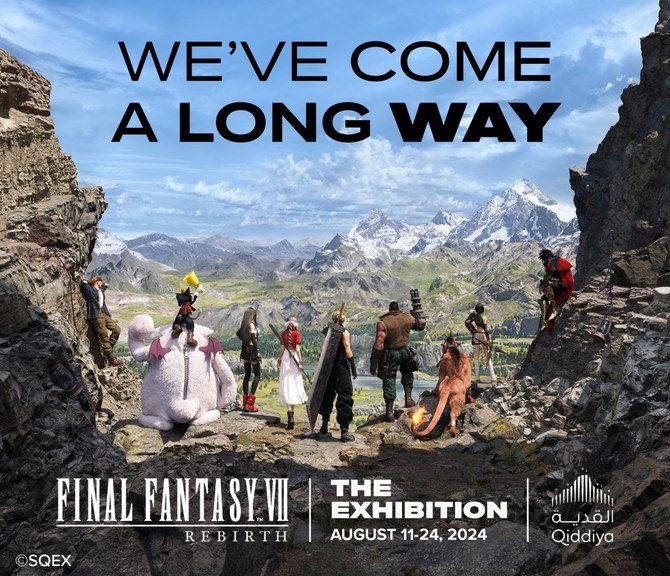
RIYADH: Qiddiya City, a destination for entertainment, sports and culture, has collaborated with international video game publisher Square Enix to bring “Final Fantasy VII Rebirth” to The Boulevard in the heart of Riyadh, during the 2024 Esports World Cup.

The event will run from Aug. 11 with Final Fantasy VII Rebirth producer Yoshinori Kitase and director Naoki Hamaguchi making a special appearance at the event on Aug. 16.

Visitors can immerse themselves in the story of the role-playing game as the more than 15,000 sq ft retrospective experience takes the form of the legendary city of Midgar, complete with scaled replicas of the in-game vehicles Tiny Bronco and the Buggy.

Fans will have the opportunity to play the game at the event. Additionally, VIP ticket holders will have the chance to win prizes, including limited-edition signed posters and merchandise.

Fans can attend a one-night event featuring a special presentation and Q&A session with Kitase and Hamaguchi as they share their experiences of creating the game.

The event will take place at Riyadh’s Falcons Team HQ at 8 p.m. Tickets can be purchased from Aug. 1 on WeBook.com. For international fans, the event will be live-streamed on Twitch and supported by a live watch party featuring popular gaming influencers.

Arnab Bhattacharya, director of strategy for the Gaming & Esports District at Qiddiya, said: “The legend of Final Fantasy VII, with beloved relatable characters, an incredible story, stunning art and epic soundtrack, is exactly the type of interactive experience we aspire to deliver to gaming fans across the globe as we continue to develop the wonder and lore of Qiddiya City’s Gaming & Esports District. 

“This is one of my favorite games of all time and I believe anyone who plays it will have a truly memorable experience. We’re incredibly grateful for the opportunity to collaborate with Square Enix and bring this remarkable game to life during the most anticipated gaming event of the year.”

Final Fantasy VII Rebirth, the second part in the Final Fantasy VII remake series, retells the story of the game that redefined the RPG genre in three distinct standalone titles and lets players take on the role of heroes Cloud, Barret, Tifa, Aerith, Yuffie and Red XIII.

Earlier this year, Qiddiya City was announced as the Nexus partner of the EWC.

The three-year partnership will see the Qiddiya Gaming & Esports District become the official home of the EWC. Starting in 2024, Qiddiya City is the presenting partner of two venues: The Elite Player Lounge and The Qiddiya Esports Arena. The Elite Player Lounge is designed as a place for participating EWC professional players to train, relax, socialize and prepare for matches.

Also this year, Qiddiya City’s Gaming & Esports District unveiled the world-first Elite Esports Bootcamps. The cyberpunk-themed facilities are designed for esports teams to train and prepare for competition using the latest hardware and software.

The Esports World Cup has transformed Riyadh into the epicenter of esports fandom and gaming culture.

Located in Boulevard City, fans can watch their favorite athletes and clubs compete across 22 game championships for a share of more than $60 million in prize money — the largest prize pool in esports history.

Over eight weeks, the Esports World Cup features festival activities that include gaming activations, community tournaments, pop culture celebrations and international experiences.


Rebuilding lives: Saudi initiative gives fresh hope to amputees

Updated 08 December 2025
Follow

Rebuilding lives: Saudi initiative gives fresh hope to amputees

  • Baitureh Health Association has provided life-changing support to more than 1,000 people
  • Prosthetic limbs can cost up to $76,000

MAKKAH: The Baitureh Health Association for the Care of Amputees has quickly become one of Saudi Arabia’s most impactful humanitarian initiatives, transforming support for people with lost limbs.

Established in 2020, the association deals with people’s physical, psychological and social needs and fills a long-standing gap in the national health system.

CEO Badr bin Alyan told Arab News that the initiative was created in response to a growing need, driven by amputations linked to accidents, blood disorders, occupational injuries and other causes.

Its operations were “based on service integration rather than fragmentation, enabling beneficiaries to return to their lives with confidence, ability and independence,” he said.

This holistic process covers everything from initial evaluations to psychological and physical rehabilitation, family support, prosthetic fitting and ongoing maintenance.

Its psychological support programs include group sessions led by certified mentors who have undergone similar experiences, as well as field visits to support patients before and after amputation.

More than 1,000 people across the Kingdom have so far benefitted from the association’s work, about 10 percent of them children, whom Alyan said were “the most sensitive and the most in need of intensive psychological and family support.”

Its specialist programs for children — My First Step and Therapeutic Entertainment — help young people adapt to prosthetics, overcome trauma and build confidence in a safe and supportive setting.

The association has completed more than 300 prosthetic fittings, including silicone cosmetic limbs, mechanical, hydraulic, electronic and 3D-printed models. 

Alyan said the type of prosthetic selected depended on a number of factors, such as age, lifestyle, type of amputation, activity level and psychological readiness.

Children also have to undergo frequent adjustments to their new limbs to account for their growth.

Each prosthetic cost between SR20,000 ($5,300) and SR285,000, Alyan said.

The association funds its work through sponsorships, community contributions and strategic partnerships.

Despite its success, Alyan said there were still challenges to be faced, including the lack of a consolidated base for the provision of psychological support and therapy services and prosthetics development and maintenance.

There was also a shortage of local experts, he said.

In response, the association set up a rehabilitation center, which Alyan said would help to localize prosthetics manufacturing, reduce costs and accelerate fitting processes and create opportunities for local experts to develop their knowledge and experience.

But providing prosthetics was only part of the association’s work, he said.

“Rebuilding a human life is the deeper goal.”