Pakistan slashes prices of petrol, diesel for next fortnight ​

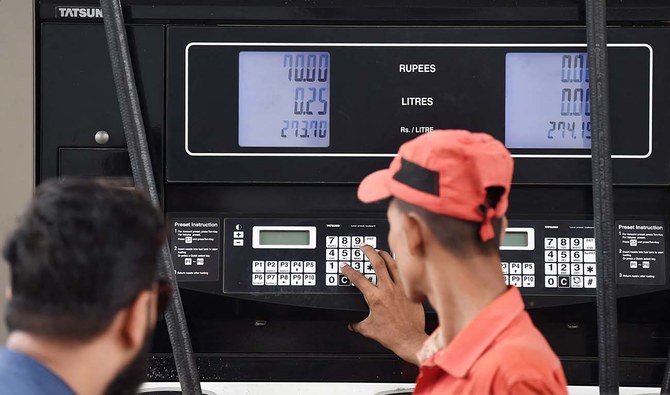
An employee prepares to fill petrol in a vehicle at a fuel station in Karachi on August 1, 2023. (AFP/File)
Short Url
Updated 31 July 2024
Follow

Pakistan slashes prices of petrol, diesel for next fortnight ​

  • Pakistan slashes price of petrol by Rs6.17 [$0.022[ per liter to Rs269.43 [$0.97] per liter
  • Prices decreased due to “price variations in international market,” says finance division

ISLAMABAD: Pakistan has slashed the price of petrol for the next fortnight by Rs6.17 [$0.022] per liter to Rs269.43 [$0.97] per liter, the country’s finance division confirmed on Wednesday. 

In a notification, the finance division announced it has also decreased the price of high speed diesel by Rs10.86 [$0.039] per liter to bring it to Rs272.77 [$0.98] per liter.

“The Oil & Gas Regulatory Authority (OGRA) has worked out the consumer prices of Petroleum Products, based on the price variations in the international market,” the notification read. 

Pakistan increased the prices of petroleum products by Rs9.99 [$0.036] and high speed diesel by Rs6.18 [$0.022] per liter on June 30. 
.
The fuel prices had been increased after Pakistan and the International Monetary Fund reached an agreement for a $7 billion, 37-month loan program that comes with tough measures. 

The latest decrease will be a slight relief for the masses in a country where petroleum and electricity prices have been the key drivers of high inflation. 

Petrol is mostly used in private transport, small vehicles, rickshaws and two-wheelers while any increase in the price of diesel is considered highly inflationary as it is mostly used to power heavy transport vehicles and particularly adds to the prices of vegetables and other eatables.


TV reporter dies after falling from rooftop during Pakistan kite-flying festival

Updated 08 February 2026
Follow

TV reporter dies after falling from rooftop during Pakistan kite-flying festival

  • Pakistan's Lahore marked the Basant festival on Feb. 6-8 after the Punjab government lifted an 18-year-old ban on kite flying
  • Malik Zain, a reporter affiliated with GNN news channel, fell from a four-storey building while flying a kite, Lahore police say

ISLAMABAD: A television reporter died after falling from a rooftop while flying a kite during the Basant spring festival in the eastern Pakistani city of Lahore, police and hospital authorities confirmed on Sunday.

Pakistan's Lahore marked the Basant festival on Feb. 6-8 after the Punjab provincial government this year lifted a ban on kite flying after 18 years, with extensive safety measures in place.

The festival, which marks the onset of spring, was banned in 2008 after deaths and injuries to motorcyclists and pedestrians from stray kite strings, sometimes coated with metal to make them more formidable in mid-air battles.

Malik Zain, a reporter affiliated with private news channel GNN, fell from the rooftop of a building during the final day of Basant celebrations in the eastern Pakistani city, according to police.

"Lahore journalist Malik Zain died after falling from the fourth floor while flying a kite in Gulshan-e-Ravi during Basant," the Lahore police said in a statement.

The reporter was shifted to the government-run Mian Munshi District Headquarters Hospital where he was pronounced dead, with cardiopulmonary arrest mentioned as the cause of death.

"Head injury due to fall from height," hospital authorities diagnosed in their report into Zain’s death.

The development came hours after Punjab Chief Minister Maryam Nawaz extended timings for Basant till early Monday morning.

“I am pleased to announce that Basant celebrations timings are being extended till 5:00 AM tomorrow morning,” CM Nawaz said in an X post on Sunday, highlighting the festivity, unity and joy across Lahore.

“This extension is a reward for the people of Lahore for celebrating Basant with great discipline and for responsibly following all safety SOPs (standard operating procedures).”

The Punjab government ‍banned the use of metallic or chemical-coated strings during the festival. Kites ‍and strings had to bear individual QR codes so they could be traced, and ‍motorcyclists had to attach safety rods to their bikes to fend off stray thread.

Some 4,600 producers had registered with the authorities to sell kites and strings ahead of the festival. Authorities had made it mandatory for owners to register rooftops with 30 or more revelers, while dozens of roofs ​had been declared off-limits after inspections.