Wayanad: Relentless downpours and howling winds hampered Wednesday’s search for survivors of landslides that struck Indian tea plantations and killed at least 150 people, most believed to be laborers and their families.
Days of torrential monsoon rains have battered the southern coastal state of Kerala, with blocked roads into the Wayanad district disaster area complicating relief efforts.
With the only bridge connecting the worst-hit villages of Chooralmala and Mundakkai washed away, rescue teams were forced to cart bodies on stretchers out of the disaster zone using a makeshift zipline erected over raging flood waters.
Several who managed to flee the initial impact of the landslides found themselves caught in a nearby river that had burst its banks, volunteer rescuer Arun Dev told AFP at a hospital treating survivors.
“Those who escaped were swept away along with houses, temples and schools,” he said.
Senior police officer M.R. Ajith Kumar told AFP that around 500 people had been rescued since successive landslides struck before dawn on Tuesday.
“So far we have got more than 150 bodies,” he said.
“Still large areas are to be explored and searched to find out whether live people are there or not.”
Wayanad is famed for the tea estates that crisscross its hilly countryside, which rely on a large pool of laborers for planting and harvest.
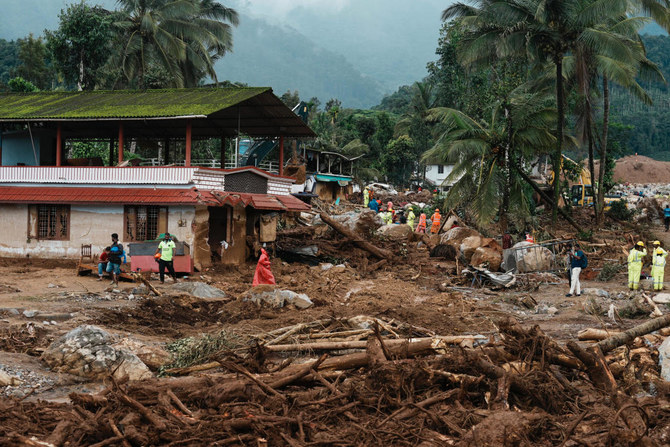
A number of brick-walled row homes built to accommodate seasonal workers were inundated by a powerful wall of brown sludge as laborers and their families slept inside.
Other buildings were caked with mud as the force of the landslide scattered cars, corrugated iron and other debris around the disaster site.
“Catastrophic debris flows are extremely violent, so survival is very difficult,” Hull University earth scientist Dave Petley told AFP.
“This will have been exacerbated by the timing — in the early hours when people were asleep — and by flimsy structures that offered little protection.”
More than 3,000 people were sheltering in emergency relief camps around Wayanad district, the state government said.
At least 572 millimeters (22.5 inches) of rain fell in the two days leading up to the landslides, according to state chief minister Pinarayi Vijayan.
Kerala’s disaster agency said more rain and strong winds were forecast for Thursday with the likelihood of “damage to unsafe structures” elsewhere in the state.
Indian opposition leader Rahul Gandhi, who until recently represented Wayanad in parliament, said he had been unable to go through with a planned visit to the disaster.
“Due to incessant rains and adverse weather conditions we have been informed by authorities that we will not be able to land,” he said in a post on social media platform X.
“Our thoughts are with the people of Wayanad at this difficult time,” he added.
Monsoon rains across the region from June to September offer respite from the summer heat and are crucial to replenishing water supplies.
They are vital for agriculture — and therefore the livelihoods of millions of farmers, and food security for South Asia’s nearly two billion people — but they also bring regular destruction.
The number of fatal floods and landslides has increased in recent years, and experts say climate change is exacerbating the problem.
“Events like landslides, they are part of these climate-change-triggered heavy rainfall disasters,” Kartiki Negi of the Indian environment think tank Climate Trends told AFP.
“India will continue to see more and more of these kinds of impacts in the future,” she added.
Damming, deforestation and development projects in India have also exacerbated the human toll.
India’s worst landslide in recent decades was in 1998, when rockfalls triggered by heavy monsoon rains killed at least 220 people and buried the tiny village of Malpa in the Himalayas.


![]()

India landslide toll hits 150 as rain hampers rescue work
Short Url
https://arab.news/2paj2
India landslide toll hits 150 as rain hampers rescue work
- Days of torrential monsoon rains have battered the southern coastal state of Kerala, with blocked roads into the Wayanad district disaster area complicating relief efforts


Latest updates


© 2026 SAUDI RESEARCH & PUBLISHING COMPANY, All Rights Reserved And subject to Terms of Use Agreement.