Rescuers scramble to find survivors after dozens killed in India landslides

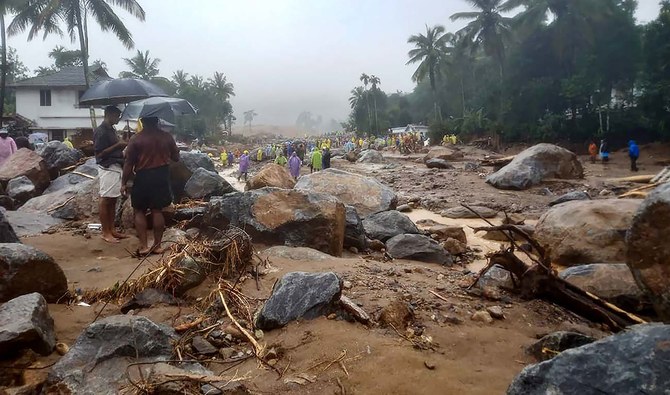
Relief personnel conduct a search and rescue operation at a site following landslides in Wayanad on July 30, 2024. (AFP)
Short Url
Updated 30 July 2024
Follow

Rescuers scramble to find survivors after dozens killed in India landslides

  • At least 84 people feared dead, over 100 remain missing
  • Kerala government declares two-day mourning for victims

NEW DELHI: A massive rescue operation was underway in the southern Indian state of Kerala on Tuesday following landslides that have killed dozens of people in the hilly district of Wayanad.

The landslides struck in the early hours of the morning when people were asleep as waves of mud crushed their homes.

Teams from civil defense, police, 200 personnel of the army, and rescue swimmers from the navy have been deployed to the affected areas, but search efforts were hampered by heavy rains.

The Kerala Revenue Ministry estimated that at least 84 people were dead and 116 injured, but the Wayanad District Disaster Response Force told Arab News it was difficult to ascertain the exact numbers, as more than 120 were missing, trapped under mud and debris.

“We fear that the death figure will go up as many missing might be dead. As of now, we can’t speculate,” the disaster response force office told Arab News. “Rescue operation is going on in full swing.”

Most of Kerala was on the India Meteorological Department’s highest alert due to extreme rainfall on Tuesday morning.

Jebi Mather, member of the upper house of the Indian Parliament representing Kerala, told lawmakers that reports from the state indicate that entire families had disappeared under the mud.

“The devastation cannot be measured at this moment … It is so vast,” she said.

Some 350 families lived in the hilly forest region, where most residents worked on tea and cardamom plantations.

Opposition leader Rahul Gandhi, the former MP for Wayanad, said in a post on X that he was “deeply anguished” by the disaster.

“The devastation unfolding in Wayanad is heartbreaking,” he said. “I have urged the Union government … to extend all possible support.”

The Kerala government declared official mourning on Tuesday and Wednesday.


Mali, Burkina say restricting entry for US nationals in reciprocal move

Updated 31 December 2025
Follow

Mali, Burkina say restricting entry for US nationals in reciprocal move

  • Both countries said they are applying the same measures on American nationals as imposed on them

ABIDJAN: Mali and Burkina Faso have announced travel restrictions on American nationals in a tit-for-tat move after the US included both African countries on a no-entry list.
In statements issued separately by both countries’ foreign ministries and seen Wednesday by AFP, they said they were imposing “equivalent measures” on US citizens, after President Donald Trump expanded a travel ban to nearly 40 countries this month, based solely on nationality.
That list included Syrian citizens, as well as Palestinian Authority passport holders, and nationals of some of Africa’s poorest countries including also Niger, Sierra Leone and South Sudan.
The White House said it was banning foreigners who “intend to threaten” Americans.
Burkina Faso’s foreign ministry said in the statement that it was applying “equivalent visa measures” on Americans, while Mali said it was, “with immediate effect,” applying “the same conditions and requirements on American nationals that the American authorities have imposed on Malian citizens entering the United States.”
It voiced its “regret” that the United States had made “such an important decision without the slightest prior consultation.”
The two sub-Saharan countries, both run by military juntas, are members of a confederation that also includes Niger.
Niger has not officially announced any counter-measures to the US travel ban, but the country’s news agency, citing a diplomatic source, said last week that such measures had been decided.
In his December 17 announcement, Trump also imposed partial travel restrictions on citizens of other African countries including the most populous, Nigeria, as well as Ivory Coast and Senegal, which qualified for the football World Cup to be played next year in the United States as well as Canada and Mexico.