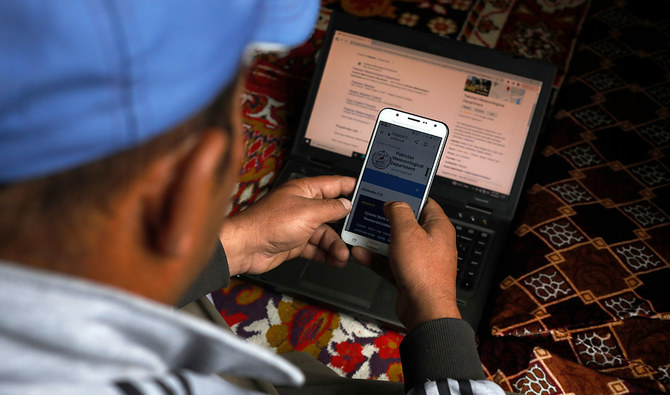
ISLAMABAD: Pakistani engineers have developed and successfully tested a government messaging app for secure communication among officials, authorities said Tuesday, even as Islamabad restricts social media use and regularly shuts down Internet and mobile phone networks to prevent dissent.
Should the government approve it, the messaging platform could eventually also be available to millions of citizens, said Baber Majid, chief executive officer at the country’s National Information Technology Board.
Enter “beep,” a chat application that Pakistani authorities say is exclusively homegrown.
“Beep has already successfully undergone trial runs since 2023 and is now ready for launch,” Majid said.
Meanwhile, ordinary Pakistanis have been struggling to access the social networking platform X, which authorities blocked ahead of the Feb. 8 parliamentary elections earlier this year, a vote overshadowed by violence, an unprecedented national shutdown of all mobile phone services and allegations of vote rigging.
Authorities later insisted that the phone service suspension was necessary for security reasons, but critics and Pakistan’s imprisoned former Prime Minister Imran Khan have said the real intention was to disable communication to allow for vote rigging — a charge the government denies.
There have also been frequent Internet restrictions in southwestern Balochistan province and elsewhere. Pakistan every year suspends phone services during the Ashura, an Islamic commemoration when minority Shiite Muslims hold processions.
Pakistan imposed five separate Internet restrictions during and after the elections, according to research by the Netherlands-based cybersecurity company Surfshark B.V., which offers VPN services and data leak detection. It also tracks cases of government-imposed Internet and social media disruptions.
“Such actions taken by the government undermine the very aspect of democracy and make it impossible for fair elections to take place,” it said.
Pakistan’s phone and Internet suspensions have also affected communication between officials and security forces. Hence “beep,” which Majid said would ensure uninterrupted communication among officials.
He said the app has been designed to share text, audio, and videos and hold conference calls. It requires an Internet connection but Majid did not elaborate on measures that would restrict Internet availability to just Pakistani officials — or possibly whoever else gets approval to use the app.
“Beep is safer than other messaging apps,” he said.


Pakistan set to launch its own secure messaging app for government officials
https://arab.news/vgjrx
Pakistan set to launch its own secure messaging app for government officials

- ‘Beep’ has been designed to share text, audio, and videos and hold conference calls
- Officials say the messaging platform could eventually be made available to citizens

Pakistan bulk cargo terminal signs deal to ship copper-gold output from Reko Diq
- Pakistan International Bulk Terminal says the deal positions it as the primary logistics gateway for Reko Diq’s mineral output
- A top Barrick Mining official says the agreement marks a ‘step forward,’ with exports from the project expected to begin in 2028
ISLAMABAD: A bulk cargo terminal operating at Pakistan’s Port Qasim has signed an agreement to handle and export copper-gold commodities from Reko Diq, including minerals, metals and other natural earth resources, in a move expected to support multibillion-dollar mineral exports from the country, the company said on Monday.
The terminal operator, Pakistan International Bulk Terminal Limited (PIBT), said the agreement positions it as the primary export gateway for Reko Diq’s mineral output and strengthens Pakistan’s ambitions to expand its footprint in global commodity markets.
The deal covers logistics, storage and exports for output from the Reko Diq copper-gold project in southwestern Balochistan province, one of the world’s largest undeveloped mineral deposits, with shipments expected to begin from 2028.
“This agreement is a historic milestone for PIBT and Pakistan, enabling exports from one of the world’s most significant mining projects and serving as a cornerstone for national economic growth,” Sharique Azim Siddiqui, CEO of PIBT, said in a statement.
He expressed appreciation to the government, the Special Investment Facilitation Council, the Ministry of Maritime Affairs and the Port Qasim Authority for their “pivotal role.”
Barrick Mining Corporation, which is developing Reko Diq, also welcomed the agreement.
“We’re delighted to have signed this important agreement with PIBT which marks another step forward in ensuring that Reko Diq delivers lasting value to all our stakeholders but particularly the people of Balochistan and Pakistan,” Mark Hill, the company’s top official, said.
PIBT is a fully mechanized multipurpose bulk terminal located at Port Qasim and was developed with a $305 million investment in partnership with the International Finance Corporation.
The terminal currently has an annual handling capacity of 12 million tons of imports and 4 million tons of exports, with further investment planned to upgrade its export systems, the company said.


