

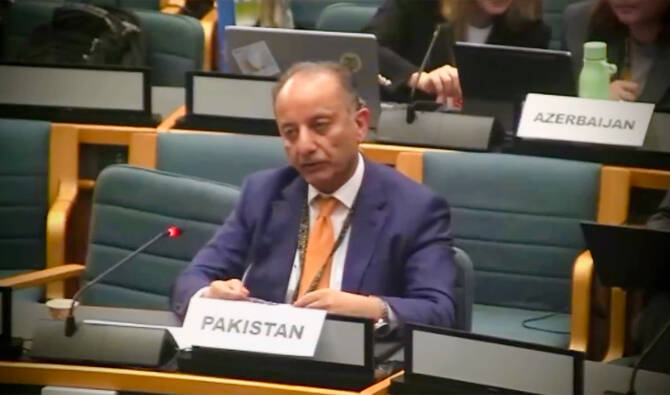
Pakistani minister urges universal rights, dialogue at UN civilizations forum in Riyadh

akistan’s climate change minister Musadik Malik is addressing 11th Global Forum of the United Nations Alliance of Civilizations (UNAOC) in Riyadh on December 14, 2025. (Senator Musadik Malik)
Short Url
Updated 15 December 2025
Follow

Pakistani minister urges universal rights, dialogue at UN civilizations forum in Riyadh

  • Musadik Malik warns selective application of human rights and weakening multilateralism risk deepening global divisions
  • The minister also mentions water rights and urges equitable sharing by upper riparian states to support regional stability

ISLAMABAD: Pakistan’s climate change minister said principles of justice and human rights must be applied universally, according to an official statement released on Monday, warning against selective enforcement as he addressed a United Nations forum in Saudi Arabia focused on dialogue among civilizations.

The remarks came at the 11th Global Forum of the United Nations Alliance of Civilizations (UNAOC), held in Riyadh to mark the body’s 20th anniversary. The forum brings together political leaders, policymakers, and civil society groups to promote dialogue, mutual understanding, and cooperation across cultures and religions.

Its latest edition comes at a time of growing geopolitical fragmentation and conflict.

“I am firmly committed to women’s rights, minority rights, environmental rights, and children’s rights,” Musadik Malik said while addressing the gathering. “These rights are fundamental and non-negotiable.”

He said the global order was increasingly marked by weakening multilateralism, rising conflicts, and declining international funding for development and environmental priorities, cautioning that unilateral actions were replacing collective approaches with consequences for global peace and justice.

Malik questioned what he described as the selective application of human rights principles, drawing attention to the situations in Palestine and Kashmir, and said the rights of people in those regions must be recognized and protected in line with international norms.

The minister also highlighted water rights as a growing source of regional tension, emphasizing the responsibility of upper riparian states to ensure equitable and just sharing of water resources with downstream countries to support stability and sustainable development.

His statement comes months after India said unilaterally it was holding the Indus Waters Treaty “in abeyance,” a move described as illegal by the administration in Islamabad and as “an act of war.”

The 1960 agreement between India and Pakistan, brokered by the World Bank, divides the rivers of the Indus basin between the two countries and sets rules for how they can use and manage shared water resources to avoid conflict.

Malik said the UNAOC’s 20th anniversary was a timely reminder of the need to recommit to dialogue, peace, and mutual respect in an increasingly divided world.


EU, Pakistan sign €60 million loan agreement for clean drinking water in Karachi

Updated 17 December 2025
Follow

EU, Pakistan sign €60 million loan agreement for clean drinking water in Karachi

  • Project will finance rehabilitation, construction of water treatment facilities in Karachi city, says European Investment Bank
  • As per a report in 2023, 90 percent of water samples collected from various places in city was deemed unfit for drinking

ISLAMABAD: The European Investment Bank (EIB) and Pakistan’s government on Wednesday signed a €60 million loan agreement, the first between the two sides in a decade, to support the delivery of clean drinking water in Karachi, the EU said in a statement. 

The Karachi Water Infrastructure Framework, approved in August this year by the EIB, will finance the rehabilitation and construction of water treatment facilities in Pakistan’s most populous city of Karachi to increase safe water supply and improve water security. 

The agreement was signed between the two sides at the sidelines of the 15th Pak-EU Joint Commission in Brussels, state broadcaster Radio Pakistan reported. 

“Today, the @EIB signed its first loan agreement with Pakistan in a decade: a €60 million loan supporting the delivery of clean drinking water for #Karachi,” the EU said on social media platform X. 

Radio Pakistan said the agreement reflects Pakistan’s commitment to modernize essential urban services and promote climate-resilient infrastructure.

“The declaration demonstrates the continued momentum in Pakistan-EU cooperation and highlights shared priorities in sustainable development, public service delivery, and climate and environmental resilience,” it said. 

Karachi has a chronic clean drinking water problem. As per a Karachi Water and Sewerage Corporation (KWSC) study conducted in 2023, 90 percent of water from samples collected from various places in the city was deemed unsafe for drinking purposes, contaminated with E. coli, coliform bacteria, and other harmful pathogens. 

The problem has forced most residents of the city to get their water through drilled motor-operated wells (known as ‘bores’), even as groundwater in the coastal city tends to be salty and unfit for human consumption.

Other options for residents include either buying unfiltered water from private water tanker operators, who fill up at a network of legal and illegal water hydrants across the city, or buying it from reverse osmosis plants that they visit to fill up bottles or have delivered to their homes.

The EU provides Pakistan about €100 million annually in grants for development and cooperation. This includes efforts to achieve green inclusive growth, increase education and employment skills, promote good governance, human rights, rule of law and ensure sustainable management of natural resources.