

Houthis shutter UN human rights agency in Sanaa

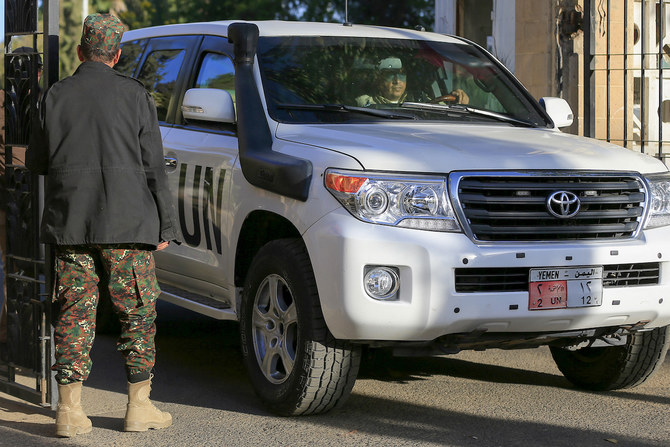
The Houthi militia has asked a UN human rights agency in Sanaa to close its office. (File/AFP)
Short Url
Updated 30 July 2024
Follow

Houthis shutter UN human rights agency in Sanaa

  • “The office will be closed down by Thursday. The Houthis intend to shut offices of foreign organizations that do not produce help or money”: Yemeni human rights minister

AL-MUKALLA: Yemen’s Houthi militia has asked a UN human rights agency in Sanaa to close its office.

The move comes amid an escalating crackdown on UN agencies and international organizations, according to a Yemeni government minister and local media.

Yemeni Human Rights Minister Ahmed Arman told Arab News on Tuesday that the UN High Commissioner for Human Rights office in Sanaa received a letter from Houthi Foreign Minister Hisham Sharaf on Monday asking that the office be closed within three days. No explanation for the request was given.

“The office will be closed down by Thursday. The Houthis intend to shut offices of foreign organizations that do not produce help or money, such as those for human rights, capacity-building and development groups,” Arman said.

In May, the Houthis began surprise attacks on UN agencies, Western missions, and human rights and assistance groups in the regions they control. They have abducted more than 70 Yemenis working for such organizations, including nine women.

The Houthis have accused Yemenis working with international organizations of using humanitarian efforts as a cover for espionage activities on behalf of the US and Israel, of employing agents for both countries and undermining the country’s agricultural, health, and educational sectors.

Arman connected recent Houthi raids and arrests to efforts to seize control of humanitarian aid by placing loyalists in foreign organizations and silencing dissidents and human rights campaigners.

“This is the continuation of the Houthis’ deliberate agenda of restricting freedoms and rights. They will keep just the offices of organizations that help them, such as the World Food Programme, the World Health Organization, UNICEF, and anything else related to aid,” he added.

Arab News asked the UN to comment on the closure of the office in Sanaa but no response has yet been received.

At the same time, the Houthis have reiterated their threats to target tankers transporting oil from Yemen if the government attempts to restart exports.

In a statement carried by the official Houthi news agency, the Houthi Supreme Economic Committee denied on Monday reaching an agreement with the Yemeni government to resume exports from oil terminals in the southern Hadramout and Shabwa provinces.

Rumors also circulated that the Yemeni government had enabled Yemenia Airways, the country’s main carrier, to boost flights from Houthi-held Sanaa in return for the militia stopping attacks on oil installations.

In late 2022, the Houthis launched drone attacks on oil terminals in Hadramout and Shabwa, effectively halting shipments and depriving the Yemeni government of a key source of income.

Rashad Al-Alimi, chairman of the Presidential Leadership Council, told a gathering of local government officials in Al-Mukalla on Monday that the Yemeni government had lost 70 percent of its revenue as a result of Houthi attacks on oil facilities, hampering its ability to pay salaries or provide vital funds for services such as electricity.

He said the Houthis had stopped purchasing gas from the government-controlled Marib in order to impoverish the Yemeni government and weaken the presidential council.

Meanwhile, the US Central Command said on Monday that its troops had destroyed a drone in a Houthi-held territory. The news comes as international marine agencies have reported no Houthi strikes on ships in the last 10 days, indicating a prolonged calm in the anti-ship campaign.

Since November, the Houthis have fired hundreds of ballistic missiles, drones and drone boats at international commercial and naval ships in the Red Sea, Bab Al-Mandab Strait, Gulf of Aden and Indian Ocean in what the militia claims is an attempt to pressure Israel to end hostilities in the Gaza Strip.


Year after Assad’s downfall, Syrians shows strong support for Al-Sharaa

Updated 10 sec ago
Follow

Year after Assad’s downfall, Syrians shows strong support for Al-Sharaa

  • Survey finds Syrians are hopeful for the future, back the government’s progress following Assad’s demise
  • Saudi Arabia is the most popular foreign country, Trump also given firm support

LONDON: As Syrians this week marked one year since the downfall of Bashar Assad, a survey conducted inside the country has found overwhelming support for the new president and placed Saudi Arabia as the most popular international partner.

The former president fled the country on Dec. 8, 2024, after a lightning offensive by opposition forces reached Damascus, bringing an end to 14 years of civil war.

The campaign was spearheaded by Ahmad Al-Sharaa, who now serves as the country’s president and has pressed ahead with efforts to stabilize Syria and rebuild relations with international partners.

Those efforts were recognized in a recently published survey that found that 81 percent of those asked were confident in the president and 71 percent in the national government.

There was also strong backing for key institutions, with more than 70 percent supporting the army and 62 percent in favor of the courts and legal system.

It was carried out during October and November by Arab Barometer, a US-based nonprofit research network.

The survey questioned more than 1,200 randomly selected adults in person across the country, asking their thoughts on a range of issues, including the government’s performance, the economy and security.

The strong support shown for Al-Sharaa is at a level that would be the envy of most Western governments and comes as Syria faces many deep challenges.

The cost of rebuilding the country has been placed at more than $200 billion by the World Bank, the economy has been devastated and the country has faced outbreaks of sectarian violence.

Al-Sharaa has worked to end Syria’s international isolation, building support from countries in the region and successfully lobbying the US to lift sanctions.

A key backer has been Saudi Arabia, which has offered political and economic support. The survey placed the Kingdom as the most popular foreign country with 90 percent viewing Saudi Arabia favorably.

Qatar was also popular, with more than 80 percent viewing the emirate as favorable and 73 percent admiring Turkey.

Most of those asked — 66 percent — also viewed the US favorably, an appreciation of President Donald Trump’s decision to ease sanctions and the impact that will have on the daily lives of Syrians.

After meeting Al-Sharaa in Washington last month, Trump announced a partial suspension of sanctions after already easing many sections of the sanctions regime against the country.

The survey found 61 percent have a positive view of Trump, a figure higher than in much of the Middle East.

There was much less enthusiasm, however, for Washington’s efforts for Syria to normalize relations with Israel.

Only 14 percent supported such a move and just 4 percent had a favorable opinion of Israel.

During the tumult of Assad’s demise, Israel’s military occupied a further swathe of southern Syria and has regularly launched attacks on the country in the last year.

More than 90 percent of Syrians said they viewed Israel’s occupation of the Palestinian territories and strikes on Iran, Lebanon and Syria as critical threats to their security.

Writing jointly in Foreign Policy magazine, Salma Al-Shami and Michael Robbins from Arab Barometer said the survey results provided reasons to be optimistic about Syria’s future.

“We found that the country’s people are hopeful, supportive of democracy and open to foreign assistance,” they said. “They approve of and trust their current government.”

But the authors also said the results provided some reasons for concern, particularly over the state of the economy and internal security.

Support for the government also dropped off sharply in regions largely home to the Alawite ethno-religious group.

The Assad dynasty that ruled Syria for more than 50 years belonged to the Alawite minority and members of the group held many of the positions of power during that rule.

The survey showed that Syrians view the economy as a major concern, with just 17 percent happy with its performance and many worried about inflation, jobs and poverty.

Some 86 percent said their incomes did not cover their expenses and 65 percent said they had struggled to buy food in the previous month.

There was also concern about security, with 74 percent supportive of any government effort to collect weapons from armed groups and 63 percent viewing kidnapping as a critical threat.

Marking the anniversary of Assad’s downfall on Monday, Al-Sharaa said the government was working to build a strong Syria, consolidate its stability and safeguard its sovereignty.