


BEIRUT: Political and diplomatic communications have intensified between Lebanon and other nations to mitigate the serious escalation between Hezbollah and Israel.
The communications aim to prevent Lebanon from entering into an open conflict, particularly in light of Israel’s decision on Sunday night to strike Hezbollah in response to what it deemed “Hezbollah’s responsibility for the shelling of Majdal Shams.”
Hezbollah has denied responsibility for the attack on Majdal Shams that killed 12 teenagers and children on Saturday.
A Lebanese government source said that “international communications” had so far succeeded in containing an all-out war.
Israeli army spokesperson Avichay Adraee stated: “Our response to Hezbollah will be clear and strong.”
A Lebanese security source confirmed that Hezbollah evacuated several key points in the south and Bekaa since Sunday, near the Lebanese-Syrian border and the vicinity of Sayyida Zainab in Syria, “in anticipation of an Israeli strike.”
Lebanon witnessed a state of anticipation and caution on Monday, especially in the southern regions, the Bekaa, and Beirut.
Movement remained relatively cautious on roads connecting the regions.
The announcement that some airlines were suspending their flights to Lebanon further increased caution.
Foreign ministries, instead of embassies, warned their citizens to leave Lebanon immediately or “prepare for long periods of shelter.”
Caretaker Prime Minister Najib Mikati received a call from British Foreign Secretary David Lammy, who renewed “the call on all parties to exercise restraint to prevent escalation.”
Lammy stressed the need to “resolve disputes peacefully and through the implementation of relevant international resolutions.”
Reuters reported that US Secretary of State Antony Blinken called Israeli President Isaac Herzog and emphasized “the importance of preventing the escalation of conflict after the missile attack in the Golan Heights.”
According to Reuters, Blinken and Herzog discussed “a diplomatic solution that allows residents on both sides of the Israeli-Lebanese border to return to their homes.”
Reuters quoted an Israeli official as saying: “We want to harm Hezbollah, but we are not seeking a full-scale regional war.”
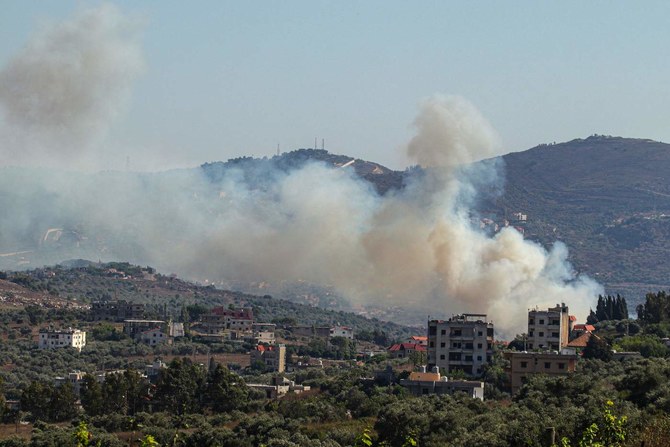
The hostile operations between Hezbollah and the Israeli army did not stop on Monday.
An Israeli raid in the morning targeted two locations.
The first raid targeted a car near Shaqra, and when a motorcycle arrived at the scene, it was targeted by a second raid.
This resulted in the death of two people and the injury of three others, including a child.
Hezbollah mourned its two killed members, Abbas Salami, aged 34, from the town of Kharbat Salem, residing in the town of Shaqra, and Abbas Hijazi, aged 29, from the town of Majdal Salem.
Israeli airstrikes hit Houla, with Israeli artillery bombarding the outskirts of Aitaroun.
Residential areas to the south of Mays Al-Jabal were also hit by artillery and phosphorous shells, resulting in fires.
The outskirts of Markaba, Rab El-Thalathine, and Kafr Hamam were also attacked.
The Israeli army conducted a sweeping operation toward Kafr Kila from its outposts in the settlement of Metula using automatic weapons.
Hezbollah continued attacking Israeli positions.
The Al-Manar channel — affiliated with Hezbollah — reported that “large fires broke out in the forests surrounding the settlement of Kiryat Shmona after missiles fell in the area.”
Hezbollah said it targeted the Al-Baghdadi site with dozens of Katyusha rockets.
It also targeted the Israeli soldiers’ position at the Al-Raheb site with guided missiles.
Israeli media reported the fall of several rockets at the Hagoma junction in Upper Galilee.
Israeli Defense Minister Yoav Gallant reiterated the Israeli threat that Hezbollah “will pay a heavy price, and we will let actions speak, not words.”
On Monday afternoon, Middle East Airlines’ aircraft landed on the runways of Rafic Hariri International Airport in Beirut after their flights were suspended on Sunday night.
The airline attributed the irregularity in its flight schedules to “insurance risks.”
The airport witnessed a rush of passengers arriving in Lebanon, mostly Lebanese expatriates, while others were departing.
Hala, an employee at the reception area at the airport, told Arab News: “When we ask arriving passengers if they are afraid to come to Lebanon, they laugh and continue to walk.”
The US Embassy in Lebanon, in a video clip by Assistant Secretary of State for Consular Affairs Rena Bitter, advised American citizens to “develop a crisis plan of action and leave before the crisis begins.”
Bitter stressed: “Washington is laser-focused on Lebanon. The US Department of State has no higher priority than the safety and security of US citizens overseas.”
She reminded US citizens of key points on crisis preparedness so they could receive direct alerts from the embassy.
She said: “Regularly scheduled commercial transportation is always the best option, while local communications and transportation infrastructure are intact and operating normally.
“Please ensure your US passports are valid for at least six months. Should commercial airlines not be available, people should be prepared to shelter in a place for long periods.”
The Italian foreign minister also urged Italian nationals to leave Lebanon, while the German government spokesperson advised German citizens to “urgently leave Lebanon.”
The Lufthansa Group, which also includes Swiss International Air Line and Eurowings, said in a statement that it would “suspend flights to Beirut until Aug. 5 due to the current situation in the Middle East, and as a precautionary measure.”
Air France and Transavia suspended their flights to Beirut until Wednesday.
Saudi Arabia urged its citizens to “adhere to the decision of not traveling to Lebanon.”
Royal Jordanian Airlines suspended its flights to Beirut.
Turkish Airlines canceled two flights to Beirut.
Turkish low-cost carrier SunExpress, Turkish Airlines’ AJET, Greece’s Aegean Airlines and Ethiopian Airlines also canceled flights.


