PARIS: France suspects members of far-left groups were behind the sabotage of the country’s high-speed rail network last week just as the Olympic Games were about to begin, Interior Minister Gerald Darmanin said on Monday.
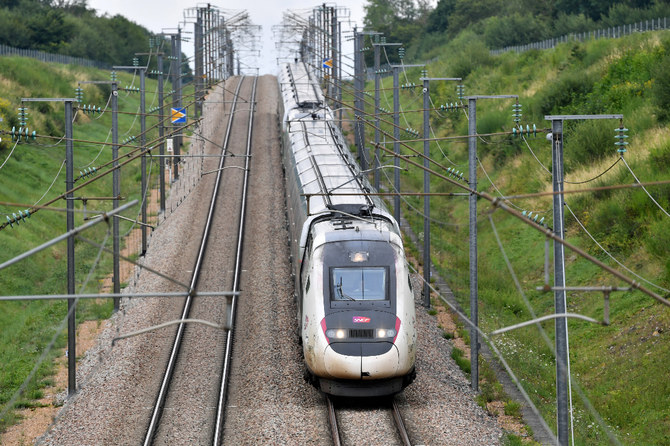
Saboteurs struck the network on Friday with pre-dawn attacks on signal substations and cables at critical points, causing travel chaos hours before the opening ceremony in Paris.
“We have identified the profiles of several people,” Darmanin told France 2 TV, adding that the sabotage bore the hallmarks of far-left groups.
In recent years, France has been targeted in attacks by Islamist militants, but security services have been increasingly concerned about far-left or anarchist militants, who typically oppose the state and capitalism.
The then-head of France’s domestic intelligence agency, Nicolas Lerner, told Le Monde newspaper last year French President Emmanuel Macron’s divisive 2023 pension shake-up had helped lure recruits to far-left groups, which have increasingly incorporated ecological issues into their ideologies.
“In recent years, the far-left movements have been known for particularly violent clandestine actions, including arson campaigns ... ransacking and destruction of property,” Lerner, who now leads the foreign spy agency DGSE, said in the interview.
In a 2023 report on terrorism trends, the European police agency Europol said left-wing and anarchist groups typically attacked “critical infrastructure, such as repeaters and antennas, government institutions and private companies” with their “most common modus operandi” being arson and improvised explosive devices.
Train services in France were back up and running by early Monday after teams worked around the clock over the weekend to fix the damage, Transport Minister Patrice Vergriete told RTL radio.
Vergriete said 800,000 people had faced travel disruptions and said the cost to the state-owned rail operator SNCF would be considerable.

France suspects far-left groups were behind rail sabotage, minister says
https://arab.news/4uqws
France suspects far-left groups were behind rail sabotage, minister says
- Saboteurs struck the network on Friday with pre-dawn attacks on signal substations and cables at critical points
- Train services in France were back up and running by early Monday after teams worked around the clock over the weekend to fix the damage
Philippines builds defense partnerships amid growing China aggression
- Island country forged new pacts with Japan, the UAE, Canada, Germany in past year
- Manila sees China’s maritime expansion as ‘quintessential security threat,’ expert says
MANILA: The Philippines and Japan have signed a new defense pact, adding to a growing list of security cooperation Manila has been forging with partner countries as it faces a growing Chinese presence in the disputed South China Sea.
Philippine-Japan security ties have strengthened in recent years over shared concerns in the region, with the two countries signing a landmark military pact in 2024, allowing the deployment of their forces on each other’s soil for joint military drills. It was Japan’s first such pact in Asia.
The new defense agreement — signed by Philippine Foreign Secretary Theresa Lazaro and Japanese Foreign Minister Toshimitsu Motegi in Manila on Thursday — is a follow-up to their 2024 pact, and would allow tax-free, reciprocal provision of ammunition, fuel, food and other necessities when their forces conduct joint training and disaster relief operations.
The security partnership is aimed at boosting deterrence against China, experts say.
“The latest defense pact with Japan is not only significant but also existential (as) a strong deterrence to China’s growing military size and ambition in the string of islands of the first island chain that includes Japan and the Philippines,” Chester Cabalza, founding president of the International Development and Security Cooperation think tank, told Arab News.
The Philippines, China and several other countries have overlapping claims in the disputed South China Sea, a strategic waterway through which billions of dollars worth of goods pass each year.
Beijing has maintained its expansive claims of the area, despite a 2016 international tribunal ruling that China’s historical assertion to it had no basis.
Japan has a longstanding territorial dispute with China over islands in the East China Sea, while Chinese and Philippine coast guard and navy ships have been involved in a series of tense incidents in the South China Sea in recent years.
“The imminent threat to maintain a status quo of peaceful co-existence in the region brings a shared responsibility for Manila and Tokyo to elevate strategic partnership to achieve this strategic equilibrium,” he said.
Motegi said he and Lazaro “concurred on continuing to oppose unilateral attempts to change the status quo by force or coercion in the East and South China seas,” in a clear rebuke of Beijing’s increasing assertiveness, without naming China.
The Philippines sees China’s maritime expansion as “the quintessential security threat,” said international studies expert Prof. Renato De Castro.
“So, of course, we rely on our efforts to build up our armed forces in terms of the comprehensive archipelagic defense operation,” he told Arab News.
The Philippines has a mutual defense treaty with the US, which the allies signed in 1951. While both governments have continued to deepen defense cooperation in recent years, Manila has also been building security partnerships with other countries.
The Philippines has signed two defense deals this month alone, including a Memorandum of Understanding on Defense Cooperation with the UAE, its first such deal with a Gulf country.
Last year, Manila signed military pacts with New Zealand and Canada, which sets the legal framework to allow military engagements, including joint drills, in each other’s territory. Both agreements still need to be ratified by the Philippine Senate to take effect.
The Philippines also signed a defense cooperation arrangement with Germany in May, aimed at boosting joint activities.


