

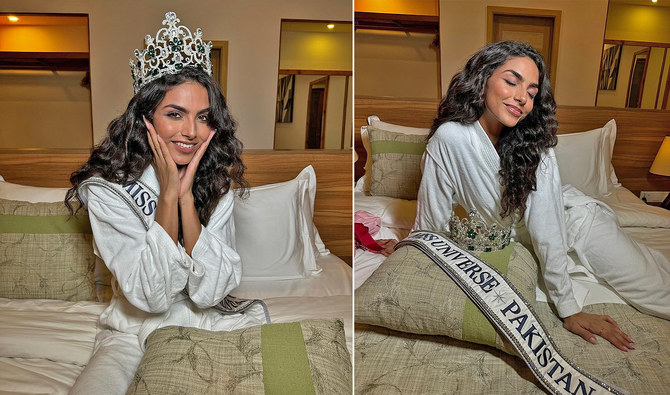

KARACHI: As Islamabad-based venture capitalist-turned-model Noor Xarmina sets out to represent Pakistan at the Miss Universe 2024 pageant in Mexico this November, her top goal is to bring change in her home country, particularly on issues like women’s safety and climate change.
Born in Islamabad but having lived abroad for over 10 years, Xarmina quit her career as a venture capitalist in London to join a drama school and then returned to Pakistan in 2023 to pursue a career in acting and modelling.
After shooting with a number of top brands in Pakistan, she submitted an application for the Miss Universe Pakistan 2024 pageant and was one of 21 candidates shortlisted, going on to win the contest in the Maldives on July 20. The pageant was organized by Dubai-based Yugen Group, which also owns the franchise rights to Miss Universe Bahrain and Miss Universe Egypt.
In the next few weeks and months, Xarmina will be putting all her energies into trainings for the 73rd edition of the Miss Universe pageant, to be held in Mexico for the first time since 2007.
So as the 29-year-old heads to Mexico for the ultimate contest, she said she wanted to be an “agent for positive change” for her home country.
“[If I win the Miss Universe 2024 title], I would very quickly want to start implementing some of the ideas I have around safety for women and fighting climate change in Pakistan,” Xarmina, who has studied biology and business, told Arab News in an interview this week. “So, I would immediately want to look into some of these social causes that I’ve spoken about.”
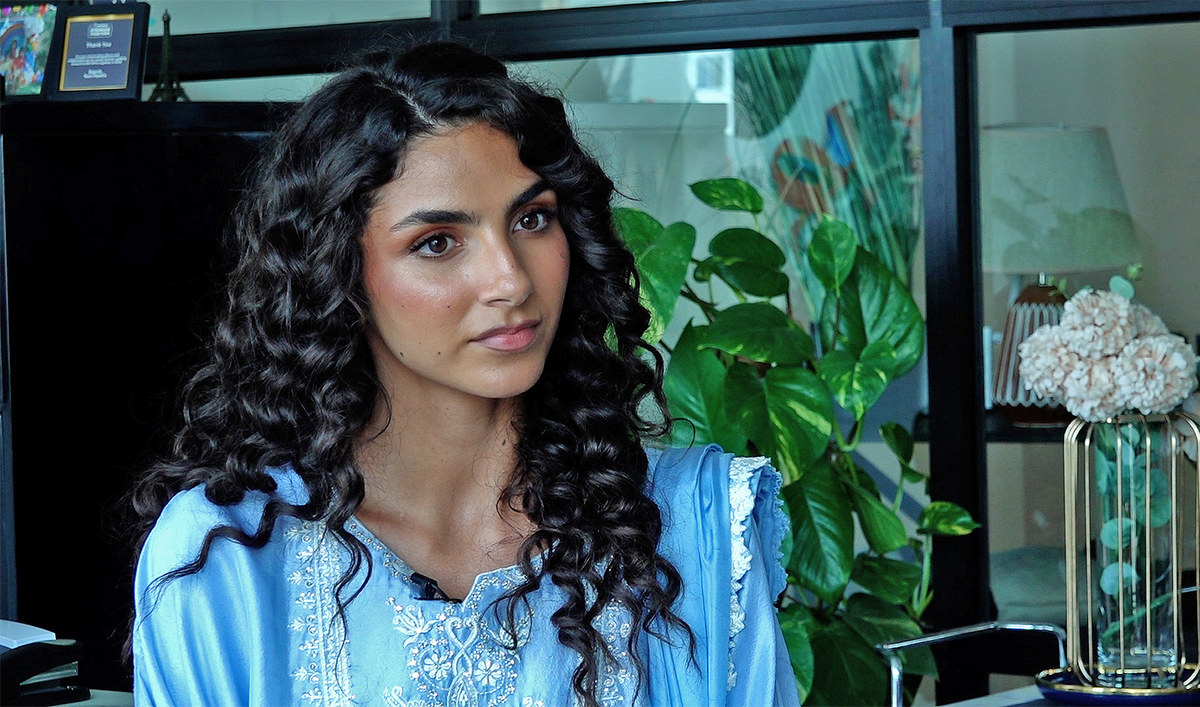
Noor Xarmina, Miss Universe Pakistan 2024, talks to Arab News Pakistan in Karachi, Pakistan on July 26, 2024. (AN photo)
Women’s safety and climate change are both major challenges in Pakistan, consistently ranked among the most dangerous countries for risks to women and seeing thousands of cases of violence against women every year, from rape and acid attacks to sexual assault, kidnappings and so-called “honor killings.”
The South Asian nation of 240 million people is also one of the most vulnerable to climate change impacts.
“There are a lot of issues that women in Pakistan face and there are very few voices that can actually translate those to a global stage,” said Xarmina, who is the second Pakistani woman to win the Miss Universe Pakistan title after Erica Robin in 2023.
“So, I hope to lean into those issues, hear them and do my best to accurately translate them to the rest of the world.”
It was “sad,” the model and actor said, that it had taken Pakistani women “this long” to take part in major beauty pageants.
“We have not just beautiful women, we have very accomplished, talented, smart, outspoken women in leadership positions. The world has a very different perception of who we are, what we do and what we can do,” she said.
“So, I feel really excited to show everyone what we are capable of. It’s a very big responsibility that I’m not going to take lightly. And I hope I can do my best and make Pakistan proud.”
“CULTURAL SENSITIVITIES”
Last year, there was outrage in Pakistan when Karachi-based model Erica Robin was chosen as Miss Universe Pakistan from among five finalists at a competition held in the Maldives. Senator Mushtaq Ahmed of the Jamaat-e-Islami party called it “shameful” while then Caretaker Prime Minister Anwar ul-Haq Kakar even ordered an investigation. There was also scathing online chatter saying Robin had brought shame to Pakistan and its Muslim values and calling on the government to denounce the Miss Universe pageant altogether.
Yet, as Robin glided onto the Miss Universe stage in El Salvador as Pakistan’s first-ever contestant, she wrote on her Instagram that she felt “blessed” that “a woman from Pakistan gets the chance to meet and bond with almost 90 stunning delegates from all over the world championing equality, purpose, and sisterhood.”
Xarmina agreed with Robin that participating in global contests like Miss Universe presented an opportunity to project Pakistan in a better light.
“Changing the impression [of the country] boils down to small conversations [and] personal interactions, whether it’s a conversation I have with the representative from Mexico or the US,” she explained.
“I hope they can see that Pakistan has a very rich culture that is really centered on respect, and love and passion and unity. And so, I hope to just resonate that and leave a lasting impression.”
Xarmina also said it was important for her to participate in the event while keeping her home country’s “cultural sensitivities” in mind.
“I’ve had a more international upbringing, so I’m comfortable wearing a lot of things. But I fully recognize that Pakistan has its cultural sensitivities. And I want to respect that, of course. I want to wear something that everyone in Pakistan is proud to see me wearing,” the Miss Universe hopeful said.
Xarmina, who has lived and worked in the UK, US, South Africa, Romania, UAE, Singapore, Canada and Portugal, is now excited about doing more modeling and acting projects in Pakistan, she said:
“A lot of people feel like they need to leave [Pakistan] and it felt a bit like I’m going the reverse. But coming back to Pakistan was the best decision I ever made … The entertainment industry in Pakistan is in more nascent stages. It’s evolving. The types of stories that we’re seeing being told on screen are also maturing. It’s the most exciting time to be an actor in Pakistan.”
Asked if she wanted to send out a message to the world in view of ongoing conflicts in Palestine, Ukraine and elsewhere, Xarmina added:
“Given the right opportunities, I would always advocate for peace. I don’t think anyone believes in innocent lives being lost over political situations. So, I will always advocate that and I hope that is the energy I receive there as well.”


