

Pakistan, Saudi Arabia discuss upcoming global conference on girls’ education

1 / 2
Saudi Arabia’s Ambassador Nawaf bin Said Al-Malki (right) meeting with Pakistan’s deputy prime minister Ishaq Dar on July 27, 2024, in Islamabad, Pakistan. (Ministry of Foreign Affairs/ X)
2 / 2
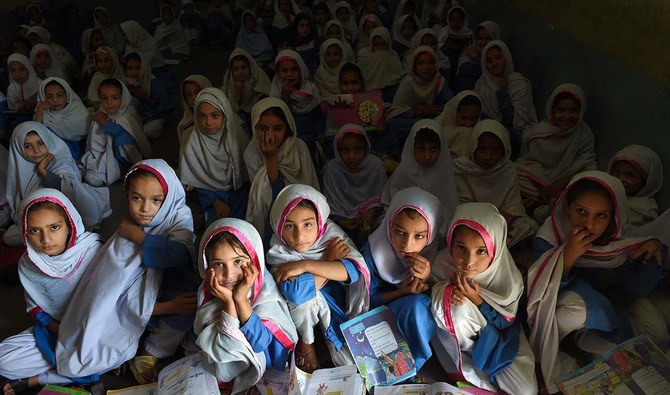
In this picture taken on September 18, 2018, girls attend a class in a school in Mingora, a town in Swat Valley. (AFP/File)
Short Url
Updated 28 July 2024
Follow

Pakistan, Saudi Arabia discuss upcoming global conference on girls’ education

  • Pakistan, Muslim World League will join hands to host global conference in Islamabad in September this year 
  • Pakistan’s deputy prime minister meets Saudi envoy to discuss cooperation in education, trade and investment

ISLAMABAD: Senior Pakistani officials this week discussed the upcoming global conference on girls’ education, scheduled to be held later this year in Islamabad, with Saudi Arabia’s Ambassador Nawaf bin Said Al-Malki, the foreign affairs ministry said. 

Pakistan will join hands with the Muslim World League (MWL) organization to host the global conference in Islamabad in September. Pakistan’s state media said last month the primary objective of the three-day conference is to “explore and formulate” effective strategies to ensure better resource allocation for promoting girls’ education on a global scale.

According to the Malala Fund, 12 million girls are out of school in Pakistan and only 13 percent of girls advance to grade IX. The international non-governmental organization says social norms such as gender stereotypes and preference for educating boys continue to prevent girls from accessing education.

Malki called on Pakistan’s deputy prime minister on Saturday to discuss the “positive trajectory of fraternal relations between Pakistan and the kingdom,” Pakistan’s Ministry of Foreign Affairs (MoFA) said in a statement. 

“Secretary education who participated in the meeting, briefed on the forthcoming conference of Muslim countries on Girls’ Education in Islamabad,” MoFA said on Saturday. 

Key topics of discussion between the two also included enhancing cooperation in various sectors including education, trade and investment, the foreign ministry said. 

“The meeting concluded with a reaffirmation of the commitment to strengthening mutually beneficial bilateral ties between the two brotherly countries,” the statement said. 

Pakistan’s state broadcaster Radio Pakistan said in June that the conference will feature a diverse group of international and national dignitaries, including education ministers from numerous Islamic countries to address and find solutions to different challenges faced by girls in the education sector. 

It said eminent scholars, education experts, policymakers and various other stakeholders are expected to attend the conference. They will share their expertise, experiences, and best practices in the field of girls’ education, Radio Pakistan said. 


Pakistan highlights economic reforms at Davos, eyes cooperation in AI, IT and minerals

Updated 6 sec ago
Follow

Pakistan highlights economic reforms at Davos, eyes cooperation in AI, IT and minerals

  • Prime Minister Shehbaz Sharif speaks at breakfast event in Davos at sidelines of World Economic Forum summit
  • Pakistan, rich in gold, copper reserves, has sought cooperation with China, US, Gulf countries in its mineral sector

ISLAMABAD: Prime Minister Shehbaz Sharif highlighted Pakistan’s recent economic reforms during the sidelines of the ongoing World Economic Forum (WEF) summit in Davos on Wednesday, saying that his country was eyeing greater cooperation in mines and minerals, information technology, cryptocurrency and artificial intelligence with other states. 

The Pakistani prime minister was speaking at the Pakistan Pavilion in Davos on the sidelines of the WEF summit at a breakfast event. Sharif arrived in Switzerland on Tuesday to attend the 56th annual meeting of the WEF, which brings together global business leaders, policymakers and politicians to speak on social, economic and political challenges. 

Pakistan has recently undertaken several economic reforms, which include removing subsidies on energy and food, privatization of loss-making state-owned enterprises and expanding its tax base. Islamabad took the measures as part of reforms it agreed with the International Monetary Fund (IMF) in exchange for a financial bailout package. 

“We are now into mines and minerals business in a big way,” Sharif said at the event. “We have signed agreements with American companies and Chinese companies.”

Islamabad has sought to attract foreign investment in its critical minerals sector in recent months. In April 2025, Pakistan hosted an international minerals summit where top companies and government officials from the US, Saudi Arabia, China, Türkiye, the UK, Azerbaijan, and other nations attended.

Pakistan is rich in gold, copper and lithium reserves as well as other minerals, yet its mineral sector contributes only 3.2 percent to the countrys GDP and 0.1 percent to global exports, according to official figures.

Sharif said Pakistan has been blessed with infinite natural resources which are buried in its mountains in the northern Gilgit-Baltistan, Khyber Pakhtunkhwa, Azad Kashmir and southwestern Balochistan regions. 

“But we have now decided to go forward at lightning speed,” he said. “And we are also moving speedily in the field of crypto, AI, IT.”

He said the government’s fiscal and economic measures have reduced inflation from nearly 30 percent a few years ago to single-digit figures, adding that its tax-to-GDP ratio had also increased from 9 to 10.5 percent. 

The prime minister admitted Pakistan’s exports face different kinds of challenges collectively, saying the country’s social indicators needed to improve. 

“But the way forward is very clear: that Pakistan has to have an export-led growth,” he said. 

Sharif will take part in an informal meeting of world leaders this year themed ‘The Importance of Dialogue in a Divided Global Landscape,’ his office said in an earlier statement. 

Pakistan’s participation at the WEF comes as Islamabad seeks to sustain recent economic stabilization and attract investment by engaging directly with policymakers, business leaders and international institutions at the annual gathering.