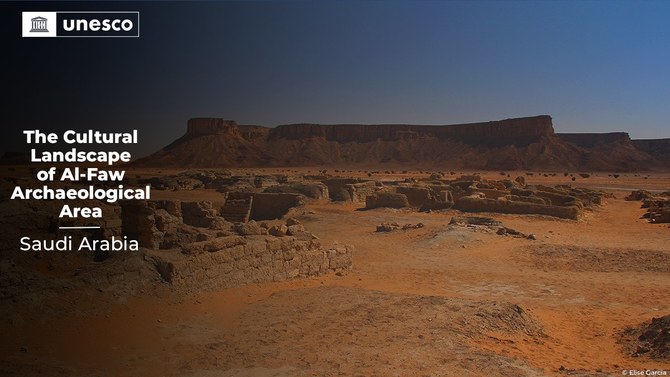
JEDDAH: Saudi Arabia’s Al-Faw archaeological site, southwest of Riyadh, on Saturday became the eighth location in the Kingdom to be registered on UNESCO’s World Heritage List.
The area in Wadi Ad-Dawasir, at the intersection of the Empty Quarter desert and the Tuwaiq mountain range, is home to almost 12,000 archaeological remains and has a history of human habitation stretching back more than 6,000 years.
UNESCO said the site was a strategic point on the ancient trade routes of the Arabian Peninsula, but was abruptly abandoned around the fifth century.
Archaeological remains uncovered at the site range from prehistoric times to the late pre-Islamic era, testifying to the successive occupation of three different populations.
Features include paleolithic and neolithic tools, tapered structures, cairns and circular constructions, the sacred mountain of Khashm Qaryah, rock carvings, funerary cairns, an ancient water management system, and remains of the city of Qaryat Al-Faw.
UNESCO said that the area’s inhabitants were known for their artistic skills in engraving, painting, and writing, and the site features residential areas and roads that formed a bridge for trade caravans.
Prince Badr bin Farhan, culture minister and governor of the Royal Commission for AlUla, wrote on X that by registering the Al-Faw archaeological area on the UNESCO World Heritage List, “we have achieved a Saudi Vision 2030 goal, with the guidance of the Crown Prince.”
He added that the registration underscores the “Kingdom’s deep historical roots and its leading role in preserving global human heritage, aligning with Saudi Vision 2030, which emphasizes the importance of national identity and heritage.”
The prince said that Saudi Arabia “understands the importance of heritage, its preservation, and educating the world about it.”
This “creates a solid foundation for the present and charts a path for the future,” he added.
Prince Badr said the commission “is committed to developing national heritage assets, increasing awareness, and ensuring their sustainability for future generations.”
Other Saudi sites on the UNESCO list are Al-Hijr (2008), At-Turaif in Diriyah (2010), Historic Jeddah (2014), Rock Art in the Hail Region (2015), Al-Ahsa Oasis (2018), Hima Cultural Area (2021), and Uruq Bani Maarid Protected Area (2023).


![]()

Al-Faw becomes 8th Saudi site on UNESCO World Heritage List
Short Url
https://arab.news/rgmqs
Al-Faw becomes 8th Saudi site on UNESCO World Heritage List
- The area in Wadi Ad-Dawasir, at the intersection of the Empty Quarter desert and the Tuwaiq mountain range, is home to almost 12,000 archaeological remains
- UNESCO said the site was a strategic point on the ancient trade routes of the Arabian Peninsula


Latest updates


Recommended


© 2026 SAUDI RESEARCH & PUBLISHING COMPANY, All Rights Reserved And subject to Terms of Use Agreement.