

Saudi Arabia’s Mawhiba ties up with UNESCO to promote STEM education in Arab countries

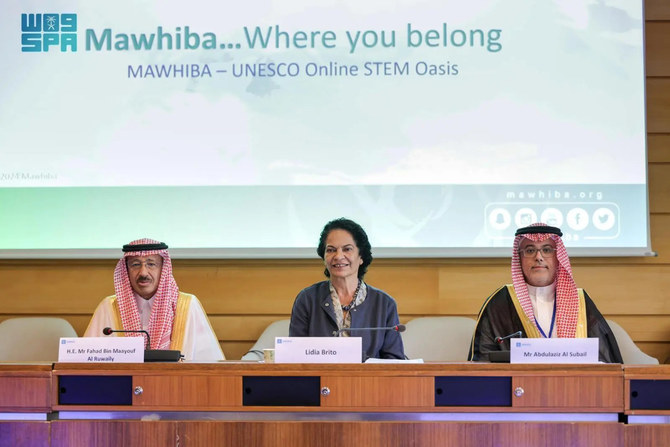
Saudi Ambassador to France and Monaco Fahd bin Mayouf Al-Ruwaili (left) joins UNESCO's Lidia Arthur Brito and Mawhiba's Abdulaziz bin Saleh Al-Subail (right) in a press conference in Paris on Friday. (SPA)
Short Url
Updated 20 July 2024
Follow

Saudi Arabia’s Mawhiba ties up with UNESCO to promote STEM education in Arab countries

  • Partnership aims to enhance STEM education for students from 6th grade to 12th grade across Arab states
  • Special attention will be given to empowering Arab girls and young women, ensuring they have equal opportunities to excel in STEM fields

PARIS: Mawhiba, an endowment organization that aims to nurture talented Saudi students in the scientific field, has signed a partnership agreement with UNESCO to foster science, technology, engineering and mathematics education across Arab countries.

The agreement was signed on July 19 in Paris by Abdulaziz bin Saleh Al-Subail, Mawhiba deputy secretary-general for business development and communication, and Lidia Arthur Brito, UNESCO’s assistant director-general for natural sciences, Mawhiba said in a news release carried by the Saudi Press Agency.

Mawhiba is the short name for the King Abdulaziz and his Companions Foundation for Giftedness and Creativity, which was organized in 1999 in honor of Saudi Arabia’s founding king.

Brito said that the partnership aimed to enhance STEM education for students from 6th grade to 12th grade across Arab states, ”focusing on refining their scientific knowledge, nurturing creativity, and fostering critical thinking.”

It sought ”to provide young people with the necessary knowledge and capabilities and to motivate them to use science, technology, engineering and mathematics to meet global challenges,” she said.

Brito said that the experience would help in exchanging these experiences globally, adding that ”there is potential for expanding these efforts to Africa and other parts of the world to promote sustainable development goals.”

Special attention would be given to empowering Arab girls and young women, ensuring they had equal opportunities to excel in STEM fields, she said.

Mawhiba has identified 97,000 gifted students out of more than 300,000 tested in more than 100 cities and villages across the Kingdom. Its sponsorship of more than 54,000 students and its participation in international science competitions for talented youth has reaped global recognition for the Kingdom. 

Saudi students have so far won more than 397 medals and prizes in these competitions, developed in excess of 16,000 ideas, acquired 15 patents, and more than 1,000 Saudi students were accepted in the world’s top 50 prestigious universities in distinguished disciplines that met the needs of national development plans, the SPA report said.

Mawhiba Secretary-General Amal bint Abdullah Al-Hazzaa emphasized the shared commitment to empowering young Arab minds and advancing sustainable development through education and innovation. She underscored the importance of this collaboration within the framework of Saudi Vision 2030.

Central to the initiative is the MAWHIBA-UNESCO Online STEM Oasis, which will serve as a global platform for local, national and regional science and engineering fairs. 

The partnership will focus on training Arab science teachers to lead research and guide students in scientific projects, thereby enhancing the overall quality of STEM education, the Mawhiba news release said.

“Mawhiba is committed to expanding the use of the UNESCO Open Science Portal and the UNESCO Science-2-Innovation Network to build the capacity of young scientists and women in STEM education globally.

“Over the past three years, Mawhiba has supported 839 students from Arab states through enriching STEM programs, setting a precedent for regional cooperation and development in STEM education,” it added.

By joining forces with UNESCO, Mawhiba aims to amplify its ability to address global challenges such as climate change, health crises and technological disruptions, it said.


Experimental farm in Al-Lith looks into future of Saudi Arabian agriculture

Updated 01 February 2026
Follow

Experimental farm in Al-Lith looks into future of Saudi Arabian agriculture

  • Research initiative reflects strategic transformation

JEDDAH: An experimental farm in Saudi Arabia’s Al-Lith Governorate is one of the research initiatives reflecting the strategic transformation taking place in the Kingdom’s agricultural sector.

The farm uses highly efficient, sustainable production models that combine scientific research with commercial application, contributing to strengthening the country’s food security system and the sustainability of water resources.

Located in the Ghumaiqa Center on an area of about 10 hectares, the cutting-edge farm is a testing platform for modern agricultural technologies that tackle the challenge of water scarcity.

The farm includes developed open fields and modern greenhouses, supported by smart irrigation encompassing drip and sprinkler irrigation alongside surface and subsurface technologies.

All the systems operate via smart controls that enable the monitoring of water consumption and ensure improved efficiency, thereby achieving a balance between agricultural production and water conservation.

The farm also uses treated and diluted low-salinity seawater.

It aims to diversify agricultural water sources, reduce reliance on freshwater, and open new horizons for agriculture in coastal and semi-arid environments.

The project represents a promising investment opportunity in the field of smart agriculture, enabling the development of commercially scalable production models, particularly for high-value vegetables and fruits, while reducing operational costs associated with water and energy, enhancing the economic feasibility of future agricultural projects.

In addition, the project contributes to transferring and localizing agricultural expertise, supporting local food supply chains, and creating an attractive environment for agricultural investment.

This aligns with Sustainable Development Goals and enhances the efficiency of the private sector in adopting innovative agricultural solutions.

Yahya bin Abdulrahman Al-Mahabi, the director of the Ministry of Environment, Water and Agriculture office in Al-Lith Governorate, told the Saudi Press Agency that the project represented the future of agriculture in the Kingdom.

He explained that the vision was based on investing in technology, enhancing the return on water per unit, and integrating scientific research with investment opportunities.

Al-Mahabi spoke of the experimental farm as a modern, scalable and replicable model applicable in several regions of the Kingdom, particularly in coastal environments.

Al-Mahabi highlighted the Ministry of Environment, Water and Agriculture’s commitment to supporting distinctive projects that contributed to achieving food security while developing rural areas and enhancing agricultural production efficiency, in line with the objectives of the Kingdom’s Vision 2030.