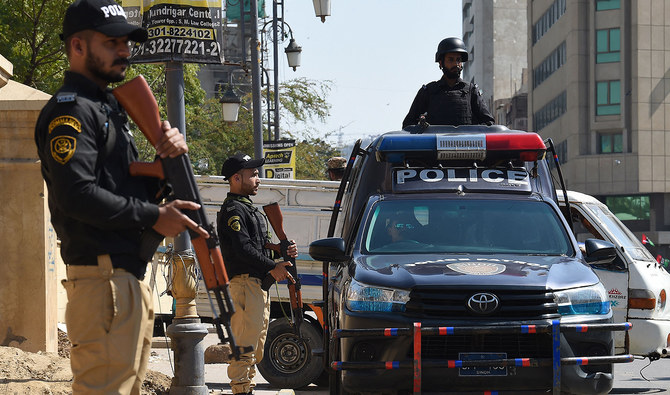
KARACHI: At least five men were killed in an armed clash between two groups in the southern Pakistani city of Karachi late Thursday, police officials said.
Both groups, who exchanged gunfire in Karachi’s Defense Housing Authority (DHA) area, belong to the Bugti tribe based in Pakistan’s southwestern Balochistan province, according to police.
Asad Raza, deputy inspector-general (DIG) of Karachi’s South district, told Arab News that both parties involved were cousins and part of extended family of late Baloch nationalist leader Nawab Akbar Khan Bugti.
“It appears that the conflict began when one party’s vehicle collided with another, leading to a heated argument that quickly escalated to an exchange of fire,” Raza said.
“The two cousins already had past family issues, and the accident acted as a catalyst for the tragedy.”
Police had arrested 17 individuals from both sides, including two gunmen from crime scene and two injured persons, according to the official.
Clashes among tribesmen over family feuds and lands have been a common occurrence in Pakistan’s southwestern Balochistan and southern Sindh provinces.
Earlier this year, Bugti tribesmen attacked bandits in riverine areas of Sindh near the Punjab-Balochistan border and killed nine dacoits, according to local media reports.
The Bugti tribesmen attacked the area to avenge the killing of one of their tribal leaders, Sardar Abdul Rehman Kalpar Bugti, who was allegedly gunned down by the bandits.
The warring factions often accuse each other of injustices and police of siding with opponents, an allegation denied by the law enforcers.

Five killed in armed clash between rival groups in Pakistan’s Karachi
https://arab.news/yh87m
Five killed in armed clash between rival groups in Pakistan’s Karachi
- Both groups, who exchanged gunfire in Karachi’s Defense Housing Authority, belong to the Bugti tribe based in the southwestern Balochistan province
- DIG Asad Raza says the rival groups were led by cousins who already had family issues and an accident involving their cars acted as catalyst for tragedy
Pakistani, Bangladeshi officials discuss trade, investment and aviation as ties thaw
- Pakistan and Bangladesh were once one nation, but they split in 1971 as a result of a bloody civil war
- Ties between Pakistan, Bangladesh have warmed up since last year and both nations have resumed sea trade
ISLAMABAD: Pakistan's High Commissioner to Bangladesh Imran Haider on Sunday met Chief Adviser Muhammad Yunus in Dhaka, the latter's office said on, with the two figures discussing trade, investment and aviation.
Pakistan and Bangladesh were once one nation, but they split in 1971 as a result of a bloody civil war, which saw the part previously referred to as East Pakistan seceding to form the independent nation of Bangladesh.
Ties between Pakistan and Bangladesh have warmed up since former prime minister Sheikh Hasina’s ouster as a result of a student-led uprising in August 2024. Relations remain frosty between Dhaka and New Delhi over India’s decision to grant asylum to Hasina.
Pakistan has attempted to forge closer ties with Bangladesh in recent months and both South Asian nations last year began sea trade, followed by efforts to expand government-to-government commerce.
"During the meeting, both sides discussed ways to expand cooperation in trade, investment, and aviation as well as scaling up cultural, educational and medical exchanges to further strengthen bilateral relations between the two South Asian nations," Yunus's office said in a statement on X.
In 2023-24 Pakistan exported goods worth $661 million to Bangladesh, while its imports were only $57 million, according to the Trade Development Authority of Pakistan. In Aug. this year, the Pakistani and Bangladeshi commerce ministries signed a memorandum of understanding to establish a Joint Working Group on Trade, aiming to raise their bilateral trade volume to $1 billion in the financial year that began in July.
The Pakistani high commissioner noted that bilateral trade has recorded a 20 percent growth compared to last year, with business communities from both countries actively exploring new investment opportunities, according to the statement.
He highlighted a significant increase in cultural exchanges, adding that Bangladeshi students have shown strong interest in higher education opportunities in Pakistan, particularly in medical sciences, nanotechnology, and artificial intelligence. Haider also said that Dhaka-Karachi direct flights are expected to start in January.
"Chief Adviser Professor Muhammad Yunus welcomed the growing interactions between the two countries and emphasized the importance of increased visits as well as cultural, educational and people-to-people exchanges among SAARC (South Asian Association for Regional Cooperation) member states," the statement read.
"Professor Yunus also underscored the need to further boost Bangladesh–Pakistan trade and expressed hope that during Mr. Haider’s tenure, both countries would explore new avenues for investment and joint venture businesses."


