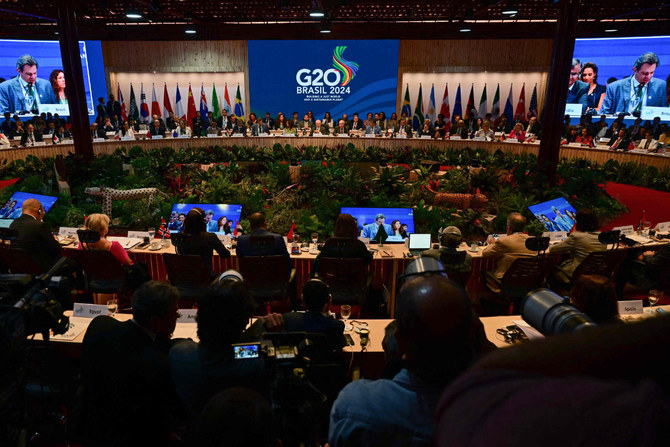

RIO DE JANEIRO: The world’s 20 biggest economies (G20) agreed on Thursday to work together to ensure the ultra rich are effectively taxed, in a declaration that seeks a balance between national sovereignty and more cooperation on tax avoidance.
The declaration, which will be published on Friday, was a priority for Brazil, chairing talks of the G20 this year, whose leader Luiz Inacio Lula, a former factory worker, was pushing to include the “billionaire tax” on the G20 agenda.
“With full respect to tax sovereignty, we will seek to engage cooperatively to ensure that ultra-high-net-worth individuals are effectively taxed,” the G20 tax declaration, seen by Reuters, said.
“Cooperation could involve exchanging best practices, encouraging debates around tax principles, and devising anti-avoidance mechanisms, including addressing potentially harmful tax practices,” it said.
Brazil has spurred discussion of a proposal to levy a 2 percent wealth tax on fortunes over $1 billion, raising estimated revenue of up to $250 billion annually from 3,000 individuals.
“What started today is a broader process that will require the participation of academia, scholars, and international organizations with experience and time, such as the OECD and the UN,” Finance Minister Fernando Haddad told reporters.
France, Spain and South Africa — which will chair the G20 in 2025 — had expressed support, an official from the Brazilian Ministry of Finance told journalists last week.
Others in the G20, while supportive, noted how difficult it is likely to be to implement the agreement.
“We all know that we are starting a process which is very, very challenging,” European Economic Commissioner Paolo Gentiloni said on the sidelines of the G20 meeting.
“The first step will be to work on exchange of information among different countries. It will be something to discuss in the coming months and years.”
US Treasury Secretary Janet Yellen also applauded the spirit of discussions on the declaration, but was wary of a new global tax policy, noting US President Joe Biden had proposed several policies to that end, including a “billionaires tax.”
“We think ... it makes sense for most countries to take this approach of progressive taxation. And we are happy to work with Brazil on that and propagate these ideas in the G20,” she told reporters at the G20 meeting.
“But tax policy is very difficult to coordinate globally and we don’t see a need or really think it is desirable to try to negotiate a global agreement on that. We think that all countries should make sure that their taxation systems are fair and progressive.”
Washington is not the only skeptic. On the eve of the G20 meeting, Germany’s finance ministry said it considers the idea of a minimum wealth tax to be “irrelevant.”
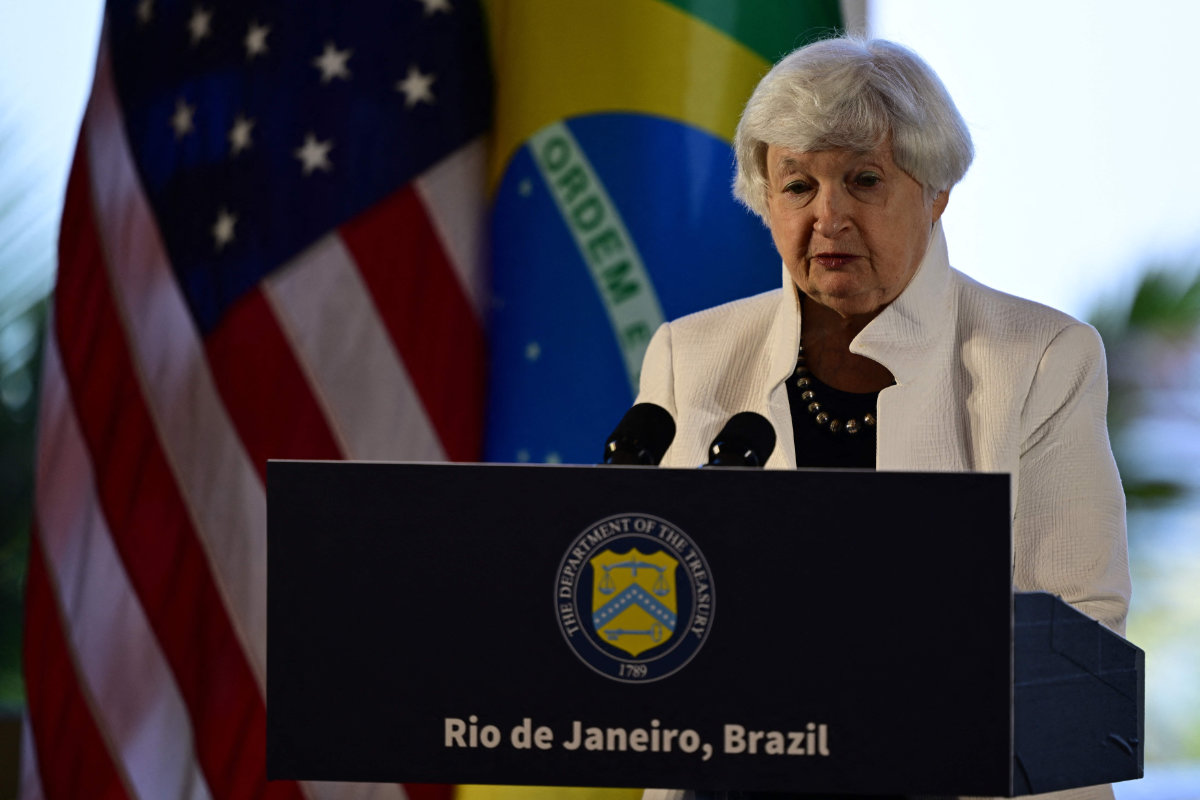
US Treasury Secretary Janet Yellen holds a press conference in the framework of the G20 Ministerial Meeting in Rio de Janeiro, Brazil, on July 25, 2024. (AFP)
Tax havens
An agreement on a global tax on billionaires is necessary to diminish the attractiveness of tax havens, said economist Bruno Carazza, a professor at the Dom Cabral Foundation, a business school.
Billionaires currently pay the equivalent of 0.3 percent of their wealth in taxes, according to a report from French economist Gabriel Zucman commissioned by Brazil. The report said a 2 percent tax would raise $200 billion to $250 billion per year globally from about 3,000 individuals, money that could fund public services such as education and health care as well as the fight against climate change.
The richest 1 percent have amassed $42 trillion in new wealth over the past decade, nearly 36 times more than the entire bottom 50 percent of the world’s population, according to an Oxfam analysis released Thursday ahead of the finance ministers’ meeting.
Brazil’s President Luiz Inácio Lula da Silva defended the need for increased taxation of the world’s richest in Rio on Wednesday when he unveiled plans for a global alliance against hunger and poverty.
“At the top of the pyramid, tax systems stop being progressive and become regressive. The super-rich pay proportionally much less tax than the working class,” Lula said.
“Some individuals control more resources than entire countries. Others have their own space programs,” he added.
The “billionaire tax” would be aimed at the world’s richest individuals such as Tesla and Space X owner Elon Musk, with a fortune that Forbes magazine estimates at around $235 billion, Amazon owner Jeff Bezos with some $200 billion, or French luxury goods tycoon Bernard Arnault with a fortune of some $180 billion.
According to charity Oxfam, the richest 1 percent have amassed $42 trillion in new wealth over the past decade, nearly 34 times more than the entire bottom 50 percent of the world’s population, deepening wealth inequality.
The average wealth per person in the top 1 percent rose by nearly $400,000 in real terms over the last decade compared to just $335 — an equivalent increase of less than nine cents a day — for a person in the bottom half, Oxfam said.
The global alliance against hunger and poverty aims to implement a mechanism to mobilize funds and knowledge to support the expansion of policies and programs to combat inequality and poverty, according to a statement from Brazil’s G20 press office on Tuesday. It would be managed by a secretariat located at the UN Food and Agriculture Organization headquarters in Rome and Brasilia until 2030, with half of its costs covered by Brazil, Lula said in his speech.