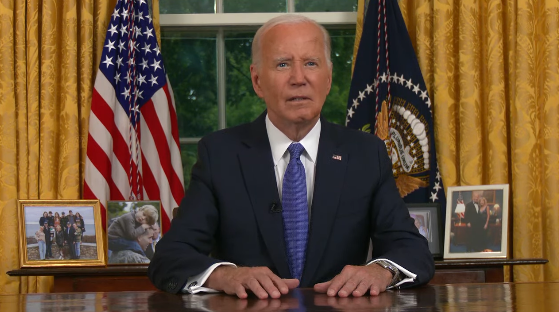
WASHINGTON: President Joe Biden on Wednesday delivered a solemn call to voters to defend the country’s democracy as he laid out in an Oval Office address his decision to drop his bid for reelection and throw his support behind Vice President Kamala Harris.
Insisting that “the defense of democracy is more important than any title,” Biden used his first public address since his announcement Sunday that he was stepping aside to deliver an implicit repudiation of former President Donald Trump. He did not directly call out Trump, whom he has called an existential threat to democracy. The 10-minute address also gave Biden a chance to try to shape how history will remember his one and only term in office.
“Nothing, nothing can come in the way of saving our democracy,” Biden said. “And that includes personal ambition.”
It was a moment for the history books — a US president reflecting before the nation on why he was taking the rare step of voluntarily handing off power. It hasn’t been done since 1968, when Lyndon Johnson announced he would not seek reelection in the heat of the Vietnam War.
“I revere this office,” Biden said. “But I love my country more.”
Trump, just an hour earlier at a campaign rally, revived his baseless claims of voter fraud in the 2020 presidential election, which he lost to Biden. His refusal to concede inspired the Capitol insurrection of Jan. 6, 2021, which Biden called “the worst attack on our democracy since the Civil War.”
Biden skirted the political reality that brought him to that point: His abysmal performance in a debate against Trump nearly a month ago, where he spoke haltingly, appeared ashen and failed to rebut his predecessor’s attacks, sparked a crisis of confidence from Democrats. Lawmakers and ordinary voters questioned not just whether he was capable of beating Trump in November, but also whether, at 81, he was still fit for the high-pressure job.
Biden tried to outlast the skepticism and quell the concerns with interviews and tepid rallies, but the pressure to step aside only mounted from the party’s political elites and from ordinary voters.
“I have decided the best way forward is to pass the torch to a new generation,” Biden said, saying he wanted to make room for “fresh voices, yes, younger voices.”
He added, “That is the best way to unite our nation.”
It was a belated fulfillment of his 2020 pledge to be a bridge to a new generation of leaders — and a bow to the drumbeat of calls from within his party to step aside.
Biden’s address was carried live by the major broadcast and cable news networks. He spooled out an weighty to-do list for his last six months in office, pledging to remain focused on being president until his term expires at noon on Jan. 20, 2025. He said he would work to end the war between Israel and Hamas in Gaza, fight to boost government support to cure cancer and push for Supreme Court reform, among other things.
The president sought to use the address to outline the stakes in the election, which both Biden and Harris have framed as a choice between freedom and chaos, but he tried to steer clear of overt campaigning from his official office.
“The great thing about America is here, kings and dictators do not rule,” Biden said. “The people do. History is in your hands. The power is in your hands. The idea of America — lies in your hands.”
Biden was also making the case for his legacy of sweeping domestic legislation and the renewal of alliances abroad. But the way history will remember his time in office and his historic decision to step aside is intertwined with Harris’ electoral result in November, particularly as the vice president runs tightly on the achievements of the Biden administration.
His advisers say he intends to hold campaign events and fundraisers benefiting Harris, whom Biden praised as “tough” and “capable,” albeit at a far slower pace than if he had remained on the ballot himself.
Harris advisers will ultimately have to decide how to deploy the president, whose popularity sagged as voters in both parties questioned his fitness for office.
Biden, aides say, knows that if Harris loses, he’ll be criticized for staying in the race too long and not giving her or another Democrat time to effectively mount a campaign against Trump. If she wins, she’ll ensure his policy victories are secured and expanded, and he’ll be remembered for a Washingtonian decision to step aside for the next generation of leadership.
Biden said he’s grateful to have served as president — nowhere else would a kid with a stutter grow up to sit in the Oval Office.
“I’ve given my heart and my soul to our nation,” he said. “I’ve been blessed a million times in return.”
Press secretary Karine Jean-Pierre said Wednesday that any question of Biden resigning his office before the election — which would allow Harris to run as an incumbent — was “ridiculous.”
Jean-Pierre said Biden has “no regrets” about his decision to stay in the race as long as he did, or his decision to quit it over the weekend. She said Biden’s decision had nothing to do with his health.


![]()

Biden delivers solemn call to defend democracy, promises to work to end Gaza war
Short Url
https://arab.news/bkfxf
Biden delivers solemn call to defend democracy, promises to work to end Gaza war
- President tells Americans the idea of the USA ‘lies in your hands’
- Promises to work to bring peace and security to Middle East


Latest updates


© 2026 SAUDI RESEARCH & PUBLISHING COMPANY, All Rights Reserved And subject to Terms of Use Agreement.