


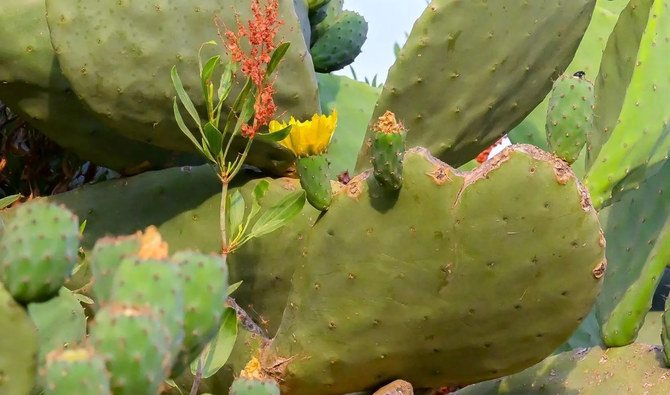
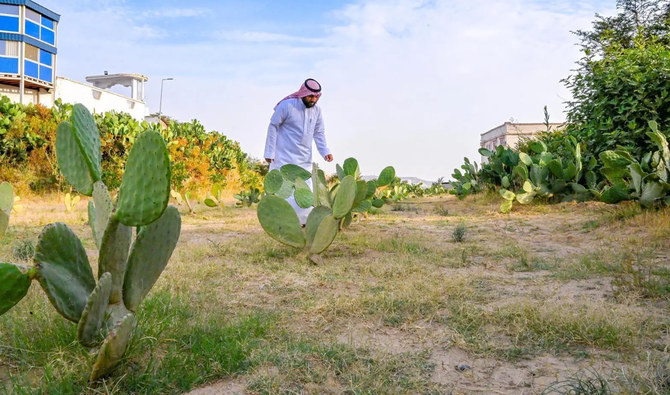
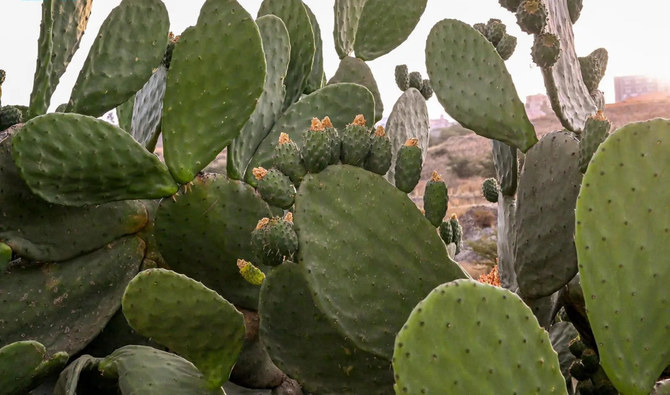

BAHA: In the heart of Saudi Arabia’s Baha region, a humble cactus is sparking an agricultural revolution. The prickly pear, known locally as Al-Barshumi, has blossomed from a niche crop into a burgeoning industry.
Once confined to private farms, prickly pear cultivation has spurred scientific research and yielded an array of food, medical and cosmetic products.
The fruit’s triumph is evident in the vibrant tapestry of green, yellow and red hues that now adorn Baha’s mountains, terraces, valleys and plains — a spectacle amplified by the region’s regular rainfall.
Fahd Al-Zahrani, director general of the Baha branch of the Ministry of Environment, Water and Agriculture, spoke about the government’s commitment to this agricultural renaissance.
“We have established a dedicated production line and oil press benefiting all regional farmers,” he said.
He also hinted at plans for a more comprehensive production line and the creation of an integrated prickly pear city, developed in partnership with the region’s Prickly Pear Association.
The initiative’s architect, Faeq Al-Ghamdi, recounted its humble beginnings. He said that what started as 80 tangled seedlings on a single farm had flourished into a network of 26 cooperating farms, collectively producing 40-70 tonnes annually.
By 2021, the farms had more than 400 seedlings of premium varieties, including “Gimoncaryo” and “Marez.” This growth has enabled a diversification beyond simple fruit production, with the range of innovative products, including prickly pear juice, ice cream and soap.
Al-Ghamdi’s original farm now has 3,000 seedlings, including imported varieties, with an annual yield of 3-5 tonnes.
“In just four years, we’ve developed 20 products, with some already registered and others in various stages of registration and research,” he said, adding that more innovations, including a perfume extract, were in the pipeline.
The project, known as the Al-Sarah Al-Barshumi Initiative, has also spawned seven scientific studies aimed at sustainable development of the prickly pear plant.
Al-Ghamdi’s vision extends beyond cultivation toward establishing Baha as a regional leader in prickly pear production, achieving domestic self-sufficiency and tapping into export markets. The project is working to double the current acreage dedicated to cultivation, establishing model agricultural cities, creating a specialized processing industry and marketing 30 prickly pear products.
“The cultivation process begins with what we call pads or stems,” he said. “These parts are carefully separated from the mother plant and we then expose these cuttings to sunlight for a period of seven to 10 days due to the high fluid content of the pads, allowing them to dry and prepare for planting. Once cured, we carefully select the planting formation.”
Beyond its economic impact, the prickly pear boom promises significant health benefits, according to Dr. Nadia Al-Zahrani, a nutrition specialist at Al-Baha University.
“Prickly pears come in a spectrum of colors, ranging from green to red, with the red variety being notably the sweetest,” she said.
Noting their rich content of fiber, vitamins E, C, and K, and various minerals she said: “These components contribute to weight management and blood sugar and lipid levels regulation.”
Al-Zahrani said another use of the prickly pear fruit was in skin care.
“The rich vitamin and mineral content of the cactus play a crucial role in enhancing skin appearance and health,” she said.
A number of farmers in the region are cultivating prickly pears, capitalizing on the area’s unique environmental assets, leveraging the region’s fertile soil and abundant water resources.
They have embraced modern cultivation techniques and begun introducing new varieties of fruits and trees, many of which were previously unknown in the region.


