

Islamabad pushes local mobile manufacturing to create jobs, deepen industrial base

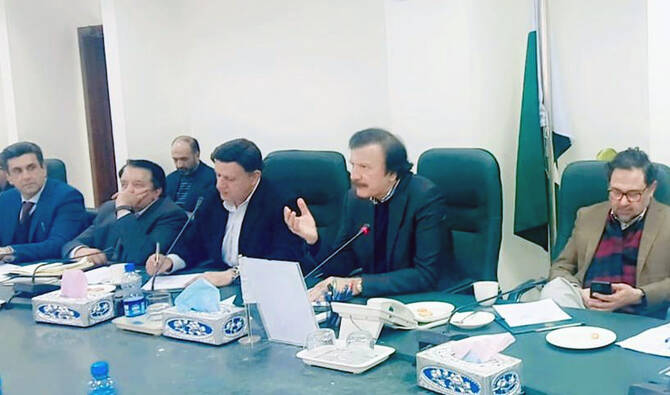
Special Assistant to the Prime Minister, Haroon Akhtar Khan (second right), chairs a high-level meeting on the Mobile and Electronic Device Manufacturing Policy, in Islamabad, Pakistan, on January 6, 2026. (Ministry of Industries and Production)
Short Url
Updated 06 January 2026
Follow

Islamabad pushes local mobile manufacturing to create jobs, deepen industrial base

  • The government says it plans to move toward phased localization of components to cut import dependence
  • It warns incentives can be withdrawn and import licenses suspended for firms missing compliance targets

KARACHI: Pakistan plans to expand local manufacturing of mobile phones and electronic devices to strengthen its industrial base and create employment, a senior official said on Tuesday, as authorities reviewed progress on a proposed mobile and electronics manufacturing policy.

The push is part of the government’s effort to move the mobile sector away from reliance on imported finished devices toward phased localization of manufacturing, with officials aiming to encourage higher-value production and reduce dependence on imports over time.

“The primary objective of the policy is to create employment opportunities at the local level and to strengthen Pakistan’s industrial base,” said Haroon Akhtar Khan, special assistant to the prime minister, while chairing a meeting on the Mobile and Electronics Device Manufacturing Policy, according to an official statement.

“Phased localization will be adopted to encourage foreign investment in high-tech manufacturing, ensuring sustainable industrial growth,” he added.

Under the proposed framework, the government plans to prioritize local manufacturing of key components, including motherboards, printed circuit boards, electronic parts and display components.

Khan said the policy would introduce strict compliance mechanisms, warning that incentives would be withdrawn and penalties imposed in cases of violations related to localization targets, reporting requirements or operational obligations.

Import licenses could also be suspended in cases of non-compliance, the statement said.

Representatives of mobile phone manufacturers attending the meeting said global brands such as Samsung, Xiaomi, Oppo, Vivo and Nokia could be potential candidates for investment under the policy framework, while noting that growth in the mobile sector could have spillover effects for other electronics industries.

Manufacturers also stressed the need for government-backed testing and certification laboratories to ensure export-quality standards, a proposal officials said would be reviewed as part of the policy process.


Pakistan joins 22 Muslim states, OIC to condemn Israeli FM’s visit to Somaliland

Updated 08 January 2026
Follow

Pakistan joins 22 Muslim states, OIC to condemn Israeli FM’s visit to Somaliland

  • Israeli Foreign Minister Gideon Saar visited breakaway African region of Somaliland on January 6
  • Muslim states urge Israel to withdraw Somaliland recognition, respect Somalia’s sovereignty

ISLAMABAD: A joint statement by Pakistan, 22 other Muslim states and the Organization of Islamic Cooperation (OIC) on Thursday condemned Israeli Foreign Minister Gideon Saar’s recent visit to Somaliland as a violation of the African nation’s territorial integrity and sovereignty.

Saar’s visit to Somaliland capital Hargeisa on Jan. 6 followed Israel’s move last month to recognize Somaliland, a breakaway region from Somalia, as an independent country. The move drew a sharp reaction from Muslim states, including Pakistan, who said it was in contravention of the UN Charter and international norms. 

Several international news outlets months earlier reported that Israel had contacted Somaliland over the potential resettlement of Palestinians forcibly removed from Gaza. Muslim countries fear Israel’s recognition of the breakaway region could be part of its plan to forcibly relocate Palestinians from Gaza to the region. 

“The said visit constitutes a clear violation of the sovereignty and territorial integrity of the Federal Republic of Somalia, and undermines established international norms and the United Nations Charter,” the joint statement shared by Pakistan’s foreign office, read. 

The joint statement was issued on behalf of 23 Muslim states, including Saudi Arabia, Bangladesh, Pakistan, Egypt, Iraq, Iran, Palestine, Jordan, Kuwait, Türkiye, Oman and others. 

It reaffirmed support for Somalia’s territorial integrity and sovereignty, pointing out that respect for international law and non-interference in the internal affairs of sovereign states was necessary for regional stability. 

“Encouraging secessionist agendas are unacceptable and risk exacerbating tensions in an already fragile region,” the statement said. 

The joint statement urged Israel to revoke its recognition of the breakaway region. 

“Israel should fully respect Somalia’s sovereignty, national unity and territorial integrity and honor its obligations in compliance with international law, and demand immediate revocation of the recognition issued by Israel,” the statement read.

Somaliland broke away from Somalia unilaterally in 1991 as a civil war raged in the country. Somaliland has its own constitution, parliament and currency, a move that has infuriated Somalia over the years as it insists the region is part of its territory.