


LONDON: Israel’s military has killed dozens of Palestinian civilians and wounded hundreds more, including children, in its relentless pursuit of Hamas commanders in Gaza, despite designating many of its areas of operation as “safe zones.”
Palestinian health officials said on Monday that 16 civilians were killed in eastern Khan Younis under Israeli shelling, even after Israel issued new orders to evacuate some neighborhoods to keep the civilian population away from areas of combat.
This latest bloodshed followed Israel’s July 13 airstrike on Al-Mawasi camp, another designated safe zone in southern Gaza, which killed at least 90 Palestinians and wounded 300 others, according to Gaza’s Health Ministry.
Israel said the target of this strike was Mohammed Deif, head of Hamas’ military wing, the Al-Qassam Brigades, as well as Rafa Salama, commander of the group’s Khan Younis Brigade, whom Israel believes was a mastermind of the Oct. 7, 2023, Hamas-led attack.
Denying reports of his death, a Hamas official told the AFP news agency following the strike that Deif was “well and directly overseeing” operations, but he provided no proof for the claim.
Meanwhile, Daniel Hagari, the spokesman for the Israeli military, has said “there are increasing signs that we succeeded in the elimination of Mohammed Deif.”

Smoke rises from Gaza, amid the Israel-Hamas conflict. (Reuters)
Speaking to Al-Arabiya TV channel on Friday, he said: “Rafa Salama was certainly eliminated; Mohammed Deif and Salama sat side by side during the strike. Hamas is hiding what happened to Deif.”
Herzi Halevi, Israel’s chief of the general staff, has also accused Hamas of “concealing the results” of the strike on a west Khan Younis compound, where both Deif and Salama were purportedly hiding.
Regardless of whether the strike on Al-Mawasi was successful or not, the attack on an area packed with civilians drew global condemnation, with observers accusing the Israeli military of violating international humanitarian law.
Josep Borrell Fontelles, the high representative of the EU for foreign affairs and security policy, wrote on the social media platform X: “Wars have limits enshrined in international law; end can’t justify all means. We condemn the violation.”
He added: “Once again we call for access to independent investigations and accountability, and for an end to the appalling situation of innocent civilians in Gaza.”
On the day of the attack, US Secretary of State Antony Blinken met with Israel’s Strategic Affairs Minister Ron Dermer and National Security Adviser Tzachi Hanegbi “to express our serious concern about the recent civilian casualties in Gaza.”

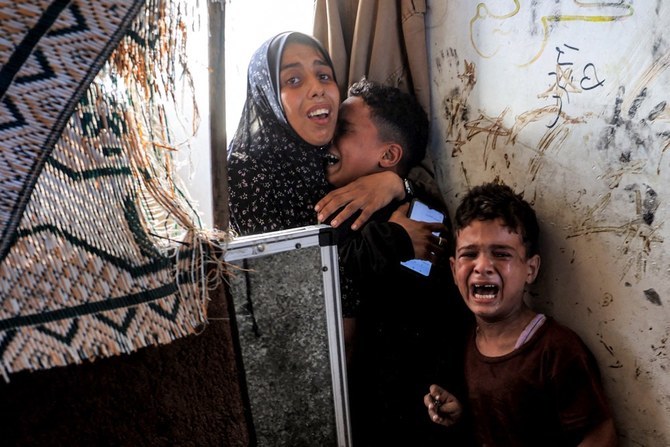
Women react after Israeli bombardment as they take refuge at the Jaouni school. (AFP)
The deadly Al-Mawasi strike was not the first incident since the conflict began on Oct. 7 in which the Israeli military has been accused of disregarding the safety of civilians and violating international humanitarian law in the pursuit of Hamas commanders.
In the fighting since the Hamas-led Oct. 7 attack, at least 38,900 Palestinians, including more than 13,000 children, have been killed, according to the UN Human Rights Office. The proportion of the dead who were combatants is a matter of dispute.
The Israeli army’s bombing campaign, which Israeli officials say is aimed at Hamas and not civilian targets, has also destroyed medical, sanitation, and educational infrastructure across the Palestinian enclave.
Last month, in an operation that rescued four hostages, the Israeli military killed and injured hundreds of Palestinians in the densely populated Nuseirat refugee camp in central Gaza.
The Israeli military said there were “under 100” Palestinian casualties but was uncertain how many of them were “terrorists.”
But almost a quarter of the 142 killed in the operation were women and children, Al-Awda Hospital in Nuseirat told BBC Arabic’s “Gaza Today” show, adding that 250 others were injured.

Children walk past a destroyed classroom in the Gaza Strip. (AFP)
Expressing “profound shock” at the impact on civilians in Nuseirat, UN spokesman Jeremy Laurence said the Israeli forces’ actions “seriously call into question whether the principles of distinction, proportionality, and precaution … were upheld.”
In March, the Israeli military mounted a raid on Gaza’s largest medical facility, Al-Shifa Hospital, where it claimed Hamas fighters and other Palestinian militants were hiding.
Some 3,000 people were sheltering in Al-Shifa at the time of Israel’s raid, Gaza’s Hamas-run Health Ministry said. At least 1,500 Palestinians, including 13 children and 21 patients, were killed in the two-week raid, according to the Euro-Med Monitor, a nongovernmental organization headquartered in Geneva.
Israeli officials said that “over 200 terrorists” were killed in and around Al-Shifa, as well as hundreds detained, including several Hamas and Palestinian Islamic Jihad operatives.
It has been impossible to independently verify the reported numbers due to a lack of reporting access to Gaza.

Israeli soldiers travel in a military vehicle by the Israel-Gaza border. (Reuters)
Between July 8 and 12, Israel attacked six schools operated by the UN Relief and Works Agency, killing dozens of civilians sheltering in the area, before reportedly razing the UN agency’s headquarters in Gaza City on July 15.
Israel has accused local staff at UNRWA of participating in the Oct. 7 attack on southern Israel, prompting the UN agency to launch an internal investigation and several major donors, including the US, to suspend funding for its operation in Gaza and throughout the region.
UNRWA Commissioner-General Philippe Lazzarini called Israel’s attack on his agency’s Gaza headquarters “another episode in the blatant disregard of international humanitarian law.”
In a post on X, he said: “UN facilities must be protected at all times. They must never be used for military or fighting purposes. Every war has rules. Gaza is no exception.”
In a separate post, Lazzarini stressed that “schools must never be used for fighting or military purposes by any party to the conflict.”
NOTABLE CIVILIAN CASUALTY EVENTS
• Oct. 7, 2023: 1,200 Israeli and other nationals killed in southern Israel, hundreds taken hostage, in Hamas-led attack.
• Oct. 31, 2023: 110+ Palestinians killed in Israeli strike targeting ‘senior Hamas commander’ in Jabalya refugee camp in northern Gaza.
• Feb. 29, 2024: 112 Palestinians waiting for aid killed, 760 more injured outside Gaza City amid Israeli gunfire and panic.
• April 1: 7 World Central Kitchen workers killed in Israeli strikes in violation of military procedures on convoy delivering aid in Gaza.
• May 27: 45+ Palestinians killed in Israeli strike targeting ‘two senior Hamas commanders’ in Rafah.
• June 9: 274 Palestinians killed in Israeli military raid that freed 4 hostages who were held in Nuseirat refugee camp.
• July 13: 90+ Palestinians killed, 300 wounded in Israeli airstrike targeting Hamas military chief Mohammed Deif in Al-Mawasi.
Source: Gaza Health Ministry, Israeli govt.
Warning that “all rules of war have been broken in Gaza,” he said: “The blatant and constant disregard of international humanitarian law continues unabated.”
Israel has consistently denied accusations that it targets civilian infrastructure, accusing Hamas and other Palestinian militant groups of using tunnels under Gaza’s hospitals to mount attacks and conceal weapons, thereby using the population as human shields.
Commenting on Israel’s conduct, a New York-based international lawyer, who asked to remain anonymous, told Arab News that in the Gaza war, “international law remains relevant as a framework for accountability and justice by providing mechanisms to hold perpetrators accountable for war crimes, genocide, and other atrocities.”

Palestinians walk on a street flooded with sewage water in Deir El-Balah. (AFP)
The International Criminal Court, which prosecutes individuals accused of war crimes, has made an attempt to hold “both parties to the conflict” accountable for alleged war crimes.
Israeli officials believe the ICC is likely to issue arrest warrants for Israeli Prime Minister Benjamin Netanyahu and Defense Minister Yoav Gallant within the next two weeks, Israeli media reported on July 17.
Karim Khan, ICC chief prosecutor, filed an application in May for arrest warrants against two Israeli and three Palestinian individuals suspected of war crimes and crimes against humanity.
Hamas commander Deif was among the Palestinians listed in the ICC’s arrest warrant, alongside Ismail Haniyeh, the head of Hamas’ political bureau, and Yahya Sinwar, head of the Islamist movement in Gaza.
The arrest warrants against Netanyahu and Gallant accused them of using starvation as a tool of war, extermination, and deliberately attacking civilian populations, alongside other war crimes and crimes against humanity.
Opinion
This section contains relevant reference points, placed in (Opinion field)
Khan said he had “reasonable grounds” to believe the five men bore “criminal responsibility” for alleged war crimes and crimes against humanity during the war in Gaza.
The decision caused anger among the Hamas leadership, in Israel, and even in the US. US President Joe Biden described the move as “outrageous,” saying there was “no equivalence — none — between Israel and Hamas.”
Hamas said the ICC’s prosecutor was “equating the victim with the executioner” and demanded the withdrawal of the allegations against its leaders.

Israel has consistently denied accusations that it targets civilian infrastructure. (AFP)
The New York-based international lawyer said that although international law and ongoing developments “create a foundation for addressing atrocities and fostering a more just and peaceful world,” its enforcement “can be inconsistent and subject to political influence.”
On July 19, the UN’s International Court of Justice at The Hague declared Israel’s occupation and annexation of the Palestinian territories, including the Gaza Strip, the West Banks and East Jerusalem, to be “unlawful” in a landmark ruling.
Stating that Israel’s discriminatory laws and policies against Palestinians violate the prohibition on racial segregation and apartheid, the ICJ also ordered Israel to end its occupation of the Palestinian territories “as rapidly as possible.”
Israel has since Oct. 7 also mounted dozens of raids on the West Bank and East Jerusalem, killing at least 500 Palestinians, 143 of them children, according to UN figures.
The ICJ’s recent ruling, however, is a non-binding advisory opinion that was sought by the UN General Assembly in 2022, preceding the Israeli onslaught on Gaza and not directly linked to it.
Responding to the ruling, Netanyahu’s office issued a statement saying: “The Jewish people are not occupiers in their own land — not in our eternal capital Jerusalem, nor in our ancestral heritage of Judea and Samaria (the occupied West Bank).
“No decision of lies in The Hague will distort this historical truth, and similarly, the legality of Israeli settlements in all parts of our homeland cannot be disputed.”
In December last year, South Africa brought a case against Israel before the ICJ, alleging it had committed genocide against Palestinians in the Gaza Strip.

Between July 8 and 12, Israel attacked six schools operated by the UN Relief and Works Agency, killing dozens of civilians sheltering in the area. (Reuters)
The ICJ issued a provisional ruling in January, modified in May, ordering Israel to “immediately halt its military offensive” and urging Hamas to release the hostages immediately and unconditionally.
Regardless, Israel has continued to bomb Rafah and other parts of the Gaza Strip where well over a million displaced Palestinians are sheltered, while Hamas is believed to still hold 116 hostages.
No amount of legal wrangling has brought the conflict closer to resolution.
Diplomats and region watchers continue to call on both sides to accept an immediate ceasefire, to exchange hostages and prisoners, and to actively pursue a solution to the decades-old Israeli-Palestinian conflict, including the creation of an independent Palestinian state.


