PARIS: French President Emmanuel Macron hoped the Paris Olympics would cement his legacy. But a failed bet on a snap legislative election has left him politically stunted, casting a lingering shadow over Macron’s moment on the international stage.
As he prepares to welcome more than 100 heads of state and tens of thousands of spectators for Friday’s opening ceremony along the Seine, Macron is a fragile force — an unpopular president presiding over a caretaker government as it hosts the world’s largest sporting event amid heightened security fears.
“Macron expected to welcome the Games like an emperor,” said French historian Patrick Weil. “But now he’s a lame duck.”
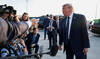
Walking around the Olympic Village on Monday, Macron defended his decision to dissolve parliament and denied the ensuing political instability would overshadow the Games.
“It was me who decided,” he said, referring to his determination to call the election ahead of the Games.
“There is no bitter taste. On the contrary, we did the things that needed to be done before (the Olympics). Now we can fully focus on the Games.”
And in a bid to keep the crisis at bay for a few weeks, he appeared to suggest he was unlikely to name a prime minister until the Games were over.
“There is a sort of truce,” he said.
Macron called the legislative vote after a thumping by the far-right National Rally (RN) in last month’s EU election, saying he wanted the poll to provide clarity.
Instead, French voters delivered a hung parliament and no bloc has so far been able to form a government, leaving Macron’s previous cabinet to manage day-to-day affairs in a caretaker capacity.
“The Olympics are a great break, an extraordinary moment, a brilliant showcase for our country,” said far-right lawmaker Julien Odoul. “But the difficulties of our compatriots continue despite the Olympic Games. And this National Assembly is currently not in a position to provide a response.”
Macron aides, Olympics officials, lawmakers and public figures stressed to Reuters that the show would go on, with years of security and logistics planning unaffected by the politics. But some acknowledged the fallout from the political crisis would hang over the Games.
Socialist lawmaker Christine Pires-Beaune said Macron’s expedited vote had left many French bewildered and angry.
“We have never been in such a thick fog,” she said.
It was not supposed to be this way.
In his New Year’s Eve address to the nation last December, Macron spoke with pride and optimism about the year ahead.
“Only once in a century does one host the Olympic and Paralympic Games,” he said. “2024 will be a year of determination, of choices and of regeneration.”
But more than six months later, Macron’s hopes of regenerating his mandate have evaporated, while the political crisis provoked by his quickfire election has also contributed to weaker-than-expected tourist appetite for the Games.
Flight and hotel bookings to Paris during the Olympics have come in lower than expected, Reuters reported earlier this month, with experts pointing the finger at high travel and accommodation costs, security fears — and political tumult.
The ceaseless drama of the US election — which has so far included an assassination attempt against Republican candidate Donald Trump and President Joe Biden dropping out of the race — has also lured eyeballs away from Macron’s flagship event.
At the Olympic Village on Monday, Macron shook hands with volunteers, wearing a confident smile.
“We are ready,” the president told police officers before thanking Olympic Village staff for their work.
French Sports Minister Amelie Oudea-Castera acknowledged that the last few weeks had been “difficult politically.”
But she rejected the idea that the political crisis had stained the Games. She said France could breathe a sigh of relief that the far-right had not won enough seats to form a government, as some polls had projected.
“I think that the Games will allow the country to come together more than ever this summer,” she told Reuters.
Arielle Dombasle, a US-born French singer and actor, recently set social media alight with her performance of a stomping, operatic Olympic number at Paris City Hall, in which she was dressed in a white, hooped, floor-length skirt and peroxide wig.
“There is a terrible bashing among the French of the Olympics, which are nevertheless an astonishing international gathering of the most extraordinary human specimens: the man who jumps the highest, the woman who swims the fastest,” she said.
“There is an atmosphere of anxiety. The world is in disorder, to say the least. But these Games are the occasion for the greatest celebrations.”


![]()

Macron’s political gamble casts shadow over Paris Olympics

Short Url
https://arab.news/m9fde
Macron’s political gamble casts shadow over Paris Olympics
- As he prepares to welcome more than 100 heads of state and tens of thousands of spectators for Friday’s opening ceremony along the Seine, Macron is a fragile force


Latest updates




© 2026 SAUDI RESEARCH & PUBLISHING COMPANY, All Rights Reserved And subject to Terms of Use Agreement.