

Kamala Harris lashes out at Trump as Democrats unite

1 / 2
US former President and 2024 Republican presidential candidate Donald Trump, a bandage on his ear after he was injured during an assassination attempt, speaks onstage during the last day of the 2024 Republican National Convention at the Fiserv Forum in Milwaukee, Wisconsin, on July 18, 2024. (AFP)
2 / 2
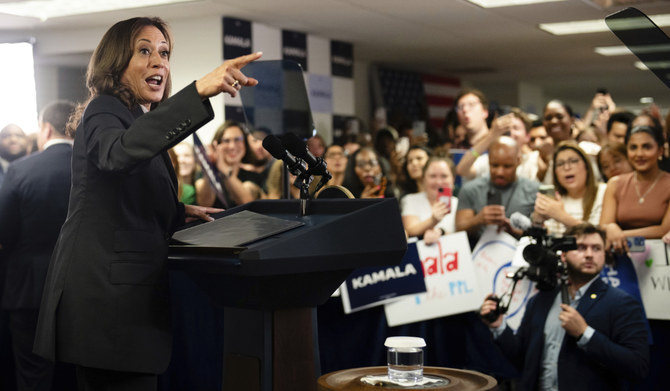
Vice President Kamala Harris speaks at her campaign headquarters in Wilmington, Del., Monday, July 22, 2024. (AP)
Short Url
Updated 23 July 2024
Follow

Kamala Harris lashes out at Trump as Democrats unite

  • "Cheaters who broke the rules for their own gain. So hear me when I say I know Donald Trump’s type”

WASHINGTON: US Vice President Kamala Harris launched her election campaign Monday with a blistering personal attack on Donald Trump and vowed to win in November despite the “rollercoaster” of President Joe Biden’s shock exit.
As she closed in on the Democratic party’s nomination with the support of a slew of heavyweights and massive voter donations, Harris lashed out at Trump in her first speech to campaign workers since Biden’s announcement Sunday.
Biden, 81, meanwhile made his first public remarks for nearly a week as he recovers from a bout of Covid.
He called in to the campaign meeting to say that dropping out — after mounting party and voter concerns over his health and mental acuity — had been the “right thing to do” and he praised Harris as “the best.”
“We are going to win in November,” a smiling Harris told campaign workers in her fiery speech at campaign headquarters in Wilmington, Delaware.
She said she had gone to the Wilmington office to address them personally after the “rollercoaster” of the last few days.
Turning her fire on Trump, Harris referred to her past role as California’s chief prosecutor, saying she “took on perpetrators of all kinds.”
“Predators who abused women. Fraudsters who ripped off consumers. Cheaters who broke the rules for their own gain. So hear me when I say I know Donald Trump’s type,” she said to applause.
Harris also pledged to focus on the politically explosive issue of abortion, after Trump praised the Supreme Court’s 2022 decision to overturn the long-held federal right to the procedure.

Biden dropped out on Sunday and endorsed Harris after three weeks of intensifying pressure, triggered by a disastrous debate performance against Trump.
Aiming to become the first woman president in US history, the 59-year-old Harris won the backing of a seemingly unassailable number of Democrats.
Notably among them was powerful former US House speaker Nancy Pelosi, who said she endorsed Harris “with immense pride and limitless optimism.”
The major AFL-CIO union federation also gave its formal endorsement on Monday.
Donors have rallied behind Harris, pouring a record $81 million into her campaign in the 24 hours after Biden stood aside.
The campaign claimed the haul was the largest one-day sum in presidential history — and that, among the 888,000 grassroots donors, some 60 percent were making their first 2024 contribution.
In his comments, Biden pledged to keep working on key topics, including ending the war in Gaza.
Addressing Harris, he added: “I’m watching you kid. I love you.”
An aide to Harris later said she would meet with Israeli Prime Minister Benjamin Netanyahu this week during his Washington visit — separate from Biden’s own planned sit-down.
Harris will not attend Netanyahu’s address to Congress, the aide said, due to a previously scheduled event.
In a strikingly symbolic moment on Monday morning, Harris hosted a ceremony for college athletes at the White House while Biden remained stuck in isolation with Covid at his Delaware beach house.
Biden’s symptoms “have almost resolved completely,” his doctor said Monday, though the White House has not yet announced any events on his schedule this week.

Biden’s stunning withdrawal has completely upended the 2024 race, transforming a long slog between two unpopular elderly men into one of the most compelling races in modern US history.
The move has jolted a demoralized party that Harris could now unify, and could give America its first female president.
It has also hit Republicans hard, with former president Trump, 78 — now the oldest presidential nominee in US history — having to completely retool a strategy that had been built around attacking Biden over his age and physical frailty.
Harris’s entry not only flips the age issue, but puts Trump — a convicted felon also found liable of sexual assault — up against a woman and former prosecutor.
And Trump has seemingly found it hard to move on from Biden.
He launched a series of invective-filled social media posts after Biden quit, mocking the president’s age and saying he and Harris posed a “threat to democracy.”
Trump’s running mate J.D. Vance echoed that line of attack at a rally in Ohio Monday, telling supporters that Harris had the momentum because “elite Democrats got in a smoke-filled room and decided to throw Joe Biden overboard.”
“That is not how it works. That is a threat to democracy,” he said.


Congressional Black Caucus and civil rights leaders unite to counter Trump administration’s agenda

Updated 4 sec ago
Follow

Congressional Black Caucus and civil rights leaders unite to counter Trump administration’s agenda

  • Rep. Yvette Clarke of New York, caucus chair, lamented the concerted effort to roll back civil rights underlying voting access and dismantling of social programs 
  • Civil rights leaders and Democratic lawmakers have already filed dozens of lawsuits against the administration’s anti-DEI policies

WASHINGTON: The Congressional Black Caucus and major civil rights groups on Tuesday marked Black History Month by relaunching a national plan to mobilize against what they say are the Trump administration’s efforts to weaken legal protections for minority communities.
The assembled leaders voiced outrage over the series of policy actions President Donald Trump has implemented since his return to the White House, as well as the president’s personal conduct, but offered few concrete details about what they’re prepared to do in response to the administration.
“Over the past year, we have seen a concerted effort to roll back civil rights underlying voting access, dismantle social programs and concentrate power in the hands of the wealthy and well-connected, at the expense of our community,” said Rep. Yvette Clarke, D-N.Y., chair of the Congressional Black Caucus.
Clarke, who spoke in front of leaders from major civil rights organizations and her Democratic colleagues, promised the caucus would “legislate, organize, mobilize our communities.” The coalition, which spoke privately before the press conference, discussed how to protect voters ahead of the fall midterms and how to build a policy agenda for Democrats should the party win back power in either chamber of Congress next year.
“It’s an all-hands-on-deck moment, and every tool available to the leadership collectively has got to be deployed to get this thing turned around,” House Minority Leader Hakeem Jeffries, D-N.Y., told The Associated Press after the press conference.
Jeffries did not rule out mass protests, organizing boycotts and further legal action as potential steps organizers may take.
The leaders’ warnings come at a moment when the Trump administration has continued its crusade against diversity, equity and inclusion across the US government, in higher education and the private sector.
At the start of his second term, Trump signed multiple executive orders banning the use of “illegal DEI” in government agencies, as well as organizations that interact with the federal government. Trump has threatened to withhold funds from major companies, non-profit groups and state governments as part of the administration’s efforts to upend DEI.
The administration has also sought to redefine the nation’s culture and how history is taught in museums, classrooms and other educational settings. It also prioritized investigating and prosecuting civil rights cases of potential discrimination against white people through both the Justice Department’s civil rights division and the Equal Employment Opportunity Commission, among other agencies.
Civil rights leaders and Democratic lawmakers have already filed dozens of lawsuits against the administration’s anti-DEI policies.
Locked out of power in both chambers of Congress, Democrats have fewer ways to conduct oversight or limit the actions of the Trump administration. And civil rights leaders, who were largely knocked on the back foot by a deluge of policy changes over the last year, are attempting to regroup ahead of this year’s midterm elections.
Progressive civil rights leaders, who are broadly unhappy with the administration’s entire agenda, have argued that the president’s agenda on immigration, voting rights, the economy and other issues is exploiting hard-won policies that civil rights leaders had, for decades, used to ensure anti-discrimination and economic advancement for Black communities.
“This is about how this administration is using the tools we built as a Black community to ensure that all of our people are protected,” said Maya Wiley, president and CEO of the Leadership Conference on Civil and Human Rights.
Progressive state leaders and civil rights groups have also stepped up their efforts elsewhere. A coalition of state attorneys general and civil rights groups this month launched a coalition to promote DEI and accessibility policies through more aggressive legal action.
“State attorneys general are in a unique position to defend these fundamental rights, and this campaign will ensure everyone is heard and shielded from those who aim to weaken civil rights,” Illinois Attorney General Kwame Raoul said in a statement on Monday announcing the initiative.
The initiative includes Democratic attorneys general from fourteen states District of Columbia, as well as over a dozen civil rights groups from across the country. The group intends to launch inquiries and file lawsuits across the country into instances where, the leaders argue, organizations may be violating anti-discrimination laws in response to the rollback of DEI policies by major companies and the Trump administration.
The effort faces an uncertain and shifting legal landscape.
Federal courts remain divided over the use of race in hiring and anti-discrimination in the workplace. And the conservative-majority on the Supreme Court has ruled against the use of race in college admissions. Several justices have voiced skepticism about how race and other characteristics can be used by government agencies and private institutions, even if a policy was meant to combat discrimination.
On Tuesday, the assembled civil rights leaders repeatedly acknowledged the uphill battle that their movement faced on multiple fronts. Some said that the administration’s policy decisions may set up stark political battles in the coming years.
Marc Morial, president of the National Urban League, said: “We commit today to fight and fight and fight until hell freezes over, and then, I can assure you, we will fight on the ice.”