


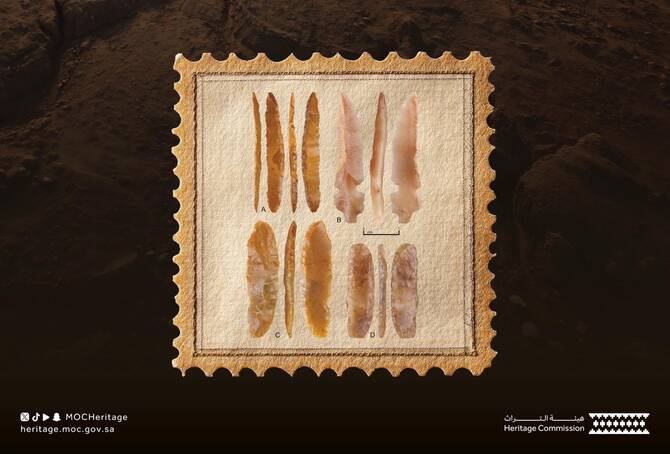

RIYADH: The Saudi Heritage Commission has revealed archaeological findings which provide evidence of a 13,500-year-old human settlement associated with the Natufian culture in northern Arabia.
The findings, presented in the journal Nature, are the result of the excavation at the Sahout site, located on the southern edge of the Nefud Desert between the Arnan and Al-Misma mountains.
The site was a strategic geographic position linking internal desert environments with settlement networks connected to the Levant, making it a key location for understanding early human movement and dispersal in the region during the late Ice Age and the beginning of the Holocene.
The study documented human settlement at the site dating back about 13,500 years.
Stratified excavation uncovered distinctive stone tools, most notably Helwan bladelets — small, finely crafted stone implements used as arrowheads or as components of hunting tools.
These artifacts are important archaeological indicators associated with Natufian culture.
Their discovery at the Sahout site confirms the presence of human communities possessing advanced technical skills and the ability to adapt to desert environments.
It also reflects the connection of the Arabian Peninsula to broader cultural networks extending to the Fertile Crescent during this early period.
The discovery also revealed a later settlement phase dating from between about 10,300 and 8,700 years ago, characterized by greater settlement density and technological development in stone industries.
Archaeologists discovered Abu Salem points, a type of finely crafted arrowhead used in hunting.
These findings provide important evidence of advanced human societies with sophisticated technological skills, reflecting a high level of organization and environmental knowledge during the Pre-Pottery Neolithic period.
Geochemical analyses of the obsidian used to manufacture the stone tools showed that the material originated from Jabal Al-Abyad in the Khaybar region, about 190 km south of the site.
This indicates the existence of extensive communication and exchange networks, demonstrating that early communities were capable of traveling long distances to obtain resources from distant areas.
The study also documented a direct link between human settlement and rock art at the site.
Carving tools were found within dated archaeological layers alongside artistic elements depicting life-size camels and human figures.


