

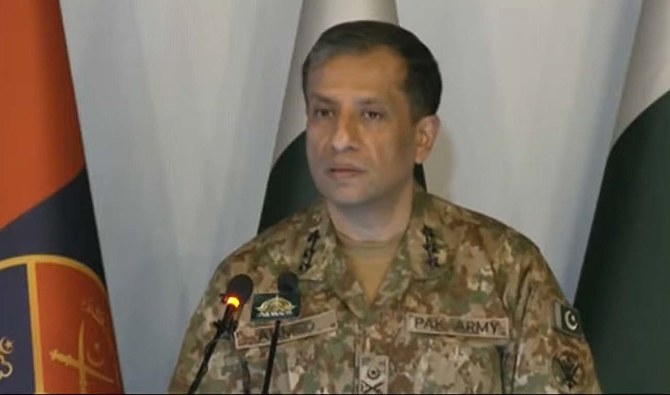

ISLAMABAD: A spokesman for the Pakistan army said on Monday anti-terrorism efforts, including a new “comprehensive” operation announced by the government, were being “politicized” to the detriment of the country’s national interests, in veiled comments against the party of jailed ex-premier Imran Khan.
Pakistan last month announced it would launch a new “multi-pronged” operation called Azm-e-Istehkam, or Resolve for Stability, that would not only eliminate militants though military and intelligence actions but also deter extremist thinking through socio-economic uplift.
The campaign has so far been rejected by opposition parties, particularly the Pakistan Tehreek-e-Insaf (PTI) party of former prime minister Khan, on the grounds that opposition parties and parliament were not consulted.
Pakistan has seen a massive surge in militancy in recent months, with daily attacks on security forces and assassinations of police and government officials. Islamabad blames the attacks on militants operating out of Afghanistan. Kabul denies that it allows its territory to be used by insurgents and says Pakistan’s security woes are a domestic issue.
Addressing a press conference on Monday, Lt. Gen. Ahmed Sharif Chaudhry said the Azm-e-Isjtehkam operation had been “politicized” by what he described as a “political mafia.”
“Why did a mafia, a political mafia, and an illegal mafia say that they would not let this [campaign] happen?” Chaudhry said, adding that opponents of the operation had tried to make it “controversial” and paint it as a purely military operation in which thousands would be displaced.
“Azm-e-Istehkam is a comprehensive and integrated counter-terrorism campaign, not a military operation as it is being presented,” he added. “This is a comprehensive campaign against terrorism, which won’t just root out terrorism but which will lift up all of society … and the stakes are very high here.”
He said 137 officers and soldiers had been killed in anti-terror operations this year and security forces had conducted 22,409 intelligence-based operations. Together, the armed forces, police, intelligence agencies, and other law enforcement agencies were conducting more than 112 operations daily, the general said.
Despite the army’s sacrifices, he said “digital terrorists” were using “fake news and propaganda” to spread lies about the army and its intentions. He was answering a question about the army’s decreasing popularity in Pakistan.
“This is digital terrorism,” Chaudhry said. “The physical terrorist also attacks law enforcement agencies and the army, and the digital terrorist also attacks the army. They are doing the same thing.”
“Digital terrorists,” the spokesman said, would be deterred through laws, regulation and monitoring.
Chaudhry’s veiled comments about the PTI and Khan came days after the federal government of PM Shehbaz Sharif announced plans to ban the party and moved the country’s top court to press treason charges against Khan.
Khan came to power in 2018 and was ousted in 2022 after what is widely believed to be a falling out with Pakistan’s powerful military, which had helped propel him into office. The army denies political interference.
Since his ouster, the PTI founder and his party have faced an ever-widening state-backed crackdown and Khan himself has been in jail since August last year. He was acquitted earlier this month in one of the last standing convictions against him but was not freed after authorities issued new orders to arrest him in another case involving riots by his followers in May last year.
Khan, arguably the country’s most popular politician, says all legal cases are motivated to keep him out of politics and dent the popularity of the PTI. He has led an unprecedented campaign of defiance against the army and independent analysts say has succeeded in denting its popularity in a nation that has been ruled by the military for nearly half its history.
The convictions against Khan had ruled him out of Feb. 8 general elections, which all candidates from his party were forced to contest as independents after the election commission denied the party its iconic symbol of a cricket bat on technical grounds. Despite the setbacks, Khan-backed candidates won the most seats in the polls but could not form the government, which is now being led by Sharif’s PML-N party in coalition with other parties.


