

Bangladesh continues curfew as students await official notice on government job reforms

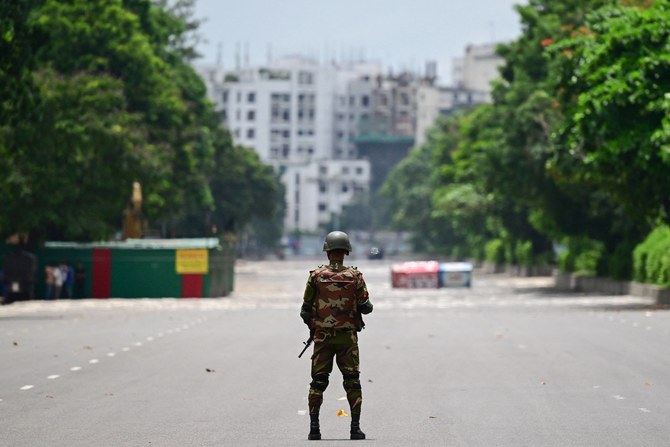
A Bangladesh army personnel stands guard near the parliament house amid a curfew following clashes between police and protestors in Dhaka on July 22, 2024. (AFP)
Short Url
Updated 22 July 2024
Follow

Bangladesh continues curfew as students await official notice on government job reforms

  • Bangladesh internet connection has been cut off since Thursday night
  • Main student group says not all of their demands have been met 

DHAKA: Bangladesh remains under curfew and a widespread communications blackout on Monday, a day after the Supreme Court scaled back a controversial job-quota system following deadly clashes that have killed more than 100 people over the past week. 

University students have been demonstrating since the beginning of this month to demand a reformation of the quota system that reserved 30 percent of government jobs for relatives of veterans who fought in Bangladesh’s 1971 liberation war. 

The peaceful protests turned violent last week, with clashes between student protesters and security forces killing 174 people and injuring thousands, according to a count by Bengali daily Prothom Alo, which reported over a dozen deaths on Sunday alone. 

Bangladesh was still under curfew for a third day on Monday, with military personnel patrolling the capital and other areas, while internet connection remained suspended across the country since it was disrupted from Thursday night. 

“Everything is in order today across the country, except a few separate incidents in Dhaka, Narayanganj and Narsingdi,” Biplab Barua, special assistant to Prime Minister Sheikh Hasina, told Arab News. 

“We hope that in the next 48 hours, the situation will take a better look, and the country will go for normal operations. We are expecting to restore the broadband Internet services tonight (Monday). As soon as the situation takes a normal look, the length of curfew hours will be eased.” 

On Sunday, the Supreme Court ordered for the quota reserved for relatives of veterans to be cut to 5 percent and for 93 percent of jobs to be allocated on merit, while the remaining 2 percent will be reserved for members of ethnic minorities and people with disabilities. 

Bangladesh’s top court was ruling on an appeal. The government had abolished the quotas following student protests in 2018 but they were reinstated by the High Court in June, setting off a fresh round of demonstrations. 

“Our students are not responsible for the anarchy and atrocities on the streets. It’s the opposition parties … which hijacked the movement from the students,” Barua said. 

“Students’ demands have been fulfilled by the court, and the government will issue a circular by Tuesday regarding the quota system in the government job.” 

Students Against Discrimination, the main protest organizing group, said on Monday that some of their demands are still unmet, including the reopening of universities as well as investigations into the deadly crackdown. 

Student protesters are also waiting for the government to issue an official notification on the Supreme Court decision. 

“Since the curfew is underway, we are not on the streets at the moment. It will endanger the lives of our students,” Sarjis Alam, a protest coordinator with Students Against Discrimination, told Arab News.  

“At the moment, we are waiting to see the government circular on the quota system … We demanded reformation of quota systems in all grades of government jobs … It’s very important to us,” he said. “(After) seeing the government’s circular, we can comment whether our demands were addressed or not.” 


Only 4% women on ballot as Bangladesh prepares for post-Hasina vote

Updated 5 sec ago
Follow

Only 4% women on ballot as Bangladesh prepares for post-Hasina vote

  • Women PMs have ruled Bangladesh for over half of its independent history
  • For 2026 vote, only 20 out of 51 political parties nominated female candidates

DHAKA: As Bangladesh prepares for the first election since the ouster of its long-serving ex-prime minister Sheikh Hasina, only 4 percent of the registered candidates are women, as more than half of the political parties did not field female candidates.

The vote on Feb. 12 will bring in new leadership after an 18-month rule of the caretaker administration that took control following the student-led uprising that ended 15 years in power of Hasina’s Awami League party.

Nearly 128 million Bangladeshis will head to the polls, but while more than 62 million of them are women, the percentage of female candidates in the race is incomparably lower, despite last year’s consensus reached by political parties to have at least 5 percent women on their lists.

According to the Election Commission, among 1,981 candidates only 81 are women, in a country that in its 54 years of independence had for 32 years been led by women prime ministers — Hasina and her late rival Khaleda Zia.

According to Dr. Rasheda Rawnak Khan from the Department of Anthropology at Dhaka University, women’s political participation was neither reflected by the rule of Hasina nor Zia.

“Bangladesh has had women rulers, not women’s rule,” Khan told Arab News. “The structure of party politics in Bangladesh is deeply patriarchal.”

Only 20 out of 51 political parties nominated female candidates for the 2026 vote. Percentage-wise, the Bangladesh Socialist Party was leading with nine women, or 34 percent of its candidates.

The election’s main contender, the Bangladesh Nationalist Party, whose former leader Zia in 1991 became the second woman prime minister of a predominantly Muslim nation — after Pakistan’s Benazir Bhutto — was the party that last year put forward the 5 percent quota for women.

For the upcoming vote, however, it ended up nominating only 10 women, or 3.5 percent of its 288 candidates.

The second-largest party, Jamaat-e-Islami, has not nominated a single woman.

The 4 percent participation is lower than in the previous election in 2024, when it was slightly above 5 percent, but there was no decreasing trend. In 2019, the rate was 5.9 percent, and 4 percent in 2014.

“We have not seen any independent women’s political movement or institutional activities earlier, from where women could now participate in the election independently,” Khan said.

“Real political participation is different and difficult as well in this patriarchal society, where we need to establish internal party democracy, protection from political violence, ensure direct election, and cultural shifts around female leadership.”

While the 2024 student-led uprising featured a prominent presence of women activists, Election Commission data shows that this has not translated into their political participation, with very few women contesting the upcoming polls.

“In the student movement, women were recruited because they were useful, presentable for rallies and protests both on campus and in the field of political legitimacy. Women were kept at the forefront for exhibiting some sort of ‘inclusive’ images to the media and the people,” Khan said.

“To become a candidate in the general election, one needs to have a powerful mentor, money, muscle power, control over party people, activists, and locals. Within the male-dominated networks, it’s very difficult for women to get all these things.”